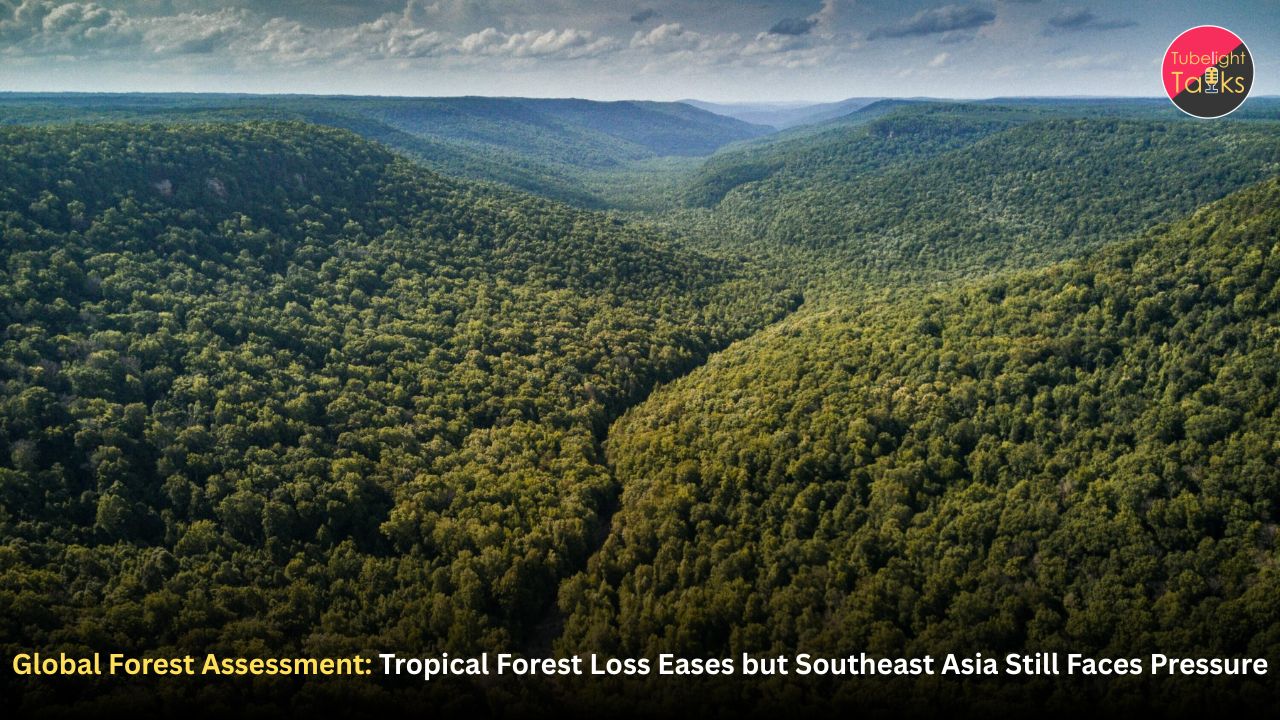
Global Forest Assessment: Forest Loss Eases in 2025, but the World Still Needs Faster Action
The latest global forest assessments show a mixed but important signal for the planet: tropical forest loss eased in 2025 after a record high the previous year, giving governments and conservationists a brief reason for hope. Researchers reported a 36% drop in global tropical forest loss in 2025, but warned that the world remains far from the pace needed to meet the 2030 goal of halting and reversing deforestation.
The United Nations’ Global Forest Goals Report 2026 is being launched this month through the UN Forum on Forests process, and early discussions are stressing the same message: progress is possible, but forests are running out of time. Southeast Asia remains a crucial test case for global forest protection.
Global Forest Assessment: A Hopeful Decline, Not a Final Victory
Tropical Forest Loss Fell in 2025
The most encouraging headline from recent forest monitoring is that tropical forest loss fell in 2025 from the record levels seen in 2024. Reuters, citing recent research, reported that global tropical forest loss decreased by 36% in 2025, falling to around 4.3 million hectares. This decline was largely linked to fewer extreme fire losses and stronger anti-deforestation policies in some regions, especially Brazil.
This is important because tropical forests are among the world’s richest ecosystems. They store carbon, regulate rainfall, protect biodiversity, support Indigenous communities, stabilize soil and help cool the planet. When tropical forests are destroyed, the damage spreads far beyond local landscapes.
However, experts warn that the decline should not be misunderstood. One better year does not mean the global deforestation crisis has been solved. Forest loss remains too high, and the world is still off track for the 2030 pledge to halt and reverse deforestation.
A Good Year Must Become a Permanent Trend
Forest scientists have stressed that a single year of lower forest loss is only meaningful if it becomes a sustained trend. Fires, weather patterns and political cycles can shift quickly. A country may reduce deforestation one year and see it rise again if enforcement weakens, commodity prices increase, elections change priorities or droughts intensify.
That is why the Global Forest Goals process matters. The United Nations Strategic Plan for Forests 2017–2030 provides six Global Forest Goals and 26 associated targets to support sustainable forest management, forest protection, restoration and international cooperation.
The Global Forest Goals Report 2026, being launched this month, is expected to assess how much progress has been made and what more is needed before 2030. UN DESA has already warned that forests cover nearly one-third of Earth and sustain billions of lives, but they continue to disappear rapidly, threatening nature and the economy.
Also Read: Saalumarada Thimmakka: Padma Shri Environmental Icon Who Planted 385 Banyan Trees Passes Away at 114
Southeast Asia: Progress and Pressure Together
Tropical Asia Shows Encouraging Signs
Some recent forest assessments suggest that Tropical Asia is performing better than other tropical regions on certain deforestation indicators. The Forest Stewardship Council noted in early 2026 that Tropical Asia is the only tropical region currently on track to halt deforestation by 2030.
This is encouraging because Southeast Asia has long faced intense pressure from palm oil, rubber, timber, mining, roads, fires and agricultural expansion. Improvements in monitoring, certification, protected areas, company commitments and public pressure have helped reduce forest loss in some places.
But regional progress is uneven. Some countries have improved, while others still face rising deforestation. The success of one area cannot hide the risks in another.
Indonesia Shows the Fragility of Gains
Indonesia remains one of the most important forest countries in the world. It contains vast tropical forests, peatlands, orangutan habitat, Indigenous territories and carbon-rich ecosystems. But recent reporting shows that Indonesia’s forest loss surged in 2025, driven by food-estate projects, bioenergy, oil palm and mining expansion. Reuters reported that Indonesian forest loss rose by 66% in 2025, reaching its worst level in eight years according to an environmental group’s assessment.
This illustrates the fragility of forest progress. Even if Southeast Asia shows encouraging long-term signs, policy shifts, commodity demands and land-use decisions can quickly reverse gains. Forest conservation cannot depend only on announcements. It requires consistent enforcement, transparent land-use planning, community rights, corporate accountability and ecological safeguards.
Why Forests Matter for Climate Stability
Forests Store Carbon
Forests act as major carbon sinks. Trees absorb carbon dioxide from the atmosphere and store it in trunks, branches, roots, leaves and soil. When forests are cut or burned, that stored carbon is released, increasing greenhouse gas emissions.
Protecting forests is therefore one of the fastest and most natural climate solutions available. Forest protection does not replace the need to cut fossil-fuel emissions, but it is essential for climate stability.
Forests Regulate Rainfall and Temperature
Forests influence local and regional rainfall. Large forest systems release moisture into the atmosphere, helping maintain rain cycles. When forests are destroyed, rainfall patterns can weaken, drought risks can rise and local temperatures can increase.
For Southeast Asia, this matters deeply. Agriculture, hydropower, fisheries, water supply and rural livelihoods depend on stable ecosystems. Forest loss can disrupt weather and water systems that millions of people rely on.
Biodiversity at Risk
Tropical Forests Are Living Libraries
Tropical forests contain extraordinary biodiversity. They are home to mammals, birds, insects, reptiles, fungi, orchids, medicinal plants and countless species still unknown to science. When forests disappear, species may vanish before they are even documented.
Southeast Asia contains some of the world’s most biodiverse landscapes, including Borneo, Sumatra, Papua, the Mekong region and island ecosystems. Deforestation threatens orangutans, tigers, elephants, hornbills, gibbons, clouded leopards, amphibians and many endemic species.
Habitat Corridors Are Essential
A major theme in modern forest conservation is connectivity. Isolated forest patches may not be enough for long-term species survival. Animals need corridors to move, breed and adapt to climate change.
Tropical corridors in Southeast Asia are especially important because development has fragmented forests. Roads, plantations and mines cut habitats into smaller pieces. Restoring corridors can reconnect landscapes and help wildlife survive.
Agriculture and Commodity Pressure
Food Systems Drive Forest Loss
Agricultural expansion remains one of the biggest drivers of deforestation. Global Forest Review data and related assessments continue to show that commodities such as cattle, oil palm, soy, cocoa, rubber, coffee and wood fiber are linked to deforestation in many regions.
In Southeast Asia, palm oil, rubber, pulpwood, rice expansion, mining roads and infrastructure projects have all affected forests. Some plantation systems are legal and economically important, but when expansion replaces natural forest, the ecological cost is severe.
Sustainable Food and Trade Policies
Reducing deforestation requires changing how food and commodities are produced and traded. Companies must trace supply chains. Governments must enforce land laws. Consumers must demand deforestation-free products. Banks must stop financing forest destruction. Farmers must receive support for sustainable practices.
Forest protection should not punish small farmers unfairly. Many rural families depend on land for survival. Policies must distinguish between industrial-scale deforestation and community livelihoods, while supporting sustainable agriculture, agroforestry and secure land rights.
Indigenous Peoples and Local Communities
Forest Guardians Need Recognition
Indigenous Peoples and local communities are among the most important forest protectors. In many regions, forests managed by Indigenous communities have lower deforestation rates than surrounding areas. They protect forests not only through law but through culture, tradition, spiritual relationship with land and daily stewardship.
Forest goals cannot be achieved if communities are excluded. Land rights, consent, traditional knowledge and community-led conservation must be central to forest policy.
Justice Is Part of Conservation
Forest protection must also be socially just. Conservation that displaces communities or criminalizes traditional livelihoods can create conflict. A fair approach protects both forests and the people who have cared for them for generations.
This is especially important in Southeast Asia, where Indigenous and local communities often face pressure from logging, plantations, mining, dams and infrastructure.
Forest Finance and the 2030 Goal
More Funding Is Needed
The Global Forest Goals require finance. Forest monitoring, protected areas, restoration, community support, fire prevention, law enforcement, sustainable livelihoods and Indigenous land rights all need funding. Without finance, commitments remain weak.
The UN Forum on Forests has emphasized cooperation, financing and implementation as central to forest goals. Its 2024–2026 voluntary national reporting cycle is designed to support assessment of progress under the UN Strategic Plan for Forests and inform the Global Forest Goals Report 2026.
Restoration Must Be Ecological, Not Cosmetic
Reforestation and restoration are important, but they must be done properly. Planting monoculture tree plantations is not the same as restoring natural forest. True restoration supports native species, biodiversity, soil health, water systems and community livelihoods.
Governments must avoid using tree-planting numbers as public relations while continuing to allow natural forests to be destroyed. Protecting existing forests is usually more effective than trying to recreate them later.
India’s Relevance in the Global Forest Debate
Forests and Development
India’s forest policy faces a difficult balance: development, infrastructure, tribal rights, biodiversity, climate commitments and economic growth. India has increased attention to tree cover, restoration and climate resilience, but natural ecosystems still face pressure from mining, roads, urban expansion and infrastructure projects.
The global forest debate matters to India because forests influence rainfall, rivers, tribal livelihoods, wildlife corridors and climate adaptation. India’s forests are not only carbon assets; they are living ecosystems and cultural landscapes.
Lessons From Southeast Asia
India can learn from Southeast Asia’s mixed picture. Strong monitoring and policy can reduce forest loss, but poorly planned development can quickly reverse gains. Forest corridors, community rights, transparent land-use decisions and biodiversity-sensitive planning are essential.
Forest Protection and Spiritual Responsibility
The global forest assessment reminds humanity that nature is not an unlimited resource for greed. Forests give oxygen, rainfall, medicine, food, shelter and climate stability, yet human beings destroy them for short-term gain. The teachings of Sant Rampal Ji Maharaj and Sat Gyaan emphasize truth, compassion, humility, righteous conduct and true worship according to holy scriptures.
His teachings guide people away from intoxication, corruption, greed, dishonesty, violence and harmful practices. In the context of forest protection, this spiritual wisdom is deeply relevant. A society that follows Sat Gyaan learns restraint, responsibility and respect for creation. Forest conservation is not only an environmental duty; it is a moral duty. When human conduct becomes pure, exploitation of nature also reduces. True development must protect both the earth and the soul.
FAQs on Global Forest Assessment
1. What does the latest global forest assessment show?
Recent assessments show that tropical forest loss fell in 2025 after a record year, but global forest loss remains far above the level needed to meet 2030 forest protection goals.
2. What is the Global Forest Goals Report 2026?
The Global Forest Goals Report 2026 is part of the United Nations Forum on Forests process and assesses progress under the UN Strategic Plan for Forests 2017–2030 and its six Global Forest Goals.
3. Is Southeast Asia reversing deforestation?
Some indicators suggest Tropical Asia is showing encouraging progress, but Southeast Asia remains under pressure from plantations, mining, agriculture, infrastructure and fires. Progress is uneven and fragile.
4. Why are tropical forests important?
Tropical forests store carbon, regulate rainfall, protect biodiversity, support Indigenous communities, maintain soil and water systems, and help slow climate change.
5. What are the main drivers of forest loss?
Major drivers include agricultural expansion, commodity production, logging, mining, roads, fires, weak enforcement and unsustainable land-use policies.
6. What is needed to halt deforestation by 2030?
The world needs stronger forest laws, community land rights, deforestation-free supply chains, sustainable agriculture, forest finance, restoration, monitoring and long-term political commitment.
Related Stories








Discussion (0)