Pikelinia floydmuraria: Tiny Pink Floyd Spider Shows How Urban Biodiversity Controls Pests
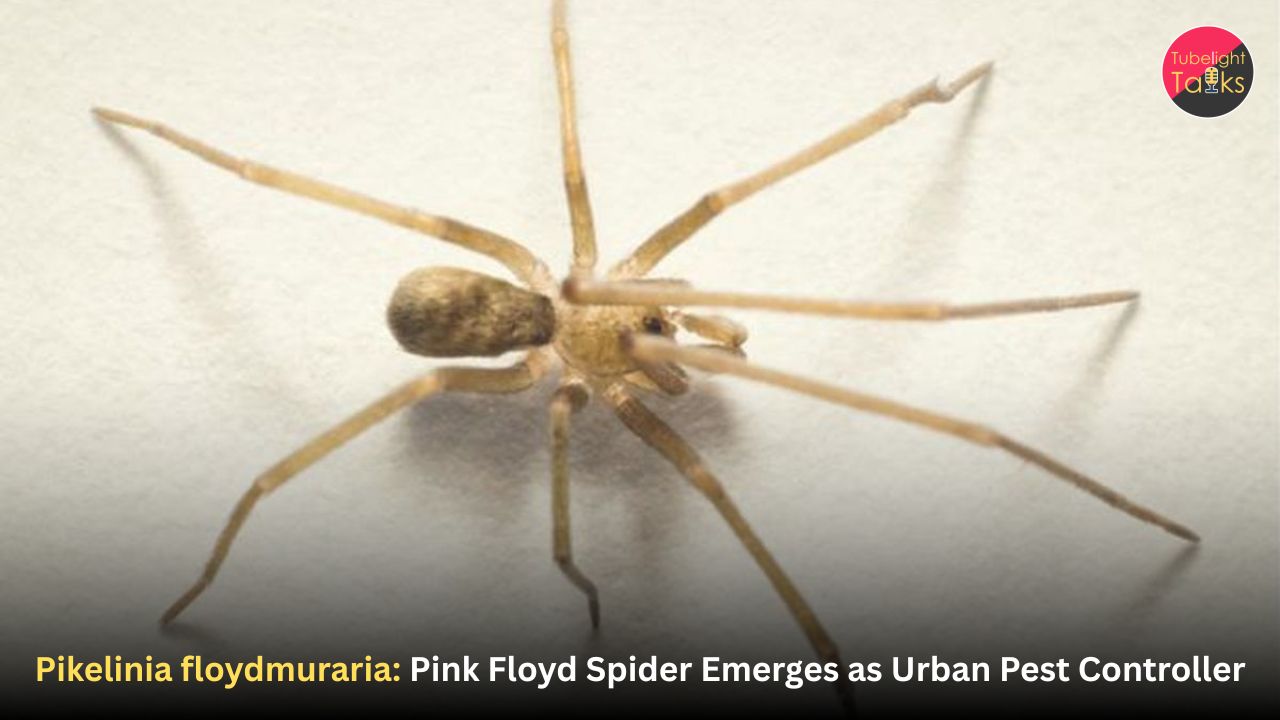
Scientists have documented a new species of wall-dwelling spider, Pikelinia floydmuraria, from Colombia, and its name is already drawing global attention. The spider belongs to the crevice-weaver family Filistatidae and measures only about 3 to 4 millimetres, yet researchers observed it hunting insects and even ants much larger than itself. Named in tribute to Pink Floyd and the spider’s wall habitat, the species was described in Zoosystematics and Evolution.
Beyond the memorable name, the discovery is important because it shows how small urban predators can help control mosquitoes, flies, ants, beetles, and other insects in city environments.
Pikelinia floydmuraria: A New Spider Species From Colombia
What Scientists Discovered
A team of researchers from institutions across South America has expanded scientific knowledge of the Pikelinia spider genus by describing a new crevice-weaver species: Pikelinia floydmuraria. The species was observed in Colombia’s department of Tolima and is now formally described in the open-access journal Zoosystematics and Evolution.
The World Spider Catalog lists Pikelinia floydmuraria as a valid species described in 2026 by Villarreal, Delgado-Santa, González-Gómez, Rodríguez-Castro, Román, Agudelo, and García, with Colombia recorded as its distribution. This makes the discovery part of the formal taxonomic record rather than only a media-friendly curiosity.
Why the Name Mentions Pink Floyd
The name floydmuraria has two meanings. “Floyd” refers to the legendary rock band Pink Floyd, while “muraria” comes from the Latin word for “wall.” Researchers chose the name because the spider lives in building walls and because it also subtly alludes to Pink Floyd’s famous album The Wall.
This kind of naming is not unusual in taxonomy. Scientists often use names that reflect a species’ habitat, morphology, location, or cultural reference. In this case, the name helps ordinary readers remember a tiny organism that might otherwise remain unnoticed.
A Wall-Dwelling Hunter Hidden in Urban Crevices
Life Inside Building Walls
Pikelinia floydmuraria is described as synanthropic, meaning it has adapted to human-created environments. It lives in cracks and crevices of building walls, where it builds webs and waits for prey. Pensoft reported that observed concentrations reached between 20 and 30 spiders in a single square metre in urban environments.
This detail is important for urban ecology. Many people assume biodiversity exists mainly in forests, wetlands, mountains, coral reefs, or protected reserves. But cities also contain microhabitats: walls, drains, gardens, streetlights, old buildings, balconies, parks, and roadside vegetation. These spaces can support insects, spiders, birds, reptiles, fungi, and plants that form small but meaningful ecological networks.
A Tiny Predator With a Large Role
Although the spider measures only 3 to 4 millimetres, it can play a useful role in managing urban insect populations. Dietary analyses found that P. floydmuraria and a related Pikelinia population feed heavily on Hymenoptera such as ants, Diptera such as flies and mosquitoes, and Coleoptera such as beetles.
Researchers also observed these spiders capturing ants up to six times their own prosoma, or body, size. That makes the spider “fierce but tiny” in a very real ecological sense. It is not large enough to frighten humans, but it is highly effective at capturing small household and urban insects.
Natural Pest Control in Cities
Why Mosquitoes and Flies Matter
Urban pest control is usually discussed in terms of chemicals, sanitation, drainage, and public health campaigns. Those measures are important, but nature also provides quiet pest-control services. Spiders are among the most effective natural predators of insects. When a wall-dwelling spider feeds on mosquitoes, flies, beetles, and ants, it contributes to the balance of insect populations in homes, streets, and public spaces.
The Pikelinia floydmuraria study specifically noted that these spiders consistently prey on known urban pests, including mosquitoes from the family Culicidae and houseflies from Muscidae.
Artificial Lights as Hunting Zones
Researchers proposed that these spiders may build webs near artificial lights because light attracts insects. Many insects are phototactic, meaning they are drawn toward light sources. By placing their webs near lamps or illuminated walls, the spiders improve their chances of catching prey.
This behavior shows adaptation to city life. The spider is not simply surviving in an urban environment; it is using features of that environment to hunt efficiently. In a time when many species are threatened by urbanization, such adaptation offers scientists a valuable example of how some organisms adjust to human-modified spaces.
Also Read: The Indian Violet Tarantula: A Hidden Gem of the Western Ghats
Why This Discovery Matters for Conservation
Urban Biodiversity Is Often Ignored
The user-provided topic described this as a “marine conservation discovery,” but the verified research concerns an urban spider, not a marine organism. Its conservation value lies in urban biodiversity, taxonomy, pest regulation, and the study of species living alongside humans.
Urban biodiversity is often overlooked because city wildlife is usually small, hidden, or wrongly considered unimportant. But a tiny spider in a wall crack can be part of a larger ecological web. It feeds on insects, provides food for other predators, and indicates that cities still contain living systems worth understanding.
Conservation Is Not Only About Big Animals
Conservation stories often focus on tigers, elephants, whales, turtles, coral reefs, or migratory birds. Those species deserve attention, but conservation also depends on documenting small and lesser-known organisms. Invertebrates such as spiders, beetles, moths, bees, flies, and ants make up a major part of biodiversity and ecosystem functioning.
The discovery of Pikelinia floydmuraria reminds us that unknown species may be living close to us, even in ordinary walls. If scientists do not document them, society may never understand their ecological value.
The Science Behind the Identification
Taxonomy and Careful Description
The formal study is titled “Another web in the wall: A new Pikelinia Mello-Leitão, 1946 (Araneae, Filistatidae) from Colombia, with notes on its diet and description of the female genitalia of P. fasciata.” It was published on February 18, 2026, in Zoosystematics and Evolution.
Taxonomy is the science of naming, describing, and classifying organisms. It may look slow compared with glamorous space missions or AI breakthroughs, but it is the foundation of biodiversity knowledge. A species cannot be protected, studied, or understood properly until it is identified and described.
Male and Female Specimens
The research described male and female Pikelinia floydmuraria specimens. Pensoft noted that one of the species’ distinctive internal features is found in females, whose reproductive organs include long and slender tubes shaped like the letter “S.”
These details may seem highly technical, but they matter for species identification. Many spider species look similar externally, so researchers often need to examine reproductive anatomy, body structure, legs, palps, and other microscopic features to confirm whether a population represents a new species.
Also Read: Hidden DNA Species: Scientists Identify New Huaxi Green Pitviper in China
A Link to the Galapagos Mystery
Similarity With Pikelinia fasciata
The study also examined Pikelinia fasciata, a related species from the Galapagos Islands. Researchers provided the first detailed description and illustrations of the female internal genitalia of P. fasciata, which was originally identified in 1902.
The Colombian spider and the Galapagos spider show strong similarities, including nearly identical male palpal structures. This is scientifically interesting because the Pacific Ocean and the Andes separate their habitats. Researchers are still unsure whether the similarities reflect shared ancestry or similar ecological adaptations.
Why This Mystery Matters
Biogeography studies how species are distributed across regions and how they reached those places. If P. floydmuraria and P. fasciata are closely related through shared ancestry, scientists may need to understand how their ancestors moved, dispersed, or became separated. If their similarities developed independently due to similar environments, that would show how evolution can shape related organisms in comparable ways.
Either possibility is valuable. It can reveal how geography, climate, human settlements, island ecosystems, and evolutionary pressure shape spider diversity across South America and the Pacific region.
DNA Barcoding and Future Research
Why Genetic Work Is Needed
The researchers recommend further molecular and DNA-based dietary analyses. Pensoft reported that DNA barcoding could help determine whether Pikelinia floydmuraria is a unique species native to Colombia and map its evolutionary history. DNA-based dietary analysis could also quantify how much these spiders act as natural urban pest regulators.
DNA barcoding works like a genetic identity test. It compares specific DNA sequences to help identify species and clarify relationships. For small organisms that are hard to distinguish visually, this can provide strong supporting evidence.
Measuring the Real Pest-Control Impact
It is one thing to observe spiders eating mosquitoes and flies. It is another to measure how much impact they have on urban pest populations. Future research could study how many insects Pikelinia floydmuraria captures per day, how dense its populations are in cities, whether it reduces nuisance insects near lights, and how it interacts with other urban predators.
Such work could help city planners, public health researchers, and conservation biologists understand how to support natural pest control without relying only on chemical insecticides.
Why Spiders Deserve a Better Reputation
Fear and Misunderstanding
Many people fear spiders, even when most are harmless to humans. This fear often leads people to kill spiders immediately, remove webs aggressively, or use pesticides unnecessarily. But spiders are important predators. They reduce insect numbers and contribute to ecological balance.
The discovery of Pikelinia floydmuraria gives a positive example of how spiders can help urban spaces. This species is tiny, hidden, and focused on hunting insects. It is not a threat in the way many people imagine.
Coexistence With Small Urban Wildlife
Coexisting with urban wildlife does not mean ignoring hygiene or allowing dangerous infestations. It means recognizing that not every insect, spider, lizard, or bird near human spaces is harmful. Some are part of a natural system that quietly helps us.
For example, avoiding unnecessary pesticide use, sealing only problem cracks, keeping homes clean, and allowing harmless spiders in outdoor corners or garden walls can support a healthier balance. Cities that respect biodiversity are often more resilient.
The Bigger Story: Cities as Living Ecosystems
Biodiversity in Human-Made Spaces
The discovery of a new wall spider in Colombia shows that urban spaces are still scientifically rich. Researchers found a species not in a remote rainforest expedition but in the built environment. That changes how we think about biodiversity surveys.
Old walls, streetlights, gardens, university buildings, and residential structures can become living laboratories. Cities are not separate from nature; they are altered ecosystems where some species disappear, some struggle, and others adapt.
Why Local Research Matters
The research was led by South American scientists and focused on South American biodiversity. This is important because local researchers often understand regional ecosystems, languages, climates, and field conditions better than outside observers. Their work builds scientific capacity and ensures that biodiversity knowledge is not limited to a few global institutions.
The more local scientists document their native and urban biodiversity, the stronger conservation policy becomes.
Media Attention and Scientific Responsibility
A Catchy Name Can Help Science
The Pink Floyd connection has made the spider more visible to the public. That is useful because taxonomy often struggles for public attention and funding. A memorable name can encourage people to read about biodiversity, spiders, urban ecology, and conservation.
However, the science must remain central. The species is not important only because it is named after a famous band. It is important because it adds to the known diversity of Pikelinia, reveals urban predatory behavior, highlights under-studied synanthropic spiders, and raises new questions about evolution and biogeography.
Avoiding Exaggeration
This spider should not be presented as a miracle solution to urban mosquitoes or disease control. It may contribute to natural pest regulation, but public health still requires sanitation, drainage, mosquito monitoring, safe housing, and evidence-based interventions. The verified research supports its role as a predator of urban insects, not as a complete replacement for pest management systems.
Responsible reporting keeps the wonder of discovery while respecting scientific limits.
Small Lives, Great Balance
The discovery of Pikelinia floydmuraria reminds us that even the smallest living beings have a role in maintaining balance. A spider hidden in a wall can control insects, support ecological order, and teach humans humility. The teachings of Sant Rampal Ji Maharaj and Sat Gyaan similarly emphasize that creation is governed by divine order and that human beings should live with compassion, righteousness, and responsibility.
Sant Rampal Ji Maharaj teaches that people should avoid dishonesty, corruption, violence, intoxication, theft, cheating, and harmful conduct, while adopting true worship according to holy scriptures. In the context of biodiversity, this spiritual understanding encourages us not to act with arrogance toward nature. Sat Gyaan teaches that human life is precious and should be guided by truth, humility, and devotion. When society respects even small creatures and avoids careless destruction, it reflects a deeper moral awareness that connects ecological balance with spiritual discipline.
Call to Action: Protect Urban Biodiversity and Seek True Knowledge
The discovery of Pikelinia floydmuraria should inspire citizens, students, researchers, and city planners to value urban biodiversity. Not every useful species lives in forests or oceans; some live quietly in walls, gardens, corners, and streetlight zones. People should avoid unnecessary pesticide use, support biodiversity research, encourage science education, and rely on verified sources before spreading claims about new species.
At the same time, everyone should also focus on the inner ecology of life. Listen to the spiritual discourses of Sant Rampal Ji Maharaj, understand Sat Gyaan, and adopt a life based on truth, compassion, discipline, and true worship. The article structure follows the uploaded Team 5 content style reference.
FAQs on Pikelinia floydmuraria
1. What is Pikelinia floydmuraria?
Pikelinia floydmuraria is a newly described species of crevice-weaver spider from Colombia. It belongs to the family Filistatidae and lives in wall cracks and crevices in urban environments.
2. Why is it named after Pink Floyd?
The name refers to Pink Floyd and the spider’s wall-dwelling habit. “Muraria” comes from Latin for “wall,” and the name also alludes to Pink Floyd’s album The Wall.
3. How big is this spider?
Researchers reported that Pikelinia floydmuraria measures only about 3 to 4 millimetres in length.
4. What does Pikelinia floydmuraria eat?
Dietary analyses found that it feeds on insects including ants, flies, mosquitoes, and beetles. Researchers also observed Pikelinia spiders capturing ants up to six times their own body size.
5. Is this spider useful for pest control?
Yes, it may help regulate urban pests naturally because it preys on mosquitoes, houseflies, beetles, and ants. However, it should be seen as one part of natural ecological balance, not a replacement for public health pest control.
6. What further research is needed?
Scientists recommend DNA barcoding and DNA-based dietary studies to clarify its evolutionary history, confirm its biogeographic origin, and measure its full potential as a natural urban pest regulator.
Related Stories










Discussion (0)