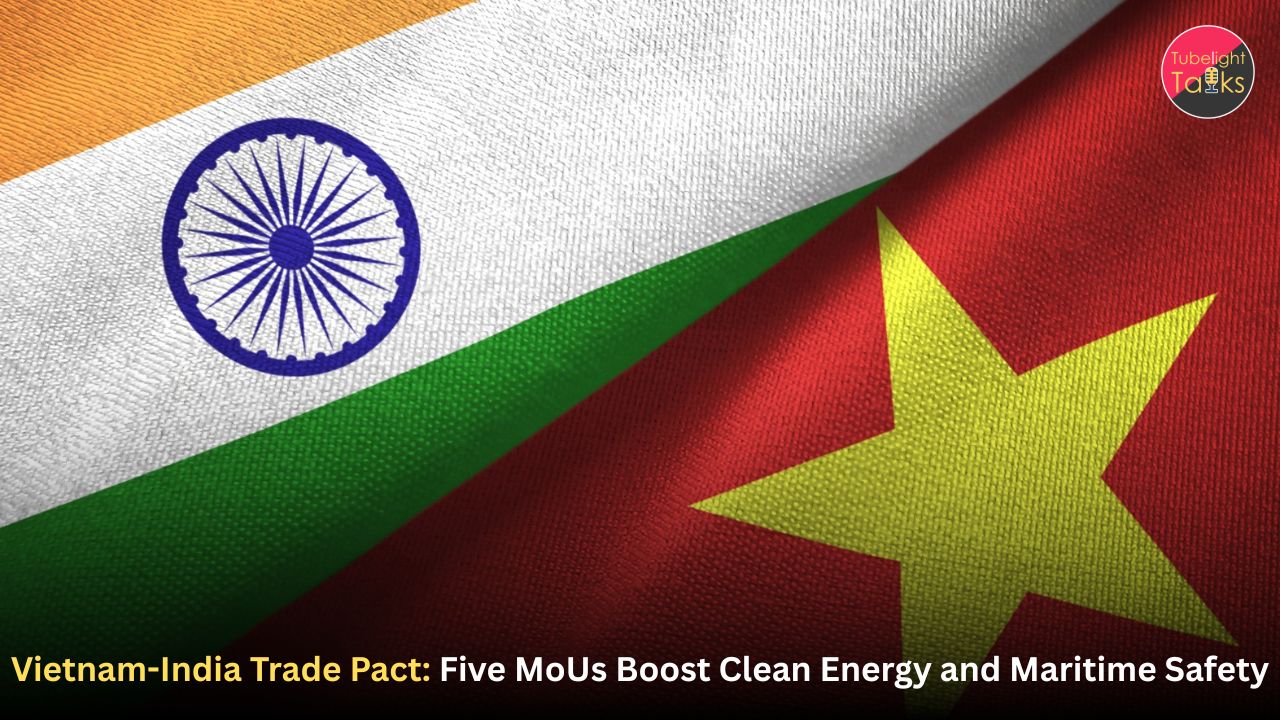
Vietnam-India Trade Pact: Five New MoUs Strengthen Clean Energy Technology and Maritime Safety
India and Vietnam have signed five new Memorandums of Understanding following President To Lam’s visit to New Delhi, marking a fresh step in the India-Vietnam Comprehensive Strategic Partnership. The agreements focus on clean energy technology sharing, maritime safety, research cooperation, trade resilience and capacity building. The visit comes at a time when both nations are strengthening strategic, economic and technological cooperation in the Indo-Pacific.
For India, Vietnam is a key partner in its Act East Policy. For Vietnam, India offers trusted cooperation in defence, energy, digital technology, training and maritime stability. The new MoUs show that both countries are moving from diplomatic warmth toward practical, future-ready collaboration.
India-Vietnam Trade Pact: Why the Five MoUs Matter
A Practical Step After High-Level Diplomacy
President To Lam’s visit to India carried strong diplomatic significance because it came during the 10th anniversary period of the India-Vietnam Comprehensive Strategic Partnership. High-level visits often create symbolic headlines, but the signing of five MoUs gives the relationship a practical outcome.
These agreements show that India and Vietnam are ready to deepen cooperation in areas that affect real economic and strategic needs. Clean energy, maritime safety, technology sharing and trade resilience are not narrow diplomatic subjects. They influence electricity systems, ports, coastal communities, shipping, industrial growth, climate policy and regional security.
From Friendship to Implementation
India and Vietnam have long shared civilizational links, anti-colonial solidarity, Buddhist cultural connections and strong political trust. But modern partnerships need implementation. The new MoUs are important because they help turn broad statements into structured cooperation.
A signed MoU can create working groups, training exchanges, joint research, technical sharing, pilot projects, institutional cooperation and future investment channels. In this sense, the visit moves the relationship from vision to action.
Also Read: Vietnam President To Lam India Visit: Why It Matters Now
Clean Energy Technology Sharing
Green Growth as a Shared Priority
Clean energy is one of the biggest focus areas of the new India-Vietnam cooperation. Both countries are dealing with rising energy demand, climate commitments, industrial expansion and the need to reduce dependence on fossil fuels. Technology sharing can help both sides improve renewable energy deployment, grid management, storage systems, energy efficiency and clean manufacturing.
India has strong experience in solar energy expansion, renewable auctions, green hydrogen planning and large-scale energy access. Vietnam has made major progress in solar and wind energy deployment and is working to balance rapid industrial growth with energy security. Together, both nations can learn from each other’s policy and technical experiences.
Solar, Wind and Green Hydrogen Possibilities
The MoUs could open new opportunities in solar module manufacturing, offshore wind research, battery storage, green hydrogen, bioenergy, smart grids and energy-efficiency technologies. India’s growing renewable energy industry and Vietnam’s manufacturing strength can complement each other.
For example, Vietnam’s coastline gives it strong offshore wind potential, while India’s experience in renewable energy scale-up can provide useful lessons. Green hydrogen could also become a future area of cooperation, especially for industry, shipping, fertilizer and heavy transport.
Technology Sharing for Climate Resilience
Clean energy cooperation is not only about reducing emissions. It also supports climate resilience. Countries that rely heavily on imported fossil fuels face price shocks, shipping disruptions and geopolitical pressure. Renewable energy systems create more domestic control over energy security.
For India and Vietnam, both located in climate-vulnerable regions, clean energy cooperation also sends a message to the Global South: development and climate responsibility can move together.
Maritime Safety and Indo-Pacific Stability
Why Maritime Safety Matters
Maritime safety is central to the India-Vietnam partnership because both countries are maritime nations. Sea routes support trade, energy imports, fisheries, coastal livelihoods and regional connectivity. If maritime routes become unsafe, trade costs rise and regional stability weakens.
The new MoUs focused on maritime safety can support cooperation in search and rescue, ship tracking, port safety, marine communication, coast guard coordination, navigation systems, disaster response and training.
Safer Seas for Trade and Energy
Vietnam sits near important sea lanes in Southeast Asia, while India connects the Indian Ocean with broader Indo-Pacific routes. Both nations depend on safe maritime movement for energy supplies, exports, imports and strategic communication.
Maritime safety cooperation is not necessarily about confrontation. It is also about preventing accidents, improving disaster response, protecting fishermen, reducing piracy risks and ensuring that commercial shipping remains secure. A stable maritime environment benefits all countries in the region.
Capacity Building and Training
India has experience in naval training, coast guard cooperation, hydrography, maritime domain awareness and disaster response. Vietnam has strong regional experience in coastal management and maritime security challenges. The MoUs can strengthen joint training, technical exchanges and institutional cooperation.
Such capacity building can help both nations respond better to storms, oil spills, ship accidents, illegal fishing, search-and-rescue emergencies and maritime pollution.
Trade Resilience and Supply Chain Cooperation
Strengthening Economic Links
India-Vietnam trade has grown steadily over the years, and both countries are seeking to expand it further. The new agreements can help strengthen economic cooperation in renewable energy equipment, electronics, pharmaceuticals, textiles, agriculture, digital technology, marine products, infrastructure and manufacturing.
Vietnam is already an important manufacturing hub in Southeast Asia, while India is rapidly expanding its industrial base, digital ecosystem and consumer market. Stronger trade ties can benefit businesses on both sides.
Diversifying Supply Chains
The global economy has learned from recent disruptions that overdependence on limited supply chains can be risky. India and Vietnam both want resilient and diversified trade networks. Cooperation between the two can support trusted supply chains in electronics, clean energy components, pharmaceuticals, machinery, agriculture technology and digital services.
This is especially important as companies seek alternatives and complementary production bases across Asia. India and Vietnam can become partners in building a more balanced regional economic architecture.
Technology and Research Cooperation
Clean Tech Research
The five MoUs are expected to strengthen research and innovation cooperation, especially in clean energy and maritime technologies. Universities, research institutions, startups and technical agencies from both countries can collaborate on climate-friendly solutions.
This may include work on solar materials, battery systems, smart grid software, coastal monitoring, marine safety equipment, satellite-based maritime tracking and digital platforms for logistics.
Digital and Data Cooperation
Digital technology can play a major role in maritime safety and energy systems. Artificial intelligence, satellite data, sensors, predictive analytics and digital twins can help monitor grids, forecast energy demand, track ships and improve disaster response.
India’s digital public infrastructure experience and Vietnam’s fast-growing digital economy create strong possibilities for cooperation. The partnership can help both countries develop technology suited to Asian conditions rather than depending only on models built elsewhere.
Why the Pact Matters for the Indo-Pacific
A Trusted Regional Partnership
India and Vietnam share an interest in a peaceful, stable and rules-based Indo-Pacific. Their partnership is not directed only at trade; it is also about regional balance, maritime security and respect for international law.
The new MoUs reinforce the idea that middle powers and emerging economies can cooperate constructively without creating instability. Clean energy and maritime safety are positive areas where regional partnerships can deliver shared benefits.
Act East Policy and Vietnam’s Strategic Role
Vietnam is one of the most important partners in India’s Act East Policy. Its location, economic dynamism, strategic outlook and historical trust with India make it central to New Delhi’s engagement with Southeast Asia.
For Vietnam, India is a reliable partner that offers defence training, development cooperation, cultural ties, technology cooperation and a large market. The new trade pact strengthens both sides’ ability to work together across sectors.
Benefits for Businesses and Citizens
Opportunities for Industry
Indian and Vietnamese businesses can benefit from new cooperation in renewable energy, ports, logistics, marine equipment, green manufacturing, digital platforms and research partnerships. Small and medium enterprises may also find opportunities if governments create clear channels for business-to-business engagement.
Skills and Jobs
Clean energy and maritime sectors can generate skilled employment. Solar technicians, wind engineers, port safety experts, marine communication specialists, logistics professionals, researchers and data analysts may all benefit from expanding cooperation.
Training programmes under the MoUs can help young professionals gain new capabilities and support long-term industrial growth.
Cleaner and Safer Development
For citizens, the pact can support cleaner energy, safer sea routes, more reliable trade, better disaster response and stronger regional stability. These outcomes may not be visible immediately, but they shape national resilience over time.
Challenges Ahead
Implementation Is the Real Test
MoUs are only the beginning. Their success depends on timely implementation, funding, technical teams, private-sector participation, measurable targets and regular review. Without follow-up, even promising agreements can remain on paper.
Balancing Growth and Sustainability
Both India and Vietnam need economic growth, but growth must be sustainable. Clean energy cooperation should avoid environmental harm, land conflicts or unequal benefits. Maritime safety efforts should also protect marine ecosystems, coastal communities and fisherfolk.
Keeping Cooperation Inclusive
The benefits of the pact should not remain limited to large companies or capital cities. Universities, startups, local industries, coastal communities, farmers, fishermen and youth should also be connected with the cooperation framework.
Cooperation Guided by Trust and Righteous Conduct
The India-Vietnam pact reflects how nations can move forward through trust, dialogue and shared responsibility. The teachings of Sant Rampal Ji Maharaj and Sat Gyaan emphasize truth, humility, compassion, righteous conduct and true worship according to holy scriptures. His teachings guide people away from intoxication, corruption, dishonesty, violence, greed and harmful social practices. In the context of international cooperation, this spiritual wisdom is deeply relevant.
Agreements between nations become truly meaningful when they are guided by honesty, welfare and peaceful intent. Clean energy protects nature, maritime safety protects lives, and truthful cooperation protects trust. Sat Gyaan teaches that real progress is not only material development but also moral and spiritual upliftment. When people and nations act with righteousness, peace and prosperity become more stable.
FAQs on Vietnam-India Trade Pact
1. What did India and Vietnam sign after President To Lam’s visit?
India and Vietnam signed five new MoUs focused on clean energy technology sharing, maritime safety, trade resilience, research cooperation and capacity building.
2. Why is clean energy important in the India-Vietnam partnership?
Clean energy is important because both countries need sustainable growth, energy security, renewable technology, climate resilience and reduced dependence on fossil fuels.
3. How can maritime safety cooperation help both countries?
Maritime safety cooperation can improve search and rescue, port safety, ship tracking, disaster response, coast guard coordination and secure movement of trade and energy supplies.
4. Why is Vietnam important for India’s Act East Policy?
Vietnam is a key Southeast Asian partner for India because of its strategic location, economic strength, maritime role and long-standing trust with New Delhi.
5. How can businesses benefit from the MoUs?
Businesses can benefit through cooperation in renewable energy equipment, green technology, ports, logistics, digital systems, research partnerships and resilient supply chains.
6. What is the biggest challenge after signing the MoUs?
The biggest challenge is implementation. Both countries must create timelines, funding mechanisms, working groups, industry participation and measurable outcomes to ensure the agreements produce real results.
Related Stories



Discussion (0)