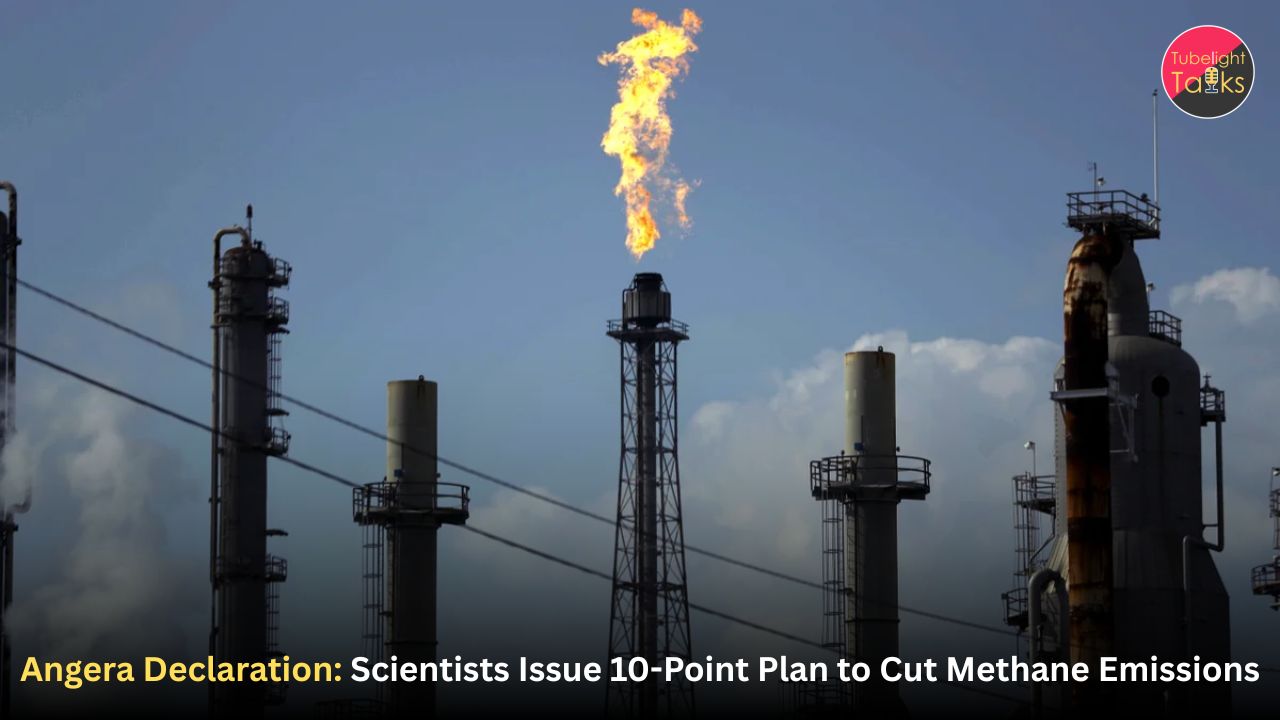
Angera Declaration: 250+ Scientists Call for Rapid Methane Cuts to Slow Global Warming
The Angera Declaration has emerged as one of the strongest scientific calls for rapid methane action, with more than 250 scientists supporting a 10-point plan to reduce methane emissions across energy, waste, agriculture, and natural systems. Methane is a powerful greenhouse gas and is responsible for nearly 30% of current warming. Unlike carbon dioxide, which remains in the atmosphere for centuries, methane breaks down much faster, meaning deep methane cuts can reduce near-term warming more quickly.
The declaration, linked to the 250th anniversary of methane’s discovery near Angera, Italy, urges governments, industries, investors, and researchers to move beyond slow promises and act immediately.
Angera Declaration: Why Methane Has Become a Climate Priority
Methane Is Short-Lived but Extremely Powerful
Methane has become one of the most urgent climate issues because it traps heat far more powerfully than carbon dioxide over the short term. Its atmospheric lifetime is shorter than CO2, but its warming effect during that period is intense. This gives the world a major opportunity: if methane emissions are cut quickly and deeply, the climate can respond faster than it would through carbon dioxide reduction alone.
This does not mean methane action can replace carbon dioxide action. The Angera Declaration is clear that methane cuts must happen alongside aggressive CO2 reductions. But methane mitigation can slow warming in the coming decades, reduce climate risks, improve air quality, and prevent crop losses from ozone exposure.
Why the Declaration Was Named After Angera
Angera, a town in Italy, has historical importance because methane was first identified there in the 18th century by Alessandro Volta. Two hundred and fifty years later, scientists gathered around the same methane story, not to celebrate the gas, but to warn humanity that the science is now clear. The Angera Declaration uses this historical moment to call for a new phase of global methane policy.
The symbolism is powerful. A gas first discovered near Angera has now become a central test of whether modern civilization can respond intelligently to climate science.
Also Read: Nearly 90 % of Satellite‑Detected Methane Leaks Are Ignored — UN Sounds Alarm
What the 10-Point Plan Demands
1. Rapid Deployment of Proven Solutions
The first demand of the Angera Declaration is simple: use the solutions already available. Many methane emissions can be reduced through existing technology and management practices. Oil and gas leaks can be detected and repaired. Landfill methane can be captured. Food waste can be reduced. Coal mine methane can be monitored and controlled. Agricultural practices can improve manure management and rice cultivation.
In many cases, captured methane can be used as an energy source, helping offset the cost of mitigation. This makes methane action not only environmentally useful but economically practical.
2. Stronger Measurement and Monitoring
The declaration stresses that methane cannot be managed if it is not measured accurately. Scientists are calling for stronger measurement, monitoring, reporting, and verification systems. Satellites, aircraft, drones, ground-based sensors, and atmospheric data can help identify large methane sources.
This is important because official inventories often underestimate methane emissions. Better data can expose hidden leaks, improve national climate reporting, guide investment, and hold companies accountable.
3. Higher Policy Ambition
The Angera Declaration calls on governments to include clear methane targets in climate plans, national policies, and Nationally Determined Contributions under the Paris Agreement. It argues that methane should not be treated as a side issue. Because methane affects climate, air quality, public health, and food security, methane action should be integrated into multiple policy areas.
This means ministries of energy, agriculture, environment, health, urban development, and finance must work together.
4. More Finance and Economic Incentives
Methane mitigation needs money, especially in developing countries and under-resourced regions. The declaration calls for public finance, private investment, development funding, and well-designed market mechanisms to accelerate methane reductions.
Finance is crucial because many solutions are known but not implemented at scale. Smaller cities, farmers, waste operators, and energy companies may need technical support, loans, grants, or incentives to take action.
5. A Holistic Climate Strategy
The declaration warns against treating methane in isolation. It calls for a multi-gas climate strategy that includes carbon dioxide, methane, nitrous oxide, and other short-lived climate pollutants. Methane action can slow warming quickly, but long-term climate stability still requires deep decarbonization.
This balanced approach prevents a dangerous misunderstanding: reducing methane is urgent, but it cannot become an excuse to delay the clean energy transition.
Methane Sources: Where the Emissions Come From
Fossil Fuels
Oil, gas, and coal operations release methane through leaks, venting, flaring, and mine emissions. Fossil fuel methane is often one of the easiest sectors to address because leaks can be detected and repaired with available technology. Reducing methane from fossil fuel systems can deliver quick climate benefits.
Agriculture
Agriculture is another major methane source. Livestock, especially cattle and other ruminants, produce methane through digestion. Rice paddies can emit methane under flooded conditions. Manure storage can also release methane. Agricultural methane is harder to eliminate, but better feed practices, manure management, rice water management, breeding, and technology can help reduce emissions.
Waste
Landfills and wastewater systems produce methane when organic matter breaks down without oxygen. Capturing landfill gas, improving waste segregation, reducing food waste, composting, and treating wastewater more efficiently can reduce emissions. Cities have a major role in this sector.
Natural Systems
Wetlands, inland waters, and thawing permafrost can release methane naturally. Climate warming may increase emissions from these systems, creating feedback loops. The Angera Declaration calls for better observation of natural methane sources so scientists can understand how climate change may amplify future emissions.
Why Methane Action Helps Public Health
Cleaner Air and Less Ozone Pollution
Methane contributes to ground-level ozone formation. Ground-level ozone is harmful to human health and can worsen respiratory illness, asthma, and premature mortality. Cutting methane emissions can therefore improve air quality relatively quickly.
This makes methane action more than a climate issue. It is also a public health strategy. Cleaner air means fewer health burdens, lower medical costs, and better quality of life, especially in polluted cities and industrial regions.
Protecting Food Security
Ground-level ozone also damages crops. It can reduce yields and harm plant growth. By reducing methane and related ozone pollution, countries can help protect food production. This is especially important in regions already facing climate stress, water shortages, heatwaves, and rising food prices.
The Angera Declaration therefore connects methane emissions with food security, rural livelihoods, and human survival.
Also Read: India Climate Action 2026: Low-Cost Reforms Transform Methane Reduction in Rice Farming
Why the World Has Been Too Slow
Commitments Are Not Enough
Many countries have endorsed the Global Methane Pledge, which aims to reduce global anthropogenic methane emissions by at least 30% below 2020 levels by 2030. But scientists warn that commitments alone are not sufficient. Atmospheric methane concentrations continue to rise.
The gap between promises and implementation remains large. Some countries lack accurate data. Some industries resist regulation. Some governments prioritize short-term economic interests. Some developing regions lack finance and technology. The Angera Declaration pushes decision-makers to move from pledges to measurable action.
Methane Is Often Invisible
One reason methane action has been slow is that methane is invisible and odorless in its pure form. Large leaks may go unnoticed without specialized monitoring. Satellite technology has changed this by making super-emitter events more visible, but monitoring is still uneven across regions.
The declaration’s demand for stronger measurement is therefore central. Once methane emissions become visible, it becomes harder for governments and companies to ignore them.
Hard-to-Abate Methane Sources
Livestock Digestion
Methane from livestock digestion is one of the hardest sources to reduce because it is linked to food systems, rural economies, cultural diets, and farmer livelihoods. Solutions may include feed additives, improved animal health, productivity improvements, manure management, and shifts toward sustainable consumption patterns.
Abandoned Coal Mines
Abandoned coal mines can continue emitting methane long after production stops. These sites require mapping, monitoring, sealing, capture systems, or other technical interventions. Many countries do not yet have full inventories of abandoned mine methane.
Old Landfills
Legacy landfill waste can emit methane for years. Cities need long-term waste strategies, landfill gas capture, composting, recycling, and organic waste diversion. Waste-sector methane control is often achievable but requires governance discipline.
International Cooperation Is Essential
Methane Knows No Borders
The Angera Declaration emphasizes that methane reductions require international cooperation. Methane emissions in one country contribute to warming everywhere. No nation can shield itself from the climate consequences of global emissions.
This is why measurement standards, data systems, finance, research, and policy frameworks need coordination. Wealthier countries and major emitters have a special responsibility to support global methane mitigation, especially in regions with fewer resources.
Science and Policy Must Work Together
Scientists can identify sources, measure emissions, model climate impacts, and test solutions. But policy-makers must create laws, incentives, funding streams, and accountability mechanisms. Businesses must implement technology. Farmers and cities must be supported. Citizens must reduce waste and demand responsible governance.
The Angera Declaration is powerful because it connects science with policy, finance, technology, and cooperation.
Methane Action and India’s Relevance
Agriculture, Waste and Energy Challenges
India has strong reasons to pay attention to methane. Agriculture, livestock, rice cultivation, landfills, wastewater, and energy systems all connect with methane emissions. At the same time, India must protect farmer livelihoods, food security, urban sanitation, and energy access.
This means methane action in India must be practical and fair. It cannot punish small farmers or poor households. It must provide solutions, finance, technology, and training.
Opportunity for Innovation
India can lead in methane-smart agriculture, biogas, compressed biogas, landfill gas capture, waste segregation, wastewater treatment, rice-water management, and digital monitoring. Methane mitigation can support clean energy, rural income, urban sanitation, climate goals, and public health.
The Angera Declaration can help shape future policy conversations in India and other developing countries by showing that methane action is both urgent and achievable.
Climate Responsibility and Inner Discipline
The Angera Declaration reminds the world that environmental damage is not only a scientific problem but also a moral challenge. Human greed, careless consumption, corruption, wastefulness, and short-term thinking have pushed nature into imbalance. The teachings of Sant Rampal Ji Maharaj and Sat Gyaan emphasize truthful living, compassion, humility, restraint, and true worship according to holy scriptures. His teachings guide people away from intoxication, dishonesty, violence, corruption, and harmful habits.
In the context of methane emissions, this spiritual wisdom is deeply relevant. A society that wastes food, pollutes air, exploits animals, and ignores future generations cannot become truly sustainable. Sat Gyaan teaches that outer reform must begin with inner reform. Climate action becomes stronger when human conduct is guided by righteousness, responsibility, and devotion to the Supreme God.
FAQs on the Angera Declaration
1. What is the Angera Declaration?
The Angera Declaration is a scientific statement and 10-point plan supported by more than 250 scientists, calling for faster action to reduce methane emissions and strengthen methane science, policy, finance, and international cooperation.
2. Why is methane important for climate action?
Methane is responsible for about 30% of current warming. It is much shorter-lived than carbon dioxide, so rapid methane cuts can slow near-term global warming faster than CO2 reductions alone.
3. Does cutting methane replace cutting carbon dioxide?
No. The Angera Declaration clearly supports methane reduction as part of a wider climate strategy that also requires aggressive carbon dioxide reduction and action on other greenhouse gases.
4. Which sectors produce the most methane emissions?
Major methane sources include fossil fuel production and use, agriculture, livestock digestion, rice cultivation, landfills, wastewater, coal mines, and some natural systems such as wetlands and permafrost.
5. What are the main solutions for methane reduction?
Key solutions include fixing oil and gas leaks, capturing landfill methane, reducing food waste, improving manure management, changing rice cultivation practices, monitoring coal mine methane, and expanding satellite and ground-based measurement systems.
6. How can methane cuts improve public health?
Methane contributes to ground-level ozone pollution. Reducing methane can improve air quality, reduce respiratory illness, prevent premature deaths, and protect crops from ozone-related damage.
Related Stories






Discussion (0)