Antarctica Tourism Warning: Record Visitor Boom Raises Disease and Contamination Risks for Fragile Wildlife
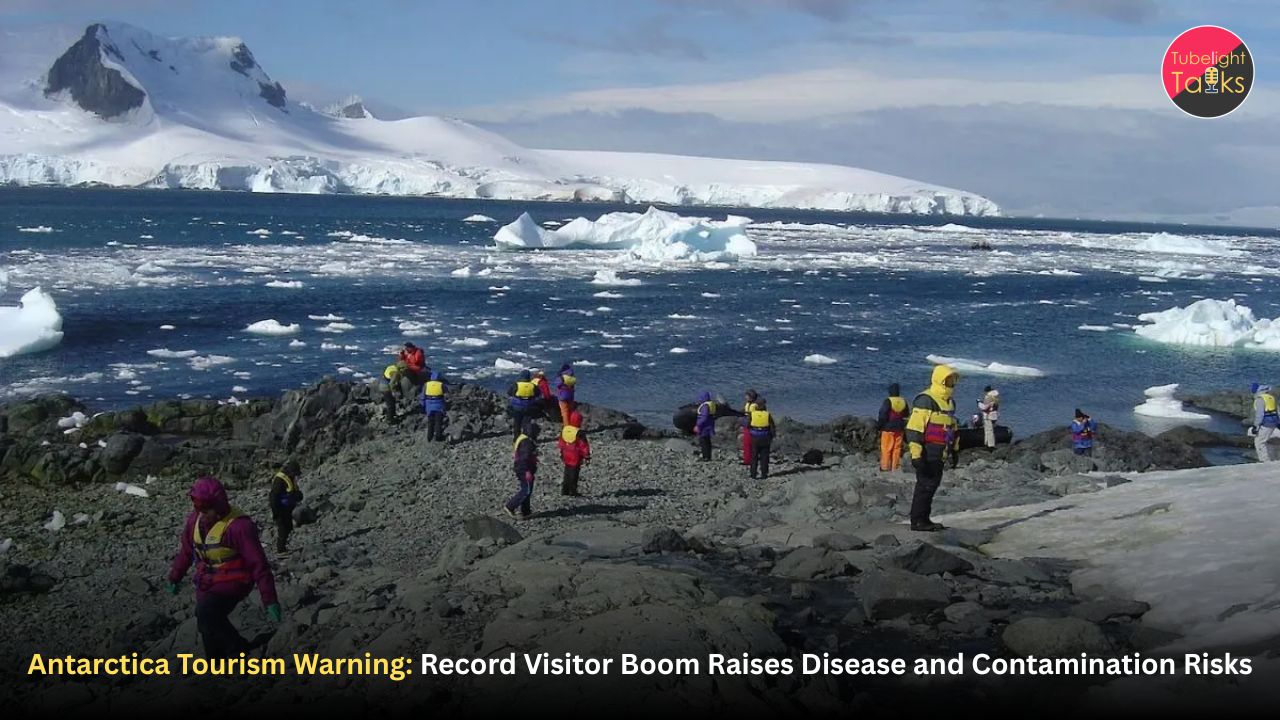
Antarctica’s tourism boom has triggered fresh warnings from scientists and environmental experts, who fear that rising visitor numbers could increase the risk of disease, contamination, invasive species and long-term ecological damage in one of the planet’s most fragile regions. More than 80,000 tourists landed on Antarctica during the 2024–25 season, while over 36,000 more viewed the continent from ships, according to the International Association of Antarctica Tour Operators.
Experts say tourism has grown tenfold in 30 years and could triple or quadruple in the next decade. The recent MV Hondius hantavirus crisis and earlier detection of H5N1 avian flu among Antarctic birds have intensified concerns over biosecurity.
Antarctica Tourism Boom: Why Scientists Are Worried
Visitor Numbers Are Rising Rapidly
Antarctica was once considered an unreachable wilderness visited mainly by scientists, explorers and specialist expeditions. That image is changing. Cruise tourism, “last-chance tourism,” luxury adventure travel and climate anxiety are bringing more visitors to the frozen continent.
IAATO’s 2024–25 data recorded 80,434 landed visits, 36,769 cruise-only visitors and 938 deep-field visitors. AP reported that tourism to Antarctica has grown tenfold in the past 30 years, and researchers estimate that annual visits could rise above 400,000 within a decade if costs fall and more ice-capable vessels enter service.
This growth may still look small compared with mass tourism destinations, but Antarctica is different. Its ecosystems are extremely slow to recover. A footprint, a seed, a microbe, an oil spill, a bird flu exposure or black carbon from ship funnels can have consequences far beyond the moment of visit.
“Last-Chance Tourism” Adds Pressure
Many tourists are travelling to Antarctica because they fear the landscape is changing quickly due to climate change. This trend is often called “last-chance tourism.” People want to see glaciers, icebergs, penguins, seals and whales before they are altered by warming.
The irony is painful: the desire to witness a vanishing environment can itself add pressure to that environment. The Antarctic Peninsula, a major tourism route, is one of the fastest-changing regions. AP cited NASA data showing that from 2002 to 2020, Antarctic ice melted at roughly 149 billion metric tons per year.
Also Read: New Study Reveals Surprising Factors Behind the Growing Height of Mount Everest
Disease Risk: From Avian Flu to Hantavirus Alarm
MV Hondius Crisis Raises Biosecurity Fears
The deadly hantavirus outbreak linked to the MV Hondius cruise ship has brought new attention to the health risks associated with expedition tourism. While officials have not indicated evidence that Antarctica itself was contaminated by the ship, the case has reminded health authorities that cruise vessels can become difficult environments during outbreaks.
AP reported that the MV Hondius left Ushuaia, Argentina, on April 1 and visited Antarctica and several isolated islands. WHO officials have been investigating possible human-to-human transmission on the cruise ship, while authorities were told there were no rats on board.
This matters because Antarctic expedition ships often follow long routes across remote waters. If illness emerges onboard, evacuation, testing, quarantine and repatriation become complicated. The Antarctic environment also has limited medical infrastructure, making prevention far more important than reaction.
Avian Flu Threatens Penguins and Seabirds
Disease concern is not limited to humans. Highly pathogenic H5N1 avian flu has already reached Antarctica’s bird populations. Reuters reported in 2024 that scientists warned of H5N1 spread after the virus was confirmed on the Antarctic mainland and detected in Adélie penguins and Antarctic cormorants. Researchers warned that crowded penguin colonies and migratory movements could increase transmission.
This is alarming because Antarctica’s wildlife has evolved in relative isolation. Penguins, seabirds and marine mammals may be vulnerable to introduced pathogens. If disease spreads through dense colonies, the effects could be severe, especially for already threatened species such as emperor penguins.
Contamination and Invasive Species
Tiny Seeds and Microbes Can Travel With Tourists
Tourists may unintentionally carry seeds, soil, feathers, insects, spores or microbes on boots, clothing, bags, camera tripods and outdoor gear. These small contaminants can be enough to introduce invasive species or pathogens into delicate environments.
AP reported that crews and passengers use vacuums, disinfectants and brushes to clean boots and equipment before visiting landing sites. Visitors are also told to avoid touching the ground with anything except their feet and to stay away from animals.
These rules show how seriously biosecurity is treated. Antarctica is not a place where casual tourism behaviour is harmless. Every landing must be managed carefully.
IAATO Guidelines and Self-Regulation
IAATO, founded in 1991, says its mission is to advocate and promote safe and environmentally responsible private-sector travel to Antarctica. It monitors and reports tourism trends and provides visitor guidance for operators and tourists.
However, environmental groups argue that voluntary systems may not be enough as tourism grows rapidly. Antarctica is governed by the Antarctic Treaty System, which designates the continent as a natural reserve devoted to peace and science. AP noted that the treaty was written when tourism numbers were much lower, and experts are now calling for stronger regulation to match current pressures.
Wildlife Disturbance and Ecological Pressure
Penguins, Seals, Whales and Krill at Risk
Antarctica’s wildlife is globally iconic but ecologically vulnerable. Penguins need breeding sites. Seals need safe resting and feeding areas. Whales rely on healthy Southern Ocean food webs. Krill, tiny crustaceans at the base of the food chain, support much of Antarctica’s marine ecosystem.
When more tourists land near wildlife areas, the risk of disturbance increases. Even well-intentioned visitors can stress animals by approaching too closely, blocking movement routes, making noise or changing behaviour patterns.
Tourism operators have rules about distance, group size and conduct, but enforcement becomes harder as numbers rise. The more ships and visitors enter the region, the more cumulative pressure builds.
Black Carbon and Snow Melt
Tourism also contributes to pollution. Cruise ships burn fuel, and emissions can release black carbon particles. When black carbon settles on snow or ice, it can darken surfaces and increase heat absorption, accelerating melt.
This pollution may be localized, but Antarctica’s systems are highly sensitive. In a region already warming, additional human-caused pollution is a serious concern.
Also Read: Nihilist Penguin Meme Goes Viral: What This Existential Trend Says About the Internet in 2026
Why Antarctica Needs Stronger Protection
Fragile Recovery
In warmer ecosystems, some damage may recover within months or years. In Antarctica, recovery can take decades. Cold temperatures slow biological processes. Vegetation is sparse. Soil development is limited. Wildlife breeding cycles are tightly linked to climate and food availability.
This is why environmental experts argue that Antarctica must be managed with extreme caution. Prevention is far easier than repair.
Tourism Is Not the Only Pressure
Tourism is only one part of the problem. Scientific stations, fishing, climate change, shipping, pollution and global disease movement also affect the region. But tourism is growing quickly, and unlike research activity, it is driven by commercial demand.
That does not mean all tourism should be banned. Responsible tourism can create Antarctic ambassadors who support conservation. But growth must be carefully limited, monitored and regulated.
What Stronger Rules Could Include
Visitor Caps and Site Limits
One option is stricter limits on visitor numbers at sensitive sites. Some landing sites may need seasonal closures, wildlife buffers or caps on daily visits. High-risk areas near breeding colonies should receive special protection.
Mandatory Biosecurity Audits
All expedition ships should follow strict cleaning, inspection and reporting systems. Boots, clothing, drones, tripods, bags and landing equipment should be checked carefully before every landing.
Disease Surveillance
Operators should coordinate with health authorities to monitor symptoms among passengers and crew. Wildlife disease surveillance should also be strengthened, especially for avian flu and other emerging pathogens.
Cleaner Vessels
Ships should reduce emissions through cleaner fuels, better technology and strict waste-control systems. Antarctica tourism should not contribute to the melting and pollution of the very landscapes tourists travel to see.
India and Global Responsibility
Why Indian Readers Should Care
Antarctica may seem distant from India, but its health affects the whole planet. Antarctic ice influences global sea levels. Southern Ocean systems affect climate and marine life. Changes in polar regions can influence weather and ocean circulation far beyond the poles.
India is also an Antarctic Treaty consultative party and runs scientific research stations in Antarctica. Indian scientists have long contributed to polar research. Therefore, protecting Antarctica is not only a Western environmental concern; it is a global duty.
Sustainable Travel Choices
Travellers should choose responsible operators, follow all biosecurity rules, avoid disturbing wildlife and think carefully before joining fragile-environment tourism. The question is not only “Can I afford to visit?” but “Can the place afford my visit?”
Protecting the Last Wilderness With Inner Responsibility
Antarctica’s tourism warning reminds humanity that even the most remote places are affected by human desire, consumption and carelessness. The teachings of Sant Rampal Ji Maharaj and Sat Gyaan emphasize truth, compassion, humility, restraint, righteous conduct and true worship according to holy scriptures. Sant Rampal Ji Maharaj’s teachings guide people away from greed, intoxication, corruption, dishonesty, violence and harmful actions. In the context of Antarctica, this message is deeply relevant. Nature should not be treated as an object for ego, entertainment or profit.
Sat Gyaan teaches that outer protection of creation must begin with inner purification of conduct. A society that lives with discipline and compassion will not exploit fragile ecosystems for temporary pleasure. True progress means protecting life, respecting nature and seeking the real purpose of human birth.
FAQs on Antarctica Tourism Warning
1. Why are scientists warning about Antarctica tourism?
Scientists are warning that rapidly growing tourism increases risks of contamination, disease, invasive species, pollution and disturbance to fragile wildlife and ecosystems.
2. How many tourists visited Antarctica recently?
IAATO recorded 80,434 landed visits and 36,769 cruise-only visitors during the 2024–25 season.
3. What diseases are concerning experts?
Experts are concerned about avian flu affecting Antarctic birds and the wider risk of disease outbreaks linked to expedition travel, highlighted recently by the MV Hondius hantavirus crisis.
4. What is biosecurity in Antarctica tourism?
Biosecurity means preventing seeds, insects, microbes, soil, feathers and pathogens from being carried into Antarctica on clothing, boots, bags or equipment.
5. Is Antarctica tourism banned?
No. Tourism is allowed under strict guidelines, but experts are calling for stronger regulation as visitor numbers rise sharply.
6. Why is Antarctica so fragile?
Antarctica’s cold environment recovers very slowly from damage. Its wildlife, soil, ice and ecosystems are highly sensitive to contamination, disturbance and climate change.
Related Stories






Discussion (0)