Middle East Naval Transit: First Merchant Vessels Successfully Cross Strait of Hormuz Under Project Freedom Escorts
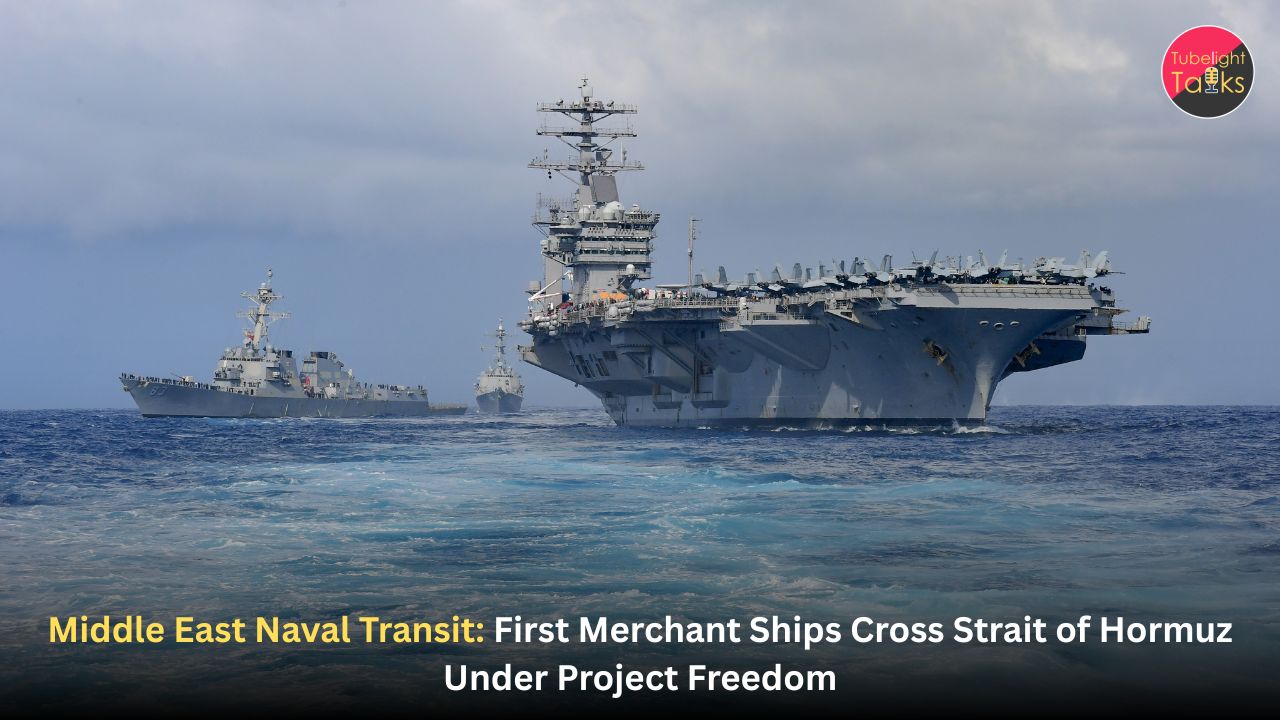
U.S. Central Command has confirmed that the first U.S.-flagged merchant vessels successfully transited the Strait of Hormuz under Operation Project Freedom, marking a significant but fragile step toward restoring commercial shipping through one of the world’s most important maritime chokepoints. The U.S. military says Project Freedom is designed to protect merchant vessels seeking safe passage through the strait after weeks of Iranian threats, attacks and disruption to commercial shipping.
U.S. defence officials said two American commercial ships crossed the strait alongside U.S. destroyers, while more vessels are expected to transit in the coming days. The development is being viewed as a limited success, but tensions remain high after renewed U.S.-Iran exchanges near Qeshm Island and Bandar Abbas.
Project Freedom: First Merchant Transit Through Hormuz
Two U.S.-Flagged Merchant Ships Cross
The first major confirmation came through U.S. military channels, with CENTCOM and U.S. defence officials saying that two U.S.-flagged merchant vessels successfully passed through the Strait of Hormuz as part of Project Freedom’s initial phase. The U.S. Department of War said the ships transited with American destroyers, proving that commercial passage through the strait could resume under heavy military protection.
The crossing is symbolically important because Iran had claimed it could control or block the waterway. U.S. officials framed the successful transit as proof that Iranian control of the strait is limited when confronted by coordinated military and diplomatic pressure. At the same time, the fact that the vessels required U.S. protection shows that the waterway is not yet normal or fully safe.
A “First Step,” Not a Full Reopening
Although the successful transit is a positive development for shipping, it does not mean the Strait of Hormuz has returned to regular commercial flow. U.S. officials have described Project Freedom as a defensive and temporary mission, focused on supporting merchant vessels seeking safe passage.
Hundreds of ships remain delayed or cautious because companies, insurers and crews want proof that the risk is manageable. U.S. officials have acknowledged that more than 1,500 vessels and about 22,500 mariners were trapped or affected inside the Persian Gulf after Iran obstructed the route.
The first transit therefore matters, but it is only the beginning. A true reopening will require repeated safe crossings, reduced military incidents, stable insurance terms, and a diplomatic arrangement that lowers the threat level.
Also read: Project Freedom Paused: Strait of Hormuz Crisis Moves Toward Diplomatic Settlement
Why the Strait of Hormuz Matters
A Critical Energy Corridor
The Strait of Hormuz is one of the world’s most important energy routes. A major share of seaborne oil trade and significant quantities of fuel and fertilizer products move through the strait. When the waterway becomes unsafe, global markets respond quickly.
Fuel prices, shipping insurance, energy imports, industrial production, fertilizer supply chains and inflation expectations can all be affected. Asia, Europe, the Gulf, Africa and global shipping companies all depend on safe movement through Hormuz.
This is why even limited transit under escort is watched globally. It tells markets whether the risk is easing or escalating.
A Narrow Waterway With Global Consequences
The strait is geographically narrow, which makes it vulnerable. Missiles, mines, drones, fast boats and coastal surveillance systems can threaten shipping in a confined space. A single successful attack on a tanker or container vessel can trigger panic across maritime markets.
Project Freedom is designed to reduce that fear by creating an enhanced security zone, using naval ships, aircraft, drones and coordinated communication to protect merchant vessels.
What U.S. Forces Are Providing
Warships, Aircraft and Overwatch
CENTCOM says U.S. support for Project Freedom includes guided-missile destroyers, more than 100 land and sea-based aircraft, unmanned platforms and around 15,000 service members. U.S. commanders have described the mission as defensive in nature, aimed at protecting innocent commercial shipping and restoring freedom of navigation.
The operational structure includes air overwatch, naval detection, communications support, escort coordination and the ability to respond to threats from Iranian fast boats or drones. U.S. officials say commercial vessels in the security area will see and hear American military presence around them.
Enhanced Security Area
U.S. officials have said CENTCOM established an enhanced security area on the southern side of the Strait of Hormuz, protected by U.S. land, naval and air assets. This area is intended to give merchant ships a safer corridor through the strait while reducing exposure to Iranian threats.
Such a security zone is not the same as normal commercial freedom. It is a militarized solution to a maritime crisis. It may help ships move, but it also keeps the region under intense military tension.
Iran’s Position and Risk of Escalation
Tehran Rejects U.S. Framing
Iran has rejected the U.S. narrative that it alone created the crisis. Iranian officials have accused Washington of violating the ceasefire and increasing military pressure near Iranian waters. Tehran has also warned that foreign military interference in the strait can worsen the situation.
This disagreement is central to the crisis. The U.S. calls Project Freedom a defensive escort mission. Iran sees it as hostile military pressure near its coast. Both sides claim they are defending lawful rights.
Renewed Strikes Complicate Transit
The successful merchant transit came amid renewed U.S.-Iran clashes near the strait. U.S. Central Command said Iranian missiles, drones and small boats targeted three U.S. Navy destroyers, after which American forces struck Iranian military sites near Qeshm Island and Bandar Abbas. Iran disputed that account and accused the U.S. of violating the ceasefire.
This means the shipping success happened in a dangerous environment. Commercial transit may be possible, but not yet routine. Each crossing could become a test of restraint.
Also Read: Trump Pauses Project Freedom as US-Iran Diplomacy Enters Critical Breakthrough Phase
Global Shipping and Insurance Reaction
Shipping Companies Remain Cautious
Shipping companies do not make decisions only based on military statements. They consider insurance costs, crew safety, cargo value, charter terms, port access, legal liability and geopolitical risk. Even if U.S. forces say a corridor is protected, private companies may wait to see whether several ships pass safely.
A single successful crossing can encourage confidence, but repeated safe movement is needed before normal traffic returns.
Insurers Will Watch Closely
War-risk insurance is central to shipping decisions. If insurers classify the strait as extremely dangerous, shipowners may face huge premiums or choose not to transit. If Project Freedom reduces risk over several days, insurance terms may improve.
This is why the first crossing is important. It creates data. If ships transit without incident, insurers may begin adjusting risk assumptions. If attacks continue, costs may remain high or rise further.
Impact on Energy Markets
Oil and Fuel Prices Sensitive to Hormuz
The Strait of Hormuz crisis has created pressure in energy markets. When traders fear disruption, prices can rise even before actual shortages occur. Import-dependent countries worry about fuel inflation, fertilizer costs and industrial supply.
Successful naval transit may calm markets temporarily, but only if it appears sustainable. If U.S.-Iran exchanges continue, markets may remain volatile.
Gulf Exporters Need Stability
Gulf producers rely heavily on safe maritime routes. Even countries not directly involved in the conflict face economic risk if tankers cannot move reliably. That is why Gulf governments are watching Project Freedom closely. They want shipping restored but fear a broader conflict on their doorstep.
Project Freedom and Diplomacy
Military Escorts Cannot Replace Negotiation
Project Freedom can move ships, but it cannot solve the political conflict by itself. A lasting solution requires an agreement on maritime access, ceasefire terms, military restraint and possibly broader U.S.-Iran issues.
Military escorts are a bridge. They keep commerce alive while diplomacy works. But if diplomacy fails, the escort mission could become a repeated flashpoint.
Pakistan and Regional Mediation
Earlier diplomatic efforts involved Pakistan and regional partners trying to prevent escalation. The success of initial ship transit may strengthen diplomacy if both sides use it as evidence that limited de-escalation can work. But renewed strikes could also weaken trust.
The next diplomatic question is whether Iran will tolerate continued escorted commercial movement or treat it as a violation of its position.
Why This Matters for India and Asia
Energy Security Concerns
India and many Asian economies depend on energy flows from the Gulf. Any Hormuz disruption affects fuel costs, fertilizer imports, shipping schedules and inflation. A secure maritime route is therefore not only a U.S. or Gulf concern; it is directly connected to Asian economic stability.
Shipping and Trade Routes
Indian exporters, importers and shipping firms also monitor Hormuz risk. Delays in the Gulf can affect petrochemicals, crude oil, LNG, fertilizers, machinery and consumer goods. Stable sea lanes support stable prices.
The Road Ahead
More Vessels Expected
U.S. officials say more vessels are expected to transit in the coming days. The key test will be whether these crossings occur without missile, drone or small-boat incidents. If dozens of ships move safely, Project Freedom may be seen as working.
Risk Remains High
The situation remains fragile because the U.S. and Iran are still exchanging accusations and military signals. Any miscalculation could disrupt transit again. Commercial shipping may resume gradually, but confidence will return slowly.
Maritime Security and the Higher Lesson of Responsibility
The first merchant transit under Project Freedom shows that global trade depends on discipline, restraint and protection of innocent lives. But military escorts cannot create lasting peace if human conduct is ruled by ego, greed and violence. The teachings of Sant Rampal Ji Maharaj and Sat Gyaan emphasize truth, humility, compassion, righteous conduct and true worship according to holy scriptures.
His teachings guide people away from violence, intoxication, corruption, dishonesty, greed and misuse of power. In the context of the Strait of Hormuz crisis, this message is deeply relevant. Nations must protect commerce and human life, but they must also seek peace through truth and restraint. Sat Gyaan teaches that real security begins when human beings abandon arrogance and follow righteous conduct.
FAQs on Middle East Naval Transit
1. What has U.S. Central Command confirmed?
U.S. Central Command confirmed that the first U.S.-flagged merchant vessels successfully transited the Strait of Hormuz under Project Freedom.
2. What is Operation Project Freedom?
Project Freedom is a U.S.-supported defensive mission aimed at restoring safe commercial shipping through the Strait of Hormuz.
3. How many merchant vessels crossed in the first phase?
U.S. officials said two U.S.-flagged merchant vessels successfully crossed as part of the initial phase.
4. Why is the Strait of Hormuz important?
It is a critical global maritime route for oil, gas, fuel, fertilizer and commercial shipping. Disruption can affect global prices and supply chains.
5. Is the waterway fully safe now?
No. The first transit is an important step, but the situation remains fragile due to continued U.S.-Iran tensions and military risks.
6. What happens next?
More ships are expected to attempt transit in the coming days, while military escorts, shipping companies, insurers and diplomats assess whether the route can remain open.
Related Stories



Discussion (0)