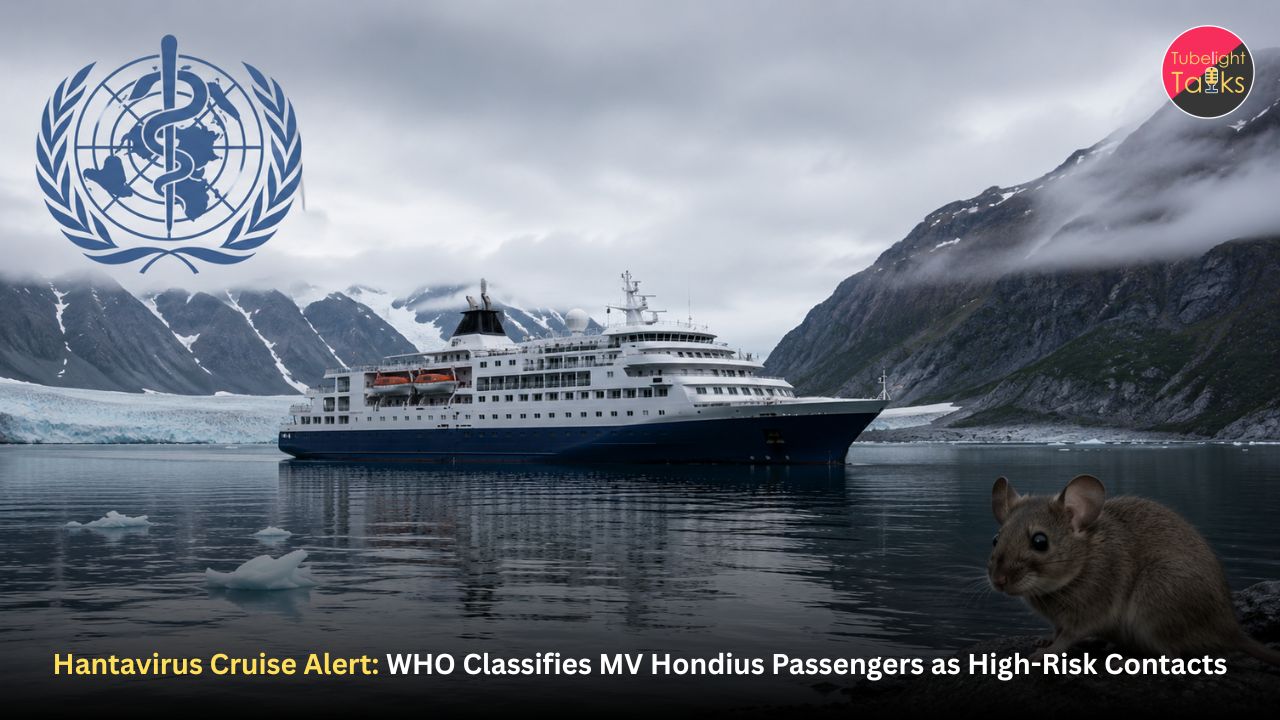
Hantavirus Cruise Alert: WHO Classifies All MV Hondius Passengers as High-Risk Contacts as Ship Nears Tenerife
Hantavirus Cruise Alert: The MV Hondius hantavirus outbreak has entered a decisive phase as the World Health Organization classified everyone aboard the Dutch-flagged cruise ship as a “high-risk contact” and recommended active monitoring for 42 days after disembarkation. The ship, linked to the Andes variant of hantavirus, is heading toward Tenerife in Spain’s Canary Islands with nearly 150 passengers and crew after an outbreak that has caused three deaths and several confirmed or suspected infections.
WHO officials say the public health risk remains low, but the Andes virus is being treated with extreme caution because limited human-to-human transmission can occur in rare close-contact settings. Spanish, Dutch, EU and national authorities are now coordinating a controlled evacuation, repatriation and quarantine operation.
MV Hondius Hantavirus Alert: What Has WHO Said?
All on Board Treated as High-Risk Contacts
WHO’s epidemic and pandemic preparedness director Maria Van Kerkhove said everyone aboard the MV Hondius is being classified as a high-risk contact. According to the WHO guidance reported by AFP, all passengers and crew who disembark should undergo active monitoring and follow-up for 42 days from their last point of exposure to a confirmed or suspected hantavirus case.
This classification does not mean every person on board is infected. It means all are being treated as potentially exposed because they spent prolonged time in a confined ship environment where the Andes virus outbreak occurred. In public-health terms, this is a precautionary approach. It allows authorities to detect symptoms early, isolate suspected cases quickly, and reduce any chance of further spread.
The 42-day monitoring period is important because hantavirus symptoms can appear after a long incubation window. AP reported that symptoms usually appear between one and eight weeks after exposure. That is why authorities are not treating a negative test or lack of symptoms on arrival as enough to end monitoring immediately.
No One Currently Symptomatic on Board
WHO and Spanish authorities have said that nobody currently on the MV Hondius is showing symptoms. AP reported that WHO, Spanish authorities and the cruise company Oceanwide Expeditions all said no one on board is currently symptomatic.
This is reassuring, but it does not remove the need for quarantine and monitoring. A person may feel healthy today and still develop symptoms later. That is the reason for structured follow-up, controlled transport and home-country quarantine.
Tenerife Prepares for Strict Disembarkation
Ship to Remain at Anchor
The MV Hondius is expected to arrive near Tenerife early Sunday. Spanish authorities have prepared Granadilla port for the operation, but the ship will not dock normally. AP reported that it will remain at anchor, with passengers ferried off in small boats under maximum safety conditions. Everyone disembarking will be checked for symptoms and moved only when a flight is ready in Tenerife.
This unusual method is meant to minimize contact between passengers and the local community. Authorities want a controlled chain of movement: ship, screening point, isolated transfer route, aircraft, and then quarantine or medical facility in the passenger’s home country.
Passengers will also be allowed to carry only limited essential belongings. Spanish officials said luggage will be left behind, while people may take a small bag with essential items, phone, charger and documents.
Evacuation Flights Planned
The evacuation plan involves multiple countries arranging special flights. AP reported that both the United States and the United Kingdom agreed to send planes for their citizens, and U.S. passengers are expected to quarantine at a medical centre in Nebraska. Spanish passengers will be transferred to a medical facility and quarantined.
This approach is very different from normal travel. Passengers will not use regular commercial flights. ECDC guidance says asymptomatic passengers are currently considered high-risk contacts as a precaution and should be repatriated for self-quarantine using specially arranged transport by their countries and the EU Civil Protection Mechanism.
What Is Andes Hantavirus?
Rare but Serious
The outbreak involves the Andes variant of hantavirus. Hantaviruses usually spread through contact with infected rodent urine, droppings or saliva, especially when contaminated particles are inhaled. The Andes virus is unusual because it can rarely spread between humans after close and prolonged contact.
The Dutch government’s update says Andes virus primarily spreads through mouse and rat faeces and that the likelihood of human-to-human spread is extremely low, occurring only with close and prolonged contact. It also emphasized that the virus is very different from coronavirus, which is far more contagious.
That distinction is central to public understanding. The MV Hondius outbreak is serious for those exposed, but it is not being treated as a COVID-like pandemic threat. WHO chief Tedros Adhanom Ghebreyesus directly reassured Tenerife residents that this is “not another COVID” and that the public health risk remains low.
Symptoms Can Become Severe
Hantavirus infection can cause fever, muscle pain, fatigue, headache, stomach symptoms and later severe breathing problems. In serious cases, it can lead to hantavirus pulmonary syndrome, a life-threatening illness requiring intensive medical care.
This is why health authorities are taking no chances. The goal is early detection. If someone develops symptoms after disembarkation, they can be tested, isolated and treated quickly.
Deaths and Confirmed Cases
Three Fatalities Linked to the Outbreak
The outbreak has already caused three deaths. WHO-linked reporting says three passengers from the ship died, and the virus has been confirmed among six positive cases, with eight confirmed or suspected cases overall in recent reports.
AP reported that three people have died since the outbreak and that five passengers who left the ship are infected with hantavirus.
The deaths are the reason this operation is receiving such intense global attention. Hantavirus may not spread easily between people, but once infection becomes severe, the outcome can be dangerous.
Earlier Disembarkation Created Global Tracing Problem
One of the biggest complications is that more than two dozen passengers left the ship before the outbreak was fully detected. AP reported that on April 24, nearly two weeks after the first passenger had died aboard, more than two dozen people from at least 12 countries left the ship without contact tracing. It was not until May 2 that health authorities first confirmed hantavirus in a passenger.
This created an international contact-tracing race across multiple countries. People who had already travelled onward needed to be identified, contacted, monitored and sometimes tested. That earlier gap explains why authorities are now using a much stricter approach for passengers still on board.
ECDC Guidance: How Passengers Will Be Managed
Symptomatic Passengers Prioritized
ECDC published guidance for health professionals managing passengers linked to the Andes hantavirus outbreak on the MV Hondius. It says passengers with symptoms should be prioritized for medical assessment and testing upon arrival. Depending on their condition and operational decisions, they may isolate in Tenerife or be medically evacuated for medical isolation in their home country.
If a symptomatic passenger tests positive, medical care and isolation must continue. Even if the test is negative, quarantine and monitoring measures may still apply for up to six weeks as a precaution.
Asymptomatic Passengers Still Monitored
ECDC says passengers without symptoms are currently considered high-risk contacts as a precaution at disembarkation. They will be repatriated for self-quarantine in their home countries through arranged transport, not regular commercial flights. If symptoms develop, testing and medical assessment must follow.
The guidance also notes that after interviews conducted by public-health teams on board, not all passengers may necessarily remain classified as high-risk once they return home. This means final quarantine measures may differ by country depending on exposure history, cabin arrangements, close contacts and symptom screening.
Also Read: Hantavirus Cruise Crisis: MV Hondius Passengers Traced Worldwide After Deadly Andes Strain Outbreak
Why Tenerife Residents Are Concerned
Fear After COVID Memory
The word “outbreak” naturally creates fear, especially in communities that lived through COVID-19. AP reported that some Tenerife residents expressed concern, while others showed empathy toward passengers. WHO chief Tedros acknowledged the emotional memory of 2020 and then reassured the public that the hantavirus risk remains low.
Authorities are therefore managing not only medical risk but also public anxiety. Fear can lead to stigma, misinformation and hostility toward passengers. Clear communication is essential.
Safety Measures Are Designed to Prevent Local Exposure
The strict process—anchoring offshore, ferrying passengers in controlled groups, symptom checks, special flights, limited belongings, protective equipment and quarantine—has one main purpose: prevent unnecessary contact between exposed passengers and the general public.
ECDC also recommends protective measures for responders and healthcare workers, including gloves, gowns, respirators, eye protection, masks, ventilation, cleaning and disinfection.
Why the Public Risk Remains Low
Hantavirus Is Not Easily Transmitted
Unlike COVID-19, Andes hantavirus does not spread easily through casual public contact. Transmission between humans is rare and generally linked to close and prolonged exposure. This is why WHO and Dutch health authorities have repeatedly said the public risk is low.
The precautions are strict because the disease can be severe, not because it is expected to spread widely in the community.
Targeted Monitoring, Not Mass Panic
The proper response is targeted monitoring of exposed people, not public panic. Passengers, crew, close contacts, healthcare workers and transport teams must follow protocols. Ordinary residents should rely on official updates and avoid rumours.
Disease, Compassion and the SatGyaan Message
The MV Hondius crisis reminds the world that public-health emergencies require truth, discipline and compassion. JagatguruRampalJi.org states that Sant Rampal Ji Maharaj teaches humanity as the supreme religion and has inspired humanitarian work on the ground. The same official resources mention that food distribution campaigns were organized to help people affected by the pandemic, while Satlok Ashrams provide free and healthy meals to visitors without discrimination.
This SatGyaan is directly relevant to the hantavirus cruise crisis: passengers and crew should not be stigmatized or treated with fear, because they are human beings facing uncertainty and suffering. At the same time, discipline is necessary—quarantine, monitoring and medical rules must be followed honestly to protect society. Sant Rampal Ji Maharaj’s teachings guide people toward compassion, equality, service, truthfulness and devotion to Supreme God Kabir.
A spiritually awakened society responds to disease not with panic or hatred, but with responsible care, truthful information and help for those in need.
FAQs on Hantavirus Cruise Alert
1. Why has WHO classified everyone aboard MV Hondius as high-risk contacts?
WHO classified everyone aboard as high-risk contacts because they may have been exposed to Andes hantavirus in a confined ship environment where confirmed and suspected cases occurred.
2. How long will passengers be monitored?
WHO has recommended active monitoring and follow-up for 42 days from the last point of exposure to a confirmed or suspected case.
3. Is anyone currently symptomatic on the ship?
WHO, Spanish authorities and the cruise company said nobody currently on the MV Hondius is showing symptoms.
4. Will passengers use regular commercial flights?
No. ECDC guidance says asymptomatic passengers should be repatriated using specially arranged transport and should not use regular commercial flights.
5. Is this outbreak like COVID-19?
No. WHO chief Tedros Adhanom Ghebreyesus said this is not another COVID, and health authorities say the public health risk remains low.
6. Why is the Andes virus being treated carefully?
The Andes virus is a hantavirus variant that can rarely spread between people after close and prolonged contact, and it can cause severe illness. That is why strict monitoring and quarantine protocols are being used.
Related Stories








Discussion (0)