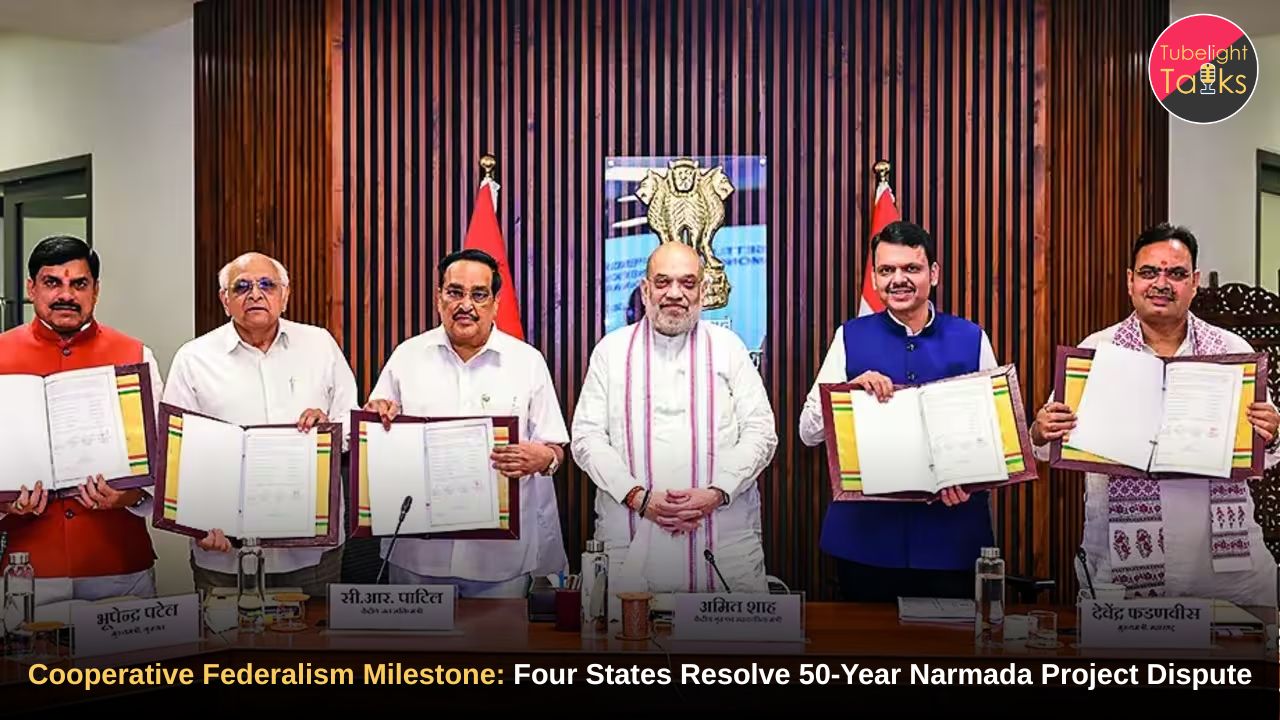
Cooperative Federalism Milestone: Four States Resolve 50-Year Narmada Project Dispute
Cooperative Federalism Milestone: In a monumental breakthrough for inter-state water relations, the four beneficiary states of the Narmada basin—Madhya Pradesh, Gujarat, Rajasthan, and Maharashtra—have signed a historic agreement to bring a definitive end to a 50-year-old financial dispute. Signed in New Delhi on July 7, 2026, the comprehensive pact outlines a one-time financial settlement mechanism to resolve decades of friction surrounding cost-sharing, land submergence compensation, and Resettlement and Rehabilitation (R&R) liabilities linked to the massive Sardar Sarovar and Indira Sagar projects.
The high-level signing ceremony was mediated and witnessed by Union Home Minister Amit Shah and Union Jal Shakti Minister C.R. Patil. The executive deal was formally signed by Madhya Pradesh Chief Minister Mohan Yadav, Gujarat Chief Minister Bhupendra Patel, Rajasthan Chief Minister Bhajan Lal Sharma, and Maharashtra Chief Minister Devendra Fadnavis.
Shattering a Half-Century Deadlock
The Genesis of the Financial Strain
The roots of the inter-state friction trace back to the implementation parameters governed by the original Narmada Water Disputes Tribunal (NWDT) Award. Over the decades, as the massive engineering frameworks of the Sardar Sarovar Project in Gujarat and the Indira Sagar Project in Madhya Pradesh expanded, structural costs escalated dramatically.
Also Read: Kerala CM Race: Poster War Erupts as Congress High Command Prepares to Finalise Next Chief Minister
Disputes grew progressively intense regarding the allocation of expenditures for the thousands of hectares of land swallowed by submergence zones and the extensive, highly sensitive human resettlement mandates. Rather than stretching out prolonged legal blockades in the courts, the consensus-driven blueprint signed this week functions as a unified structural release valve for the four state budgets.
Key Fields of Consensus
| Resolved Parameters | Impact & Scope |
| One-Time Financial Release | Closes out all historical liabilities via final, calculated fiscal transfers. |
| R&R Dues Settlement | Allocates clear accountability for pending resettlement and rehabilitation expenditures. |
| Submerged Land Compensation | Finalizes financial payouts for government, forest, and private land lost under the reservoirs. |
| Borrowing Interest Resolution | Settles decades of back-payments on interest liabilities for shared construction loans. |
The finalized agreement ensures that the complex management of shared water resources will proceed smoothly without the shadow of historical accounting grievances.
Strengthening Inter-State Foundations
Cooperative Federalism at the Forefront
Addressing the media following the signing event, Union Home Minister Amit Shah hailed the milestone as a golden standard for cooperative federalism. He noted that reduced political friction and focused central mediation have paved the way for states to resolve deep-seated disputes through constructive dialogue rather than systemic conflict.
Home Minister’s Address:
“This historic agreement resolves a payment dispute that has lingered for over 50 years. It stands as a brilliant testament to cooperative federalism, proving that even the most complex, multi-decade resource disputes can be settled through mutual goodwill and consensus.”
The structural ripple effects of the resolution are profound. For Maharashtra, Chief Minister Devendra Fadnavis indicated that thousands of crores in past claims against the state were effectively waived, leaving a minimal cleared balance liability of ₹27 crore. Concurrently, the deal unlocks optimized agricultural operations, enabling more stable, frictionless access to irrigation networks, drinking water networks, and massive hydropower outputs for the arid regions of Rajasthan and Gujarat.
Service, Humility and Public Duty
The final resolution of this multi-decade political dispute illustrates that while water flows naturally across boundaries, human ego and political friction can lock natural resources behind barriers for generations. Sant Rampal Ji Maharaj’s spiritual guidance teaches us that the resources of the earth belong equally to all creation under the divine order of the Supreme God Kabir. SatGyan reveals that real, sustainable global stability is achieved only when leaders cast aside territorial pride, corporate greed, and political posturing, choosing instead to execute their public duties with absolute humility and selflessness. While legal treaties may temporarily settle financial accounts between states, true harmony flows through a society when individuals prioritize human compassion, clear ethical governance, and the spiritual well-being of the collective human family over material dominance.
FAQs on the Four-State Narmada River Project Settlement
1. Which four states signed the historic Narmada agreement in July 2026?
The agreement was signed by the governments of Madhya Pradesh, Gujarat, Rajasthan, and Maharashtra.
2. What specific issues have been resolved by this one-time settlement?
The pact resolves decades-old disputes concerning cost-sharing, resettlement and rehabilitation (R&R) expenditures, submerged land compensation, and interest on construction-related borrowings.
3. Which major river valley projects are covered under this pact?
The settlement covers the financial and resource allocation disputes tied to the Sardar Sarovar Project and the Indira Sagar Project.
4. Who mediated the historic consensus between the four Chief Ministers?
The agreement was mediated and signed in the presence of Union Home Minister Amit Shah and Union Jal Shakti Minister C.R. Patil in New Delhi.
5. How long had this payment dispute been continuing prior to this agreement?
The inter-state payment and financial liability dispute had been dragging on for more than 50 years.
Related Stories



Discussion (0)