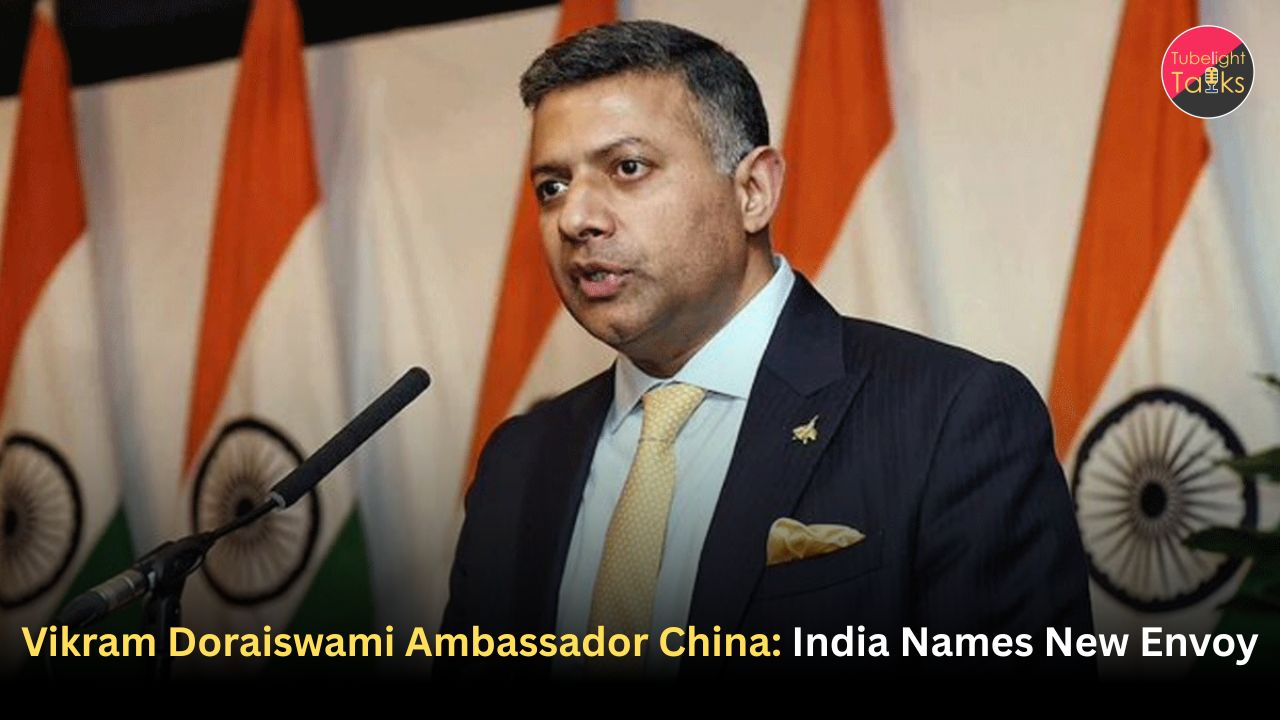
Vikram Doraiswami Ambassador China: India Names New Envoy Amid Diplomatic Reset
Senior diplomat Vikram K. Doraiswami has been appointed as India’s next Ambassador to the People’s Republic of China, according to the Ministry of External Affairs. Doraiswami, a 1992-batch Indian Foreign Service officer and currently India’s High Commissioner to the United Kingdom, is expected to take up the assignment shortly.
His move to Beijing comes at a carefully watched moment in India-China relations, when both sides are trying to stabilise ties through dialogue after the prolonged chill that followed the 2020 border clash. The appointment of Vikram Doraiswami ambassador China places an experienced diplomat with prior China exposure in one of India’s most strategically important foreign postings.
The Official Appointment and What the MEA Said
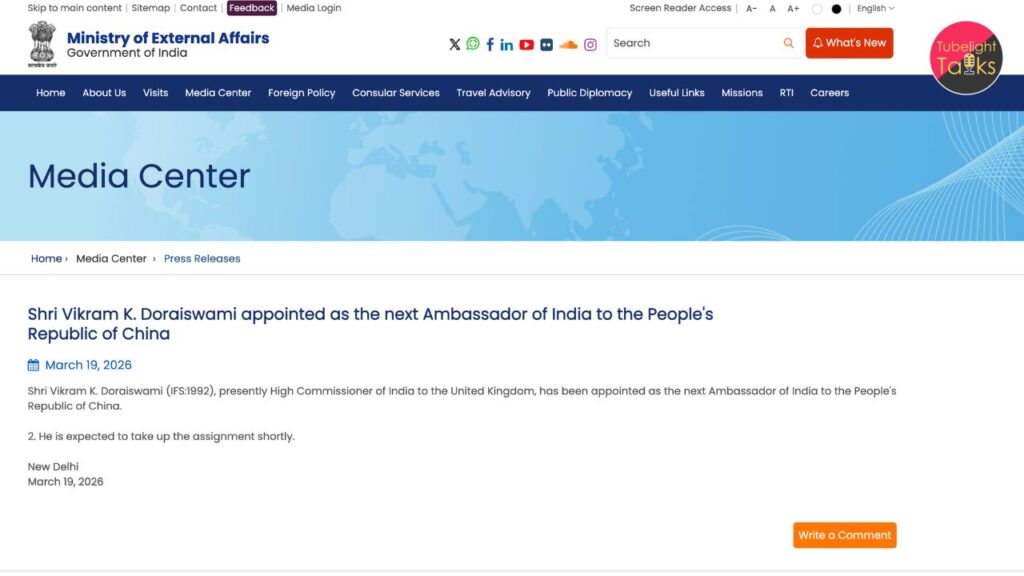
The Ministry of External Affairs announced on March 19, 2026 that “Shri Vikram K. Doraiswami (IFS:1992), presently High Commissioner of India to the United Kingdom, has been appointed as the next Ambassador of India to the People’s Republic of China,” adding that he is expected to take up the assignment shortly. That brief but important statement formally confirms a major change in India’s diplomatic representation in Beijing.
Reports on the appointment said Doraiswami will succeed Pradeep Kumar Rawat, who has been serving as India’s Ambassador to China. The transition comes at a time when India is seeking stable management of a relationship shaped by both strategic competition and practical necessity.
Who Is Vikram Doraiswami?
A Senior Career Diplomat With Long Experience
Vikram Doraiswami joined the Indian Foreign Service in 1992. The official profile on the High Commission of India in London says he previously worked briefly as a journalist, earned a Master’s degree in History from the University of Delhi, and built a wide-ranging diplomatic career across Asia, Africa, Europe, the United Nations, and the Prime Minister’s Office.
His postings have included Hong Kong, Beijing, New York, Johannesburg, Uzbekistan, South Korea, Bangladesh, and the United Kingdom. He also served as Joint Secretary for the Americas Division, headed the Bangladesh-Myanmar division, helped set up a new Indo-Pacific division at the MEA, and later worked as Additional Secretary handling international organisations and summits.
That breadth matters because the India-China relationship is not only about the border. It is also about trade, regional strategy, multilateral diplomacy, connectivity, and balancing competition with communication.
Why His China Background Stands Out
Doraiswami is not new to China-related work. His official profile says he learned Chinese in Hong Kong and then served for nearly four years at the Embassy of India in Beijing after being posted there in 1996. He also speaks Chinese, French, and some Korean. This makes him one of the relatively few senior Indian diplomats with direct language ability and earlier on-ground exposure in China.
That background is especially relevant because ambassadorial effectiveness in Beijing often depends on nuance, institutional memory, and the ability to read both the formal and informal dimensions of a complex bilateral relationship. Doraiswami’s earlier China posting does not remove the challenges ahead, but it does give him a practical base from which to engage. This is an inference drawn from his profile and the nature of the current diplomatic phase.
Also Read: India Finland Green Partnership Renewed for Pollution-Free Cities
Why This Appointment Matters Now
India and China Are Rebuilding, Not Resetting Overnight
India-China relations have improved from the depths of the post-2020 freeze, but they remain cautious rather than fully normal. Reuters reported that India and China agreed in October 2024 on patrolling along their Himalayan border, which helped thaw a standoff that had strained ties since the deadly 2020 clash. Reuters also reported in March 2025 that External Affairs Minister S. Jaishankar said issues between the two countries would remain in the “foreseeable future,” but could be handled without conflict.
Official MEA statements from March 2025 showed that both sides reviewed the border situation in what India described as a “positive and constructive atmosphere,” while also discussing the early resumption of cross-border cooperation, trans-border river issues, and the Kailash Manasarovar Yatra. Another MEA consultation the next day said the two sides had taken positive note of developments since the leaders’ meeting in October 2024 and were continuing efforts on direct flights, media exchanges, think-tank interaction, and a more stable and predictable relationship.
In that setting, sending a diplomat with China experience to Beijing looks less like a symbolic gesture and more like a measured administrative choice for a sensitive phase of engagement. That reading is an inference from the timing of the appointment, Doraiswami’s profile, and the documented effort by both governments to stabilise ties.
Connectivity and Economic Issues Are Also Back on the Table
The diplomatic track is no longer limited to border management. Reuters reported in January 2025 that India and China agreed to resume direct air services after nearly five years and work on resolving economic and trade differences. In June 2025, Reuters said both sides had agreed to expedite the resumption of direct air services and step up communication.
More recently, Reuters reported in March 2026 that India had begun easing some investment and procurement restrictions involving China after years of friction, following earlier moves on direct flights, business visas, and wider trade normalisation. This broader backdrop makes the ambassadorial posting to Beijing even more significant because the role increasingly sits at the intersection of security, economics, mobility, and political signaling.
The Key Challenges Waiting in Beijing
Border Stability and Strategic Distrust
Even as diplomacy improves, the trust deficit has not disappeared. Reuters noted that the relationship was deeply damaged after the 2020 military clash, which killed at least 20 Indian soldiers and four Chinese soldiers. The border issue continues to shape public sentiment, security planning, and the pace of wider normalisation.
For the new Indian ambassador, that means Beijing will not be a routine diplomatic assignment. The job will require careful messaging, constant political reading, and sustained work to ensure that tactical progress on talks is not derailed by deeper mistrust. Doraiswami will be stepping into a role where every positive development must coexist with unresolved structural differences. This is an inference based on the current state of ties described by Reuters and the MEA.
Trade, Technology and People-to-People Links
The bilateral agenda also includes trade imbalances, visa arrangements, direct flight restoration, investment scrutiny, media exchanges, and pilgrimage access. Official Indian statements said both sides were working on arrangements for direct flights and the resumption of Kailash Manasarovar Yatra, while Reuters reported growing movement on aviation, business access, and selective economic easing.
This means the new envoy’s responsibilities are likely to extend far beyond ceremonial diplomacy. They will include helping manage the practical mechanics of a cautious relationship: smoother communication, incremental confidence-building, and protection of India’s core interests while keeping channels open.
What Doraiswami’s Appointment Signals
The appointment signals continuity, experience, and a preference for steady diplomatic management rather than headline-driven gestures. Doraiswami’s record shows that he has handled politically sensitive assignments in Bangladesh, the UK, and multilateral settings, while his earlier Beijing service and Chinese language ability add a layer of relevance to the China post.
It would be premature to treat this single appointment as evidence of a full India-China breakthrough. But it is reasonable to say that New Delhi has chosen a seasoned diplomat with direct China familiarity at a time when bilateral ties are being repaired step by step. That, by itself, is a meaningful signal in foreign policy terms.
Diplomacy, Dialogue and True Wisdom: A Sat Gyaan Perspective
When relations between nations become tense, the world is reminded that pride, suspicion, and power struggles can disturb peace for millions. Sant Rampal Ji Maharaj explains through Sat Gyaan that real harmony begins when human beings rise above ego, conflict, and narrow self-interest.
In public life as in personal life, peaceful resolution, truth, restraint, and mutual respect create the conditions for stability. In that sense, diplomatic engagement between nations is strongest when guided not only by strategy, but also by higher values of wisdom, patience, and humanity. These teachings offer a deeper reminder that lasting peace cannot come from force alone; it must also come from righteous understanding.
FAQs: Vikram Doraiswami New Ambassador to China
1. Who is Vikram Doraiswami?
Vikram K. Doraiswami is a 1992-batch Indian Foreign Service officer who was serving as India’s High Commissioner to the United Kingdom before being appointed ambassador to China.
2. Has he worked on China before?
Yes. His official profile says he learned Chinese in Hong Kong and later served for nearly four years in India’s embassy in Beijing.
3. Why is this appointment important?
It comes at a time when India and China are cautiously rebuilding ties through border dialogue, direct flight discussions, and wider diplomatic engagement.
4. Who is he replacing in Beijing?
Recent reports said Doraiswami will succeed Pradeep Kumar Rawat as India’s ambassador to China.
5. Are India-China relations normal again?
Not fully. The relationship has improved since the 2024 border agreement, but both official statements and Reuters reporting show that stabilisation remains gradual and cautious.
6. What are the main issues he will deal with?
Key issues include border stability, direct flight restoration, trade and investment concerns, media and people-to-people exchanges, and broader diplomatic communication.
Related Stories



Discussion (0)