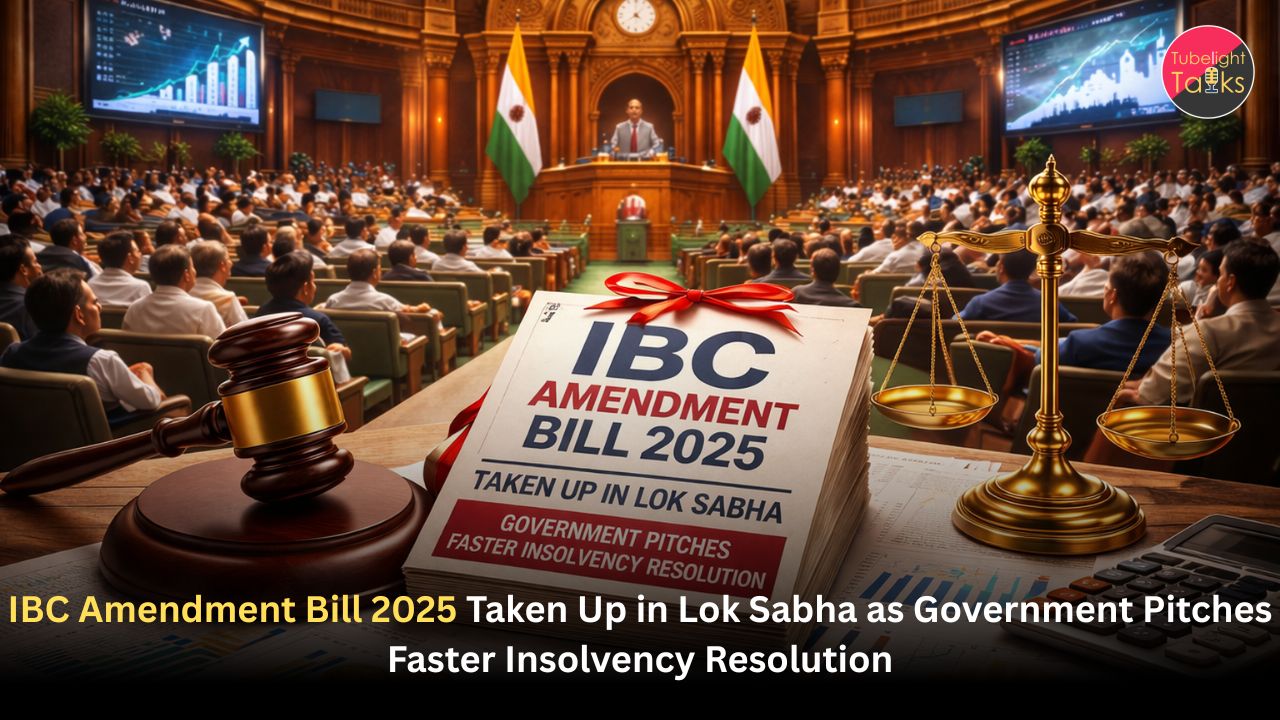
IBC Amendment Bill 2025 Returns to Centre Stage as Parliament Debates Faster Resolution of Stressed Assets
IBC Amendment Bill 2025: The Lok Sabha has taken up the Insolvency and Bankruptcy Code (Amendment) Bill, 2025 for consideration, putting one of India’s most important business-law reforms back at the centre of parliamentary debate.
According to the official parliamentary update carried by News On AIR, Finance Minister Nirmala Sitharaman moved the Bill, which seeks to further amend the Insolvency and Bankruptcy Code, 2016 to address procedural delays and interpretational issues. During the debate, BJP MP Anurag Thakur said around 8,654 corporate debtor cases had been resolved through the Corporate Insolvency Resolution Process and that about ₹4 lakh crore had been recovered since the IBC came into force.
That makes this much more than a technical bill. The IBC has been one of the defining legal-economic reforms of the last decade because it changed how India deals with business failure, creditor rights, and stressed assets. The current amendment push suggests the government believes the Code now needs a second-generation overhaul: not a replacement, but a sharper, faster, and more operationally modern version. That is an inference supported by the Bill’s focus on delays, uncertainty, and procedural efficiency.
Why the Bill matters now
The government’s own explanation of the amendment drive has been consistent. In its year-end review, the Ministry of Corporate Affairs said the Bill proposed changes to address delays in admission, resolution, and liquidation, while also improving efficiency, transparency, and value maximization for creditors.
That same concern came through in the Lok Sabha debate, where members across parties acknowledged the importance of the IBC even while disagreeing sharply on how well it is currently working. News On AIR reported that some MPs praised its role in improving credit discipline, while others argued that cases now remain stuck far beyond the intended time-bound framework.
This is why the amendment bill is timely. The original IBC changed lender behavior, encouraged earlier recognition of distress, and created a legal route to reorganize or liquidate failing firms. But over time, the process has also faced criticism for litigation delays, uncertainty in outcomes, and long resolution timelines. The amendments are therefore aimed at preserving the IBC’s core structure while making it more usable in practice. That is an inference grounded in the official ministry description and the PRS summary of the Bill.
What the Amendment Bill proposes
One of the biggest changes is the introduction of a new creditor-initiated insolvency resolution process, or CIIRP. PRS notes that the Bill removes the fast-track insolvency resolution process and instead introduces CIIRP for certain categories of corporate debtors notified by the government. Under this model, specified financial creditors can initiate the process if creditors holding at least 51% by value agree, and the debtor must first be informed and given at least 30 days to respond. During CIIRP, management stays with the debtor, but under the oversight of a resolution professional.
That proposal is significant because it marks a shift toward a more creditor-driven and potentially less disruptive pathway than full corporate insolvency resolution in every case. It also resembles a broader policy attempt to create something closer to structured, supervised resolution without instantly displacing management. This could help in cases where early intervention is possible but a full-blown insolvency takeover may be too slow or too damaging. That is an inference from the design of CIIRP described in the PRS summary.
The Bill also proposes a framework for group insolvency. PRS says it empowers the central government to prescribe rules for insolvency proceedings involving two or more corporate debtors that form part of a group, including the possibility of a common NCLT bench, a common resolution professional, and a joint committee of creditors. This matters because many business groups do not fail in neatly isolated legal boxes; distress often spreads across related entities.
A related major reform is cross-border insolvency. PRS points out that the current Code does not adequately address debtors with assets or creditors in multiple countries, and the Bill would empower the government to prescribe the manner and conditions for conducting cross-border insolvency proceedings. In an economy where Indian firms increasingly operate across jurisdictions, that is a substantial modernization step.
The Bill also tightens procedural expectations. PRS says it would make admission of CIRP mandatory when the default is proven, the application is complete, and no disciplinary proceedings are pending against the proposed resolution professional. It also says the NCLT must record reasons in writing if no order is passed within 14 days, and that records from financial institutions would be sufficient proof of default. That is intended to reduce ambiguity at the very first stage of the process.
Further, the Bill seeks to sharpen liquidation timelines and discourage abuse of process. PRS says liquidation orders must be passed within 30 days from the application or intimation, liquidation proceedings must generally be completed within 180 days extendable by 90 days, and frivolous or vexatious proceedings would attract a penalty ranging from ₹1 lakh to ₹2 crore. Those changes point to a larger policy goal: keep the insolvency framework from being slowed down by delay and misuse.
Also Read: Gujarat UCC Bill Moment: Why Live-In Registration Clause Sparks Debate
What Parliament heard during the debate
The Lok Sabha discussion showed that the Bill has support in principle but not without criticism. News On AIR reported that Anurag Thakur credited the IBC with empowering creditors and helping recover about ₹4 lakh crore, while also saying 8,654 corporate debtor cases had been resolved through CIRP.
Other MPs, however, questioned whether the Code still functions with the speed and fairness originally promised. Opposition members cited delays, uneven benefits, and concern that the system may favor larger corporate interests over smaller economic actors.
That debate is important because it reflects the current reality of IBC politics. Very few major parties now argue that India should go back to the pre-IBC era. The real argument is about whether the law has become too slow, too litigated, or too selectively effective. In other words, the consensus is mostly around the need for insolvency reform; the disagreement is over how the system is performing and whom it ultimately serves best. That is an inference based on the range of views recorded in the Lok Sabha discussion.
The Bill is important, but it is not law yet
One important factual point should stay clear: the Bill has been taken up for consideration, not passed into law yet. News On AIR reported that the discussion remained inconclusive and that the House was adjourned for the day to meet again on March 27. That means the political and legislative story is still unfolding.
The longer background also matters. PRS notes that the Insolvency and Bankruptcy Code (Amendment) Bill, 2025 was originally introduced in the Lok Sabha on August 12, 2025. Parliamentary records and PIB references show it was later referred to a Select Committee, whose report was presented in December 2025. So the current Lok Sabha consideration is part of a larger legislative process rather than a sudden move.
Why this matters for the economy
The IBC sits at the intersection of banking discipline, business restructuring, credit culture, and investment confidence. If insolvency resolution is too slow, creditors lose value, viable firms decay, and capital gets trapped. If it is too aggressive or too uncertain, businesses may fear the system rather than use it as a rescue mechanism. The amendment bill is therefore trying to recalibrate the balance between speed, fairness, and economic value preservation. That is an inference based on the official rationale of addressing delays and maximizing value.
This also explains why the government keeps emphasizing recovery numbers. The ₹4 lakh crore figure cited in the Lok Sabha is meant to show that the IBC has had real economic payoff and should be strengthened, not abandoned. Supporters will argue that the amendment bill is the next step in making the system more effective. Critics will likely counter that headline recovery figures do not by themselves settle questions of delay, transparency, and equitable treatment. Both positions are already visible in the parliamentary debate.
A Perspective on Economic Justice
Teachings associated with Sant Rampal Ji Maharaj place strong emphasis on honesty, fairness, and responsible conduct in worldly dealings. Read in that light, a law like the IBC is meaningful only when it is not used to exploit weakness, but to restore balance, discipline, and justice in economic life.
Systems become truly beneficial when they reduce harm, discourage deceit, and support fair outcomes for all affected people rather than only the most powerful. This is a spiritual reflection, not a legal claim.
Call to Action
Watch the details, not just the recovery headline
The IBC Amendment Bill, 2025 will likely shape India’s insolvency landscape for years, so it deserves closer public scrutiny than a simple “pro-business” or “anti-business” label. The key questions are whether CIIRP works as intended, whether group and cross-border insolvency frameworks are implemented sensibly, and whether the law truly reduces delay rather than just adding new layers.
A strong economy needs both speed and fairness
Insolvency law works best when it protects value without sacrificing due process. Parliament’s challenge now is to ensure that faster resolution does not become rushed resolution, and that efficiency does not come at the cost of fairness or accountability. That is the real test of this amendment bill.
FAQs: IBC Amendment Bill 2025 Taken Up in Lok Sabha as Government Pitches Faster Insolvency Resolution
1. Has the Lok Sabha passed the IBC Amendment Bill, 2025?
No. As of the latest official parliamentary update, the Lok Sabha has taken up the Bill for consideration and passing, but the discussion remained inconclusive and the House adjourned to March 27.
2. What recovery figure did the government highlight?
During the Lok Sabha debate, BJP MP Anurag Thakur said the IBC had helped recover about ₹4 lakh crore since implementation.
3. What is the biggest structural change in the Bill?
One of the biggest changes is the proposed creditor-initiated insolvency resolution process, or CIIRP, which would allow certain financial creditors to initiate a supervised process while management remains with the debtor under oversight.
4. Does the Bill deal with cross-border and group insolvency?
Yes. PRS says the Bill empowers the government to frame rules for group insolvency proceedings and for cross-border insolvency resolution where debtors have assets or creditors in multiple countries.
5. What problem is the government trying to solve with this Bill?
Official descriptions say the amendments aim to address delays in admission, resolution, and liquidation, while improving efficiency, transparency, and value maximization for creditors.
6. When was the Bill first introduced?
PRS says the Insolvency and Bankruptcy Code (Amendment) Bill, 2025 was introduced in the Lok Sabha on August 12, 2025.
Related Stories








Discussion (0)