Congress Eviction Notice Turns Akbar Road and Raisina Road Issue Into Political Flashpoint
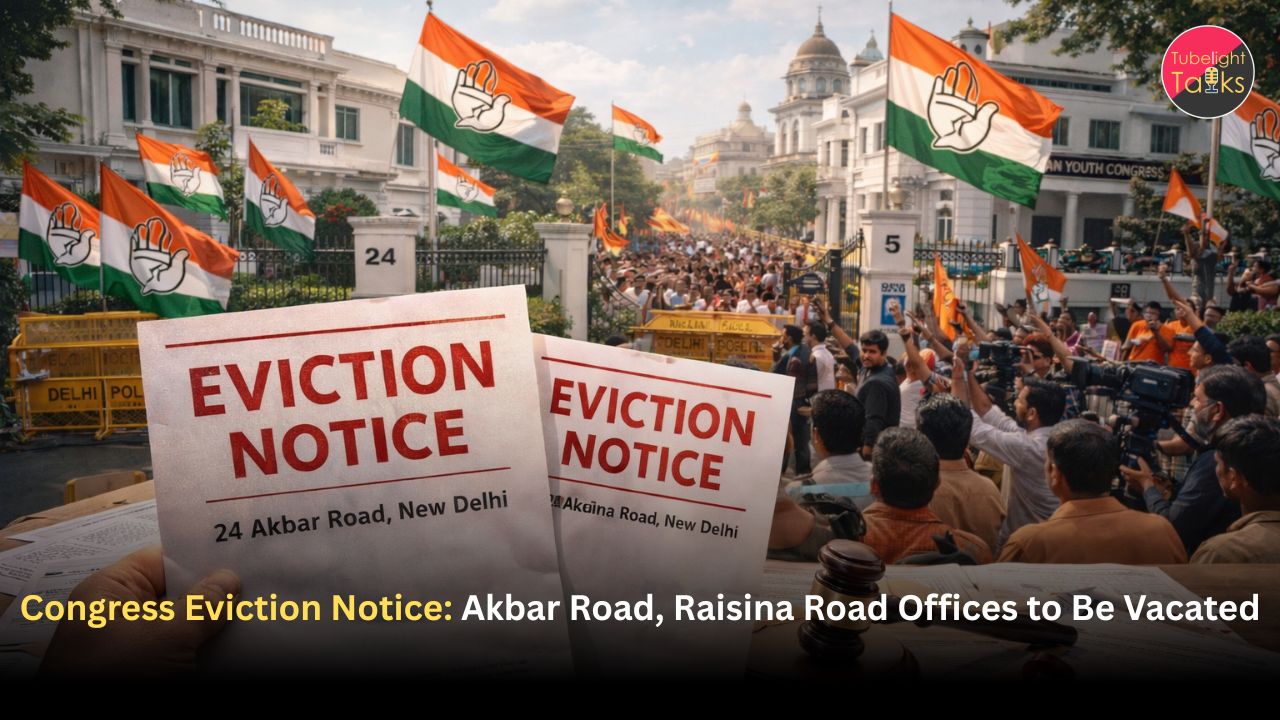
India’s political temperature has risen again after the Congress was served a Congress eviction notice to vacate two of its best-known Delhi premises: 24 Akbar Road, long associated with the party’s central functioning, and 5 Raisina Road, which houses the Indian Youth Congress. Multiple reports say the deadline is Saturday, March 28, and that the party is considering legal action against the notices.
What might appear at first like an administrative step has quickly become a national political story because these buildings carry institutional memory, symbolic weight, and continuing operational value for the Congress.
Why the notices matter so much
The Akbar Road property is not just another office address. It has served as the Congress headquarters since 1978, making it one of the party’s most recognizable political spaces in Delhi. The Raisina Road premises, meanwhile, houses the Indian Youth Congress. Together, the two buildings represent both legacy and organization: one tied to the party’s long public identity, the other to its youth structure. That is why the notices have instantly acquired political meaning beyond routine estate management.
The deadline has added to the tension. Indian Express reported that the notices, dated March 13, were received recently and require the party to vacate both addresses by March 28. Economic Times similarly described them as final notices from the Estate Department. A short compliance window in a matter involving a major national opposition party has naturally intensified the confrontation.
What rule the government is relying on
The legal-administrative basis for the move is a 2006 policy of the Land and Development Office under the Union Ministry of Housing and Urban Affairs. Indian Express reported that under this policy, national political parties that accept land allotment for construction of their own offices must vacate previously allotted government bungalows immediately on construction of their office building, or within three years from taking possession of the plot, whichever is earlier.
That rule is central to the current dispute because Congress already has its own new headquarters. According to Indian Express and NDTV, the party began construction on its allotted plot on Deendayal Upadhyay Marg in 2009, and the new building, Indira Bhavan, was completed and inaugurated in 2025. Even after that, the party retained the Akbar Road and Raisina Road premises. From the government’s perspective, that continued occupation falls afoul of the 2006 policy.
Indian Express also reported that records of the Directorate of Estates, accessed through RTI, show the allotment of three Type-VIII bungalows to the Congress—5 Raisina Road, 24 Akbar Road, and 26 Akbar Road—was cancelled on June 26, 2013. The party has already vacated 26 Akbar Road, but it continued at the other two properties. That detail strengthens the government’s argument that this is not a sudden rule change but the delayed enforcement of an older allotment position.
Why Congress is calling it vendetta politics
Congress leaders are not treating the notices as neutral administration. Times of India reported that the party accused the BJP-led government of trying to create pressure on the opposition and described the action as politically motivated. The same report quoted Congress leaders alleging that the move was an attempt to distract from other national issues and intimidate the party.
That response matters because the Congress is not disputing only the timing. It is also contesting the spirit of enforcement. Senior party figures have argued that if the government wants to apply this principle, it must do so uniformly across parties and not in a selective or one-sided manner. Economic Times reported Karti Chidambaram making exactly that point, while Times of India also carried similar objections from Congress leaders.
The political sting is sharper because of the symbolism of Akbar Road. NDTV noted that even after Congress inaugurated Indira Bhavan, party activities continued at 24 Akbar Road and many within the party retained a strong emotional connection to that address. So for Congress, this is not merely about office logistics. It is about being pushed out of a site woven into its institutional memory and public identity.
Also Read: Gujarat UCC Bill Moment: Why Live-In Registration Clause Sparks Debate
Why the government can argue this is not unique to Congress
One of the most important details in the Indian Express explainer is that the issue is not exclusive to Congress in principle. The report says the BJP too retained its 11 Ashoka Road office for some years after cancellation of allotment, even after moving to its own new office on DDU Marg in 2018, and vacated it only later. Government sources cited by the paper said both parties had been in violation of the 2006 policy by continuing to occupy allotted bungalows after receiving land for their own headquarters.
That does not erase Congress’s political complaint, but it complicates it. The government can argue that the rule exists, that it has previously affected other parties, and that enforcement is part of a broader cleanup of Lutyens’ bungalow allotments. Indian Express also recalled that in 2022 then Union Housing Minister Hardeep Singh Puri had said all parties allotted land for offices would eventually have to vacate government bungalows.
Still, the political effect depends not only on rules but on perception. In Indian politics, timing often shapes meaning. When an opposition party receives final notices with only days to comply, the legal basis may coexist with a political interpretation. That is why this row is likely to endure even if the government’s formal rulebook case is strong. This is an inference drawn from the enforcement history and the immediate reactions from both sides.
What Congress is likely to do next
The most immediate next step appears to be legal. Economic Times, NDTV, and Indian Express all reported that Congress is considering moving court or exploring legal options to prevent forcible eviction or gain relief. That suggests the party does not intend to quietly comply without contest. Instead, it is likely to turn the issue into both a legal battle and a political campaign point.
If the matter goes to court, the case will likely revolve around a few key questions: whether the government has followed due process, whether the time given is reasonable, whether the party’s continued use of the premises after inauguration of its own headquarters is legally defensible, and whether enforcement has been even-handed. Those are inferences based on the reported positions and the policy background, not yet the subject of a judicial ruling.
Why this story goes beyond property
At one level, this is a dispute about estate rules and official accommodation. At another, it is about political space in the capital. Akbar Road is not just an address on a map. It is part of the visual grammar of Indian politics.
A forced exit, or even the threat of one, allows Congress to frame itself as a target of institutional pressure while allowing the government to frame itself as enforcing long-standing rules. That is what makes this issue potent: both sides can tell a story that resonates with their supporters. This is an analytical reading based on the history of the premises, the allotment rule, and the immediate political framing by both camps.
It also comes at a time when political symbolism matters almost as much as legislative action. Removing or vacating a historic opposition address does not just change office geography. It changes the optics of power. That is why this notice has moved so quickly from administrative paperwork into headline politics. This is an inference based on the coverage and the prominence given to the Akbar Road address in reports.
Power and Fairness
From a Sat Gyaan perspective, moments of political conflict test not only institutions but character. Buildings, offices, and official privileges are temporary. What lasts is whether power is exercised with fairness and whether opposition is conducted with dignity, restraint, and truth. A public dispute becomes meaningful only when it reminds society that justice must be seen to be even-handed, not only formally claimed.
Visit For More: www.jagatgururampalji.org
Call to Action
Follow the rulebook, but watch the fairness too
Citizens should track this story carefully through verified reporting and, if the matter reaches court, through the actual legal arguments rather than partisan slogans. The core issue is not just whether a notice was issued, but whether rules are being applied consistently and transparently across the political spectrum.
Political accountability depends on equal standards
If public property rules exist, they should apply equally. If enforcement is selective, people will see politics in it. That is why this dispute matters beyond Congress alone: it raises a broader question about whether administrative power in a democracy is being used as neutral governance or as political leverage. This is an inference grounded in the current arguments from both sides.
FAQs: Congress Eviction Notice
1. What notice has Congress received?
Congress has received notices to vacate its 24 Akbar Road office and the Indian Youth Congress premises at 5 Raisina Road by March 28, 2026.
2. Why has the government issued these notices?
The move is linked to a 2006 Land and Development Office policy under which political parties allotted land for their own headquarters must vacate earlier government-allotted bungalows within three years or immediately after construction of the new office, whichever is earlier.
3. Does Congress already have a new headquarters?
Yes. Reports say Congress’s new headquarters, Indira Bhavan on Deendayal Upadhyay Marg, was completed and inaugurated in 2025.
4. Why is 24 Akbar Road so important politically?
It has served as the Congress headquarters since 1978 and is one of the party’s most recognizable political addresses in Delhi.
5. How has Congress responded?
Congress leaders have called the move politically motivated or vendetta politics and said the party is considering legal options, including approaching court.
6. Is this only about Congress, or do rules affect other parties too?
Indian Express reported that the same 2006 policy applies broadly to recognized parties meeting certain criteria, and that the BJP too had retained its old Ashoka Road office for some years after moving to its own headquarters.
Related Stories








Discussion (0)