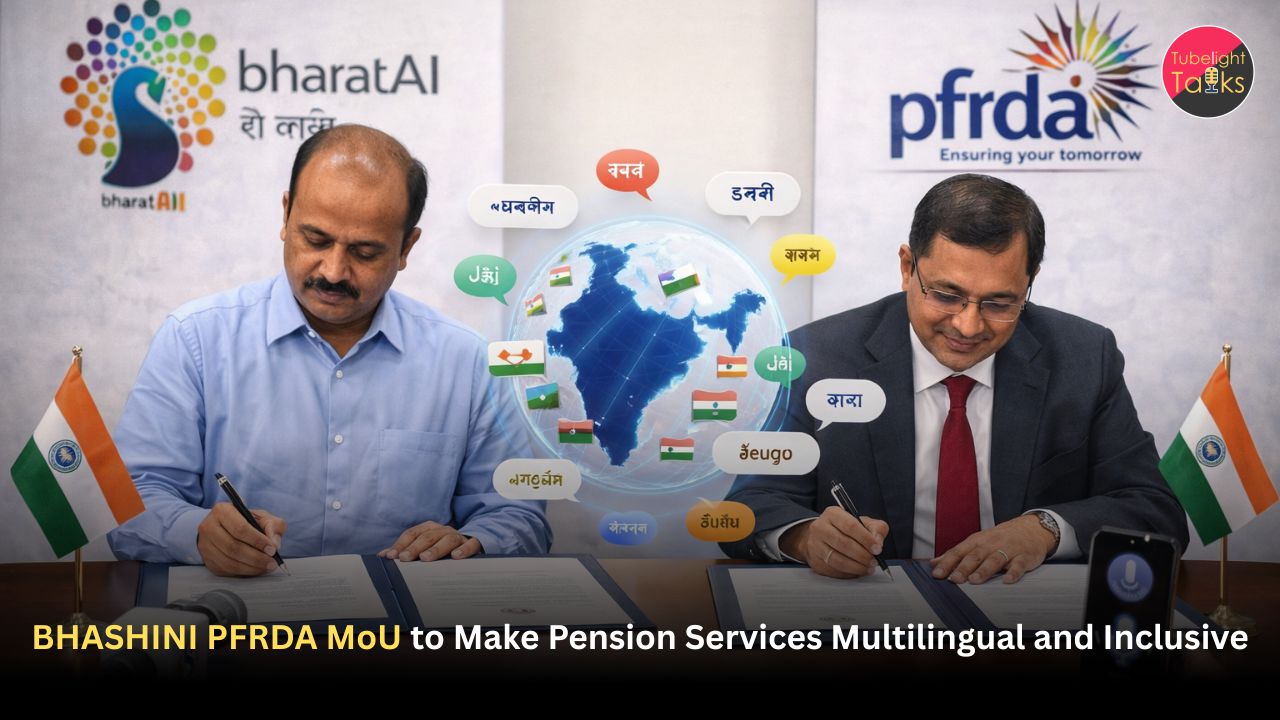
BHASHINI PFRDA MoU Marks Step Toward Inclusive Multilingual Pension Services
India’s digital governance push has added an important people-first milestone with the signing of the BHASHINI PFRDA MoU between the Digital India BHASHINI Division and the Pension Fund Regulatory and Development Authority. Signed under the “BHASHINI for Seva / Sanchalan” programme, the agreement is designed to bring multilingual, AI-supported, and voice-enabled capabilities into the pension ecosystem.
In practical terms, it means pension-related communication, interfaces, and digital interactions are set to become easier to access for users across multiple Indian languages. That makes this not just a tech story, but a governance and inclusion story too.
What the new BHASHINI–PFRDA agreement actually does
A multilingual layer is being added to pension services
According to the official announcement, the MoU creates a framework for integrating BHASHINI translation APIs, multilingual AI models, and voice-enabled technologies with PFRDA systems. The aim is to improve language accessibility across digital platforms and user interfaces in the pension sector. That means this is not a symbolic tie-up. It is intended as a working integration of language technology into actual pension-service delivery.
The coverage goal is nationwide and linguistically broad
The initiative seeks to strengthen access across all 22 languages listed in the Eighth Schedule of the Constitution within PFRDA’s communication and operational systems. That is a major design choice because it places language inclusion at the center of pension access rather than treating it as an add-on. For many subscribers and stakeholders, language is the first barrier, not the last one. This MoU directly targets that barrier.
Why this matters in real life
Pension access often depends on clarity, not just eligibility
A pension system may exist on paper, but it becomes truly useful only when people can understand notices, interfaces, instructions, and support responses. The official release says the collaboration is meant to improve communication across digital platforms and user interfaces in pension services. That matters because pension users often need clarity on enrolment, withdrawals, grievance handling, account information, and long-term planning. Better language access can reduce confusion and make the system feel less distant.
Voice-enabled tools can widen access further
The MoU does not stop at text translation. It also includes voice-enabled technologies and multilingual AI models. That is important because inclusion is not only about reading language; it is also about interacting with systems more naturally. A voice-first or voice-assisted layer can make pension services more usable for people who are less comfortable with typed digital workflows. This is an inference from the official emphasis on voice-enabled technologies and multilingual communication tools.
Why BHASHINI is becoming important in public service delivery
It is being positioned as language infrastructure for governance
The official PIB release describes BHASHINI as India’s national language digital public infrastructure and says this MoU reinforces its role as a population-scale language infrastructure supporting inclusive, secure, and interoperable multilingual AI systems across governance and financial-service sectors. That framing is important because it shows BHASHINI is being treated not as a niche software layer, but as a public digital utility for citizen access.
The partnership reflects a larger governance direction
This agreement suggests that digital public services in India are moving toward language-sensitive design rather than one-language-first design. When pension services become multilingual by default, the message is larger than pensions alone. It signals that public-facing digital systems may increasingly be judged by how well they serve citizens in the language they prefer. That is an inference based on the official language used to describe this MoU and BHASHINI’s role.
Also Read: India–France Defence Partnership Enters New Era with Focus on AI and Advanced Military Technology
What the officials said
PFRDA Executive Director Mamta Rohit said language barriers must be overcome if pension systems are to scale effectively, and she linked the BHASHINI platform to reaching people in their preferred languages and improving financial inclusion.
BHASHINI CEO Amitabh Nag said the collaboration would expand multilingual and voice-enabled access in critical financial services and bring citizen-centric digital governance closer to every Indian. Those statements show that both sides are presenting the MoU as an inclusion-led reform, not just a technology deployment.
Why this can matter for senior citizens and first-time pension users
The official release specifically says the platform can help reach first-time savers and those who may have remained outside formal retirement planning because of linguistic constraints. That is a particularly important line because it links language accessibility to financial inclusion. The pension system becomes stronger not only when existing users get better service, but when new users feel able to enter and navigate it confidently.
Inclusive Service
Teachings associated with Sant Rampal Ji Maharaj emphasize equality, compassion, and service that reaches people without discrimination. In that spirit, a multilingual pension system reflects an important human principle: public systems should not become difficult simply because someone speaks a different language. When governance becomes easier to understand, it becomes more humane.
That is how technology serves society best—when it removes distance, not when it creates new barriers. This is a spiritual reflection, not a policy claim.
Call to Action
The BHASHINI–PFRDA MoU deserves attention because it addresses a practical problem that affects everyday access: language. Policymakers, financial-service institutions, and digital-governance teams should treat this as a model worth expanding.
The success of public technology should not be measured only by launch announcements, but by whether ordinary people can understand and use it with confidence. In pension services especially, clarity is dignity.
FAQs: BHASHINI and PFRDA Sign Landmark MoU to Make Pension Services Multilingual and More Inclusive
1. What is the new BHASHINI–PFRDA MoU about?
It is a new agreement to integrate BHASHINI’s translation APIs, multilingual AI models, and voice-enabled tools into PFRDA systems to improve pension-service accessibility.
2. Under which initiative was the MoU signed?
It was signed under “BHASHINI for Seva / Sanchalan,” described as a BHASHINI Sahayogi programme.
3. How many languages is the initiative meant to support?
The official release says it aims to strengthen multilingual access across all 22 languages listed in the Eighth Schedule of the Constitution.
4. Which technologies are being introduced into pension services?
The MoU mentions translation APIs, multilingual AI models, and voice-enabled technologies.
5. Why is this important for pension users?
Because it can improve communication across digital platforms and interfaces, making pension services easier to understand and use in preferred Indian languages.
6. What broader role is BHASHINI being given here?
The government describes BHASHINI as India’s national language digital public infrastructure and says this MoU strengthens its role in inclusive multilingual governance and financial services.
Related Stories



Discussion (0)