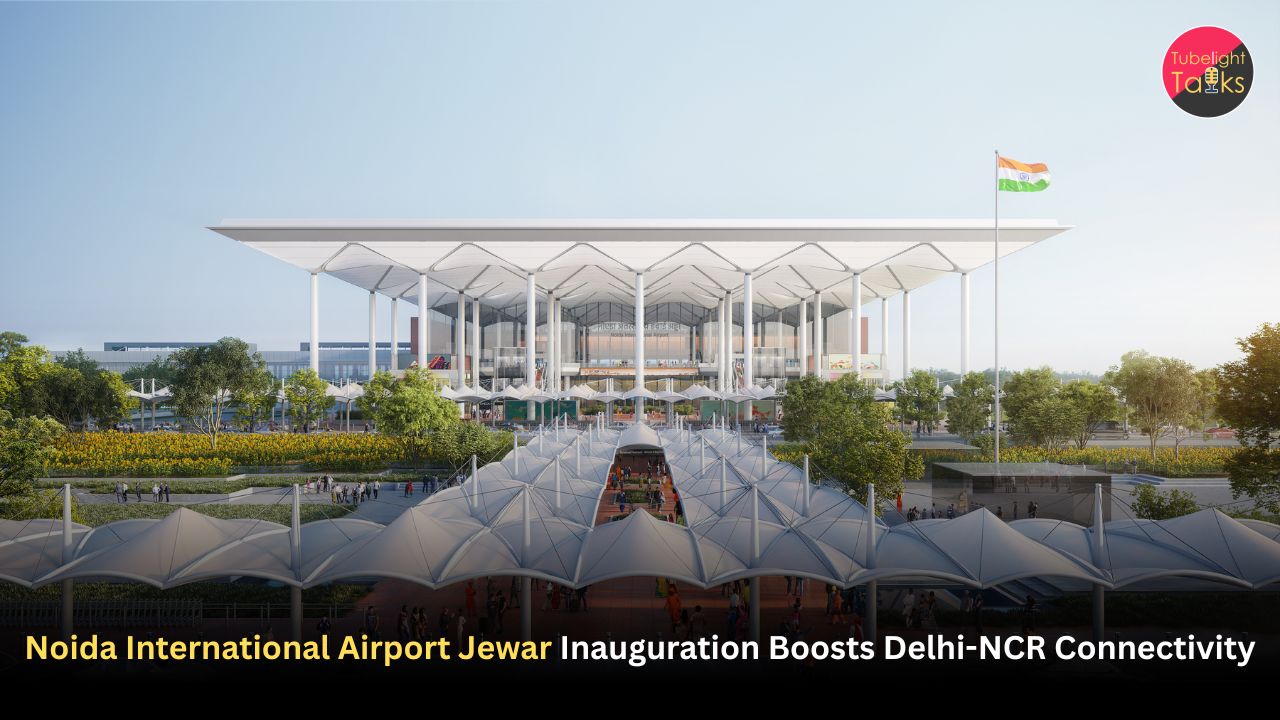
Noida International Airport Jewar Opens New Aviation Chapter for Delhi-NCR
Prime Minister Narendra Modi is scheduled to inaugurate Phase I of the Noida International Airport Jewar today, March 28, 2026, in Gautam Buddha Nagar, Uttar Pradesh. According to the official PMO release, he is set to undertake a walkthrough of the terminal around 11:30 AM and formally inaugurate the airport around 12 noon. The launch marks the opening of one of India’s largest greenfield airport projects and a major addition to the National Capital Region’s transport network.
This inauguration matters because the airport has been planned as Delhi-NCR’s second international airport, complementing Indira Gandhi International Airport rather than competing with it. The PMO says the two airports are expected to function as an integrated aviation system, easing congestion, expanding passenger capacity, and strengthening the region’s global connectivity. That makes today’s launch more than a ribbon-cutting event. It is a strategic shift in how the NCR prepares for future air traffic growth.
Why the Jewar airport launch is such a big infrastructure moment
Noida International Airport has been developed as a major new gateway for both passengers and cargo. The official release says Phase I has been built with an investment of around ₹11,200 crore under a public-private partnership model. It is designed to handle 12 million passengers annually in the first phase, with scalability up to 70 million passengers per annum over time.
The airport also brings strong operational capability from the start. The PMO says it includes a 3,900-metre runway capable of handling wide-body aircraft, modern navigation systems including Instrument Landing System, and advanced airfield lighting to support all-weather, round-the-clock operations. That means the project has been built not just for ceremonial significance, but for heavy real aviation use from the beginning.
How this changes the Delhi-NCR aviation map
Delhi-NCR has long depended overwhelmingly on IGI Airport, one of India’s busiest aviation hubs. The official PMO release and current news coverage both say Jewar has been planned specifically to ease congestion at IGI and add capacity for a region whose passenger and cargo needs keep rising.
That matters because airport congestion affects everything from flight scheduling and airline expansion to regional business travel and logistics. A second international airport gives NCR more flexibility, more room for future growth, and greater resilience in handling traffic surges.
In practical terms, Jewar is expected to reduce pressure on Delhi while also bringing aviation access closer to parts of western Uttar Pradesh and the Yamuna Expressway corridor. This is an inference from the PMO’s description of the airport’s role as a complementary second international airport for NCR.
Also Read: Air India’s West Asia Rescue Mission Shows Civil Aviation as Crisis Lifeline
Uttar Pradesh’s bigger aviation story
The airport is also politically and economically significant for Uttar Pradesh. Current Indian media coverage is widely framing the launch as a major leap in the state’s aviation network, with reports saying Jewar’s opening makes Uttar Pradesh the only Indian state with five international airports. I am treating that as media-reported context because the PMO release I reviewed does not itself state that count.
Even without that broader count, the scale of the project is enough to mark a clear state-level milestone. The airport is positioned not only as a transport facility but as an economic anchor for industrial growth, logistics, warehousing, and investment in the surrounding region. That expectation is supported by the project’s cargo focus and multi-modal design.
More than a passenger airport: cargo, logistics and connectivity
One of the most important but less publicly discussed features of the airport is its cargo ecosystem. The PMO says the project includes a Multi-Modal Cargo Hub with an Integrated Cargo Terminal and logistics zones designed to handle over 2.5 lakh metric tonnes annually in the first stage, expandable to around 18 lakh metric tonnes. It also includes a dedicated 40-acre Maintenance, Repair and Overhaul facility.
This gives Jewar a role beyond passenger travel. It can become a logistics and trade enabler for the NCR and western UP, especially for high-value freight, export-linked manufacturing, and time-sensitive cargo movement. That could make its long-term economic effect much larger than a simple airport-capacity story. This is an inference based on the official description of the cargo and MRO infrastructure.
A multi-modal, future-facing project
The official release emphasizes that the airport has been planned as a multi-modal transport hub with integration across road, rail, metro and regional transit systems. It is strategically located along the Yamuna Expressway, and the design aims to connect passenger travel with wider mobility networks.
That matters because modern airports no longer succeed on runway capacity alone. Their real strength depends on how easily people and goods can move in and out. Jewar’s long-term success will therefore depend not just on the terminal and runway, but on whether the promised surrounding connectivity matures on schedule. This is an inference from the PMO’s multi-modal emphasis.
Sustainability is part of the airport’s identity
The PMO also says the airport has been designed as a sustainable, future-ready infrastructure project aiming to operate as a net-zero emissions facility. It highlights energy-efficient systems and environmentally responsible practices, along with architecture inspired by Indian heritage.
That gives the project a second layer of ambition. Jewar is being positioned not only as a capacity solution, but as a model of next-generation airport design. Whether that ambition is fully realized will depend on operations over time, but the intent is clearly built into the project narrative from day one. This is an inference from the official sustainability language.
The symbolism of today’s inauguration
Infrastructure inaugurations often carry symbolic weight, but Jewar’s launch has unusually broad significance. It touches aviation, regional growth, logistics, investment, urban expansion, and state-level political branding all at once. The airport’s opening is being presented as a sign that India is building not just more airports, but larger and more integrated aviation ecosystems.
For the Delhi-NCR region, the symbolism is straightforward: one airport is no longer enough for the scale of growth being planned. For Uttar Pradesh, the symbolism is equally strong: connectivity is now central to its development story, and Jewar is being used to signal that shift in a visible way. This is an inference from the official framing and current news coverage.
The value of public infrastructure
Teachings associated with Sant Rampal Ji Maharaj emphasize service, welfare, and the idea that progress should benefit society in meaningful ways. In that spirit, infrastructure becomes truly valuable when it reduces hardship, improves access, and serves people rather than standing only as a display of scale.
A project like Jewar carries its deepest value not in ceremony, but in how honestly and effectively it serves travelers, workers, businesses, and ordinary families in the years ahead. This is a spiritual reflection, not a factual claim.
Call to Action
The inauguration of Noida International Airport is a major national and regional milestone, but its long-term success will depend on execution after the ceremony: operational readiness, connectivity, affordability, safety, and whether the promised relief to Delhi-NCR’s aviation burden actually materializes. Citizens should watch the project as a public asset, not just an event.
FAQs: Noida International Airport Jewar
1. What is happening at Jewar today?
Prime Minister Narendra Modi is scheduled to inaugurate Phase I of Noida International Airport at Jewar in Gautam Buddha Nagar on March 28, 2026.
2. What time is the inauguration scheduled?
The PMO says he is expected to undertake a terminal walkthrough around 11:30 AM and inaugurate the airport around 12 noon.
3. Why is this airport important for Delhi-NCR?
It has been developed as the second international airport for the Delhi-NCR region and is meant to complement IGI Airport by easing congestion and expanding capacity.
4. How big is Phase I of the project?
Phase I has been developed with an investment of around ₹11,200 crore and an initial capacity of 12 million passengers per annum.
5. Does the airport also include cargo infrastructure?
Yes. The PMO says it includes a multi-modal cargo hub designed to handle over 2.5 lakh metric tonnes annually, expandable to around 18 lakh metric tonnes, plus a dedicated MRO facility.
6. Does this make Uttar Pradesh the first state with five international airports?
Current Indian media reports are widely describing it that way. I have treated that point as media-reported context because the official PMO release I reviewed does not itself state the five-airport count.
Related Stories









Discussion (0)