Operation Urja Suraksha: Why India Is Using Naval Power to Protect Energy Stability Amid the Hormuz Crisis
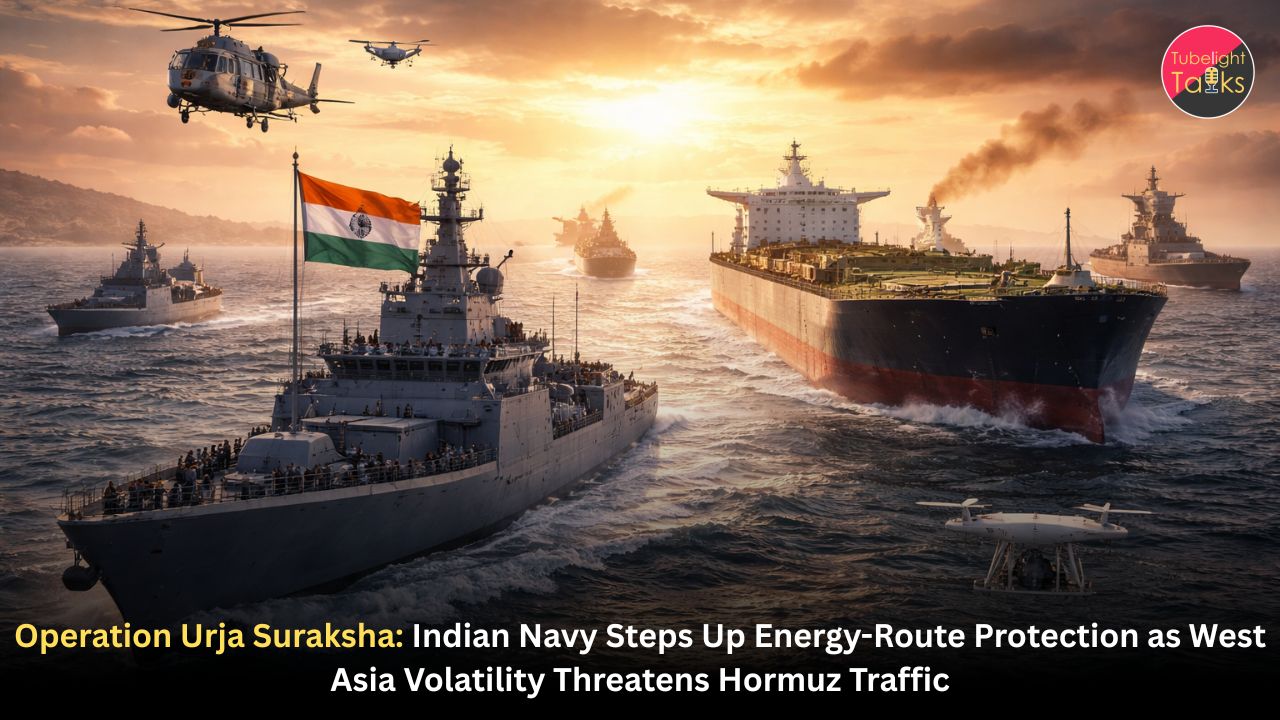
India’s response to the West Asia conflict is no longer limited to diplomacy and domestic fuel management. It now includes visible maritime protection. According to a detailed Times of India report citing defence-establishment and DG Shipping sources, the Indian Navy has launched Operation Urja Suraksha, deploying more than five frontline warships to help ensure the safe movement of India-bound cargo vessels after they exit the Strait of Hormuz.
The report says the mission focuses on protecting ships carrying critical supplies such as crude oil, LPG and LNG. That reported naval deployment fits the broader national strategy outlined by the Prime Minister’s Office after PM Modi’s March 27 video-conference meeting with Chief Ministers and Lieutenant Governors.
The PMO said the government’s priorities are to maintain economic and trade stability, ensure energy security, safeguard citizens’ interests, and strengthen industry and supply chains. Modi also asked states to work in constant coordination with the Centre, stay alert against hoarding and profiteering, and keep control rooms active at state and district levels.
What Operation Urja Suraksha is reported to be doing
The clearest current description comes from Indian media reporting. Times of India says the Navy’s warships are positioned in the Gulf of Oman and begin escort and guidance duties after India-bound cargo vessels clear the Strait of Hormuz. The same report says the mission is meant to move ships out of the troubled zone and toward the Arabian Sea under a layered-security arrangement.
That detail matters because it shows India is not claiming control over Hormuz itself. Instead, the reported operational model is to take over protection once vessels emerge from the chokepoint and enter waters where Indian naval presence can more actively secure their onward movement. This is an inference from the reported escort pattern and the geographic references in the Times of India report.
How many ships are involved, and what is at stake
Times of India reported on March 26 that there were 20 India-bound cargo vessels stranded near the Strait because of the conflict, and that the operation was focused on securing their onward movement. Reuters had separately reported on March 24 that 24 Indian-flagged ships, including eight LPG carriers, had been stranded in the Persian Gulf during the crisis, with two already returned and more expected to move as conditions allowed.
Taken together, these reports show a large and serious maritime exposure, even if the exact count varies depending on whether one is talking about India-bound cargo, Indian-flagged ships, or ships already moved out.
This is why the mission matters so much. These are not ordinary cargoes. Reuters described the situation as India’s worst gas crisis in decades, with the country urgently loading LPG onto stranded vessels and trying to keep essential energy flows alive. India imports about 60% of its cooking-gas demand, and around 90% of those imports had been coming from the Middle East before the war disruption.
The mission follows a “Team India” domestic preparedness push
The naval response did not emerge in isolation. On March 27, PM Modi chaired a meeting with Chief Ministers and Lieutenant Governors to review preparedness in light of recent developments in West Asia. According to the PMO, he said the situation remains dynamic and requires continuous monitoring and adaptive strategies. He stressed the need for vigilance, smooth functioning of supply chains, strong action against hoarding, and special attention in border and coastal states to shipping, essential supplies and maritime operations.
The PMO also said the Centre’s inter-ministerial group has been operational since March 3 and that states welcomed the decision to increase commercial LPG allocation to 70% of pre-crisis levels. So the broader picture is now clear: India is using three layers of response at once — diplomacy to keep routes open, economic measures to soften domestic pain, and naval protection to reduce the risk to actual energy cargo movement. That is an inference from the PMO statement, the LPG measures, and the reported naval deployment.
Hormuz remains the central vulnerability
The need for such a mission comes from the extreme fragility of the Strait of Hormuz. Reuters reported earlier this week that two India-bound LPG tankers carrying more than 92,000 tonnes of LPG had managed to pass through the strait, but that most ships were still stuck and traffic remained severely disrupted. Reuters also reported on March 24 that PM Modi and Donald Trump discussed the importance of keeping Hormuz open, while Modi stressed de-escalation and peace restoration.
This means Operation Urja Suraksha, as currently reported, is best understood as a damage-limitation measure in a shipping environment that remains highly unstable. It is not proof that the crisis is solved. It is proof that India believes the crisis is serious enough to justify naval risk management around its energy lifeline. This is an inference based on the continuing Reuters reporting on stranded ships and disrupted Hormuz traffic.
Reported early successes and the message they send
Times of India reported that the LPG carriers Pine Gas and Jag Vasant had already passed through the Strait under naval protection, carrying nearly 92,000 tonnes of LPG and heading toward Indian ports. Reuters had also reported these two India-bound tankers successfully transited Hormuz earlier in the week. That overlap between Reuters’ shipping report and TOI’s mission report suggests that India is gradually building a protected corridor strategy for vital cargo movement, even if not every ship can yet move normally.
That matters for public confidence. If the government can show that some crucial LPG and energy cargo is still reaching India despite war conditions, it helps calm both markets and consumers. But it also shows how narrow the margin still is: each successful passage is being treated almost like an operation in itself. This is an inference drawn from the prominence given to individual tanker movements in current reporting.
Also Read: Gulf Security Crisis Deepens as Kuwait Hit and UAE Intercepts Missiles
What this says about India’s wider strategy
India appears to be building a layered doctrine for this crisis. The Prime Minister’s official remarks emphasized state coordination, anti-hoarding vigilance, and protecting energy security. The petroleum response has already included higher commercial LPG allocations and excise-duty cuts. Now, according to Indian media, the Navy is adding an escort-and-guidance layer to help critical cargo move after Hormuz transit.
In effect, India is trying to make sure that the West Asia war does not turn into a full domestic energy and confidence crisis. That is why the story is bigger than just five warships or one operation name. It is about how a major importer protects itself when a global chokepoint becomes unstable. This is an analytical conclusion based on the combined official and reported responses.
The duty to protect life and stability
Teachings associated with Sant Rampal Ji Maharaj place strong emphasis on social responsibility, compassion, honesty and protection of human welfare. Official material linked to these teachings presents spirituality as inseparable from responsibility toward society. In that spirit, safeguarding essential supplies and protecting lives during a crisis reflects a deeper moral duty: strength is most meaningful when it is used to reduce suffering and preserve stability for ordinary people.
Call to Action
In a crisis like this, the most useful signals are concrete ones: how many ships are moving, whether LPG and crude supplies remain stable, what the government is officially saying, and whether states are preventing panic and profiteering.
Rumor about shortages can become almost as damaging as shortages themselves. The PMO has explicitly warned against misinformation and urged states to maintain public confidence through credible information and administrative alertness.
FAQs: Operation Urja Suraksha: Indian Navy Steps Up Energy-Route Protection as West Asia Volatility Threatens Hormuz Traffic
1. What is Operation Urja Suraksha?
According to Indian media reports, it is an Indian Navy mission involving more than five frontline warships to help secure India-bound cargo vessels after they exit the Strait of Hormuz, especially ships carrying crude oil, LPG and LNG.
2. Is there an official government statement naming the mission?
I found official PMO communication about India’s broader West Asia preparedness and energy-security response, but I did not find an official Navy or PIB release in the reviewed sources that independently confirmed the mission name. The specific operation name and escort details currently come from Indian media reporting.
3. How many vessels are involved?
Times of India reported 20 India-bound cargo vessels stranded near the Strait on March 26, while Reuters reported 24 Indian-flagged ships stranded in the Gulf on March 24. These figures refer to slightly different categories, but both indicate major Indian shipping exposure.
4. Why is this operation important for India?
Because India remains heavily exposed to Gulf energy routes, and disruption in Hormuz directly affects crude, LPG and LNG movement, domestic supply planning, and inflation risk.
5. Did PM Modi actually hold the “Team India” meeting with Chief Ministers yesterday?
Yes. The PMO said Modi chaired a video-conference meeting with Chief Ministers and Lieutenant Governors on March 27 to review preparedness related to the West Asia crisis and stressed vigilance, coordination, energy security, and protection against hoarding and misinformation.
6. Has any India-bound energy cargo already moved successfully?
Yes. Reuters reported that two India-bound LPG tankers passed through Hormuz earlier in the week, and Times of India reported the same vessels, Pine Gas and Jag Vasant, as early successes under the current naval-protection effort.
Related Stories





Discussion (0)