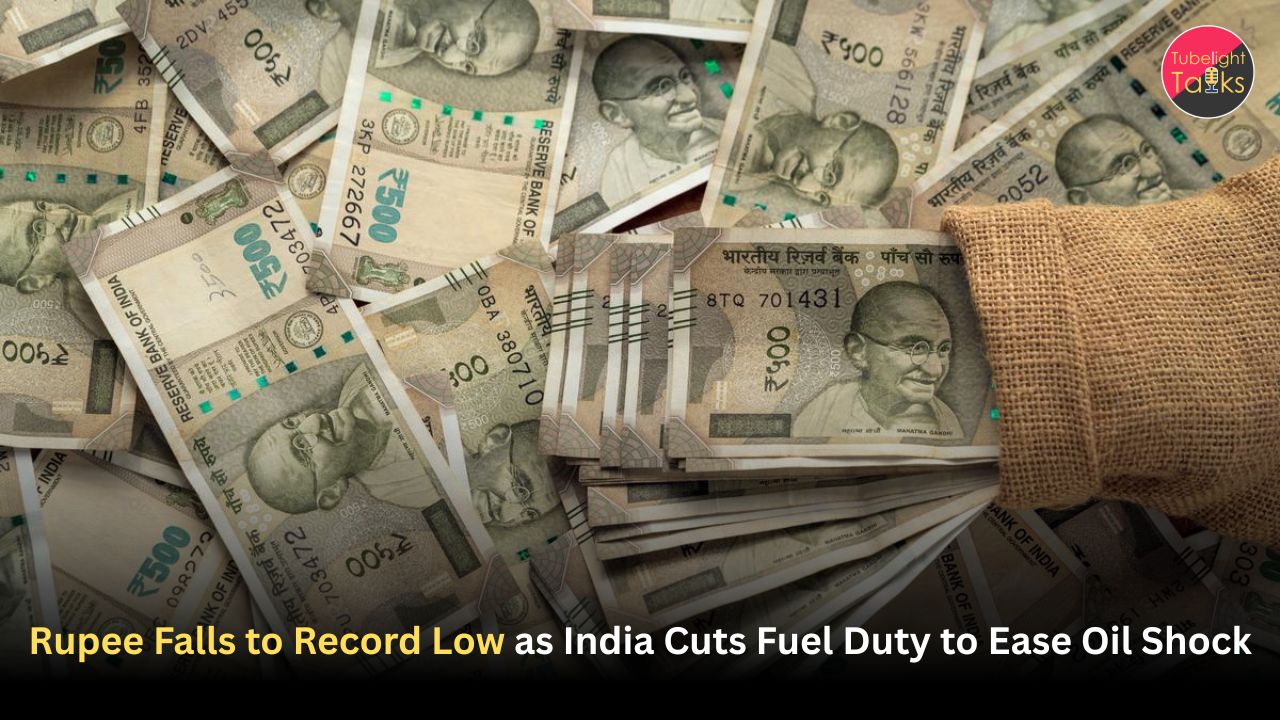
Rupee Falls to Record Low as India Activates Fuel Relief Measures
India’s economic response to the West Asia crisis is now visible in both the currency market and fuel policy, as the rupee falls to record low levels. Reuters reported on March 27 that the rupee fell past 94 per U.S. dollar to a record low of 94.1575 during the session as fears of a prolonged Iran war deepened energy risks. By the end of March 27 trading, Reuters reported the rupee weakened further and closed at 94.8125, underscoring how quickly pressure intensified.
At the same time, the government has moved to absorb part of the oil shock. Reuters reported that India implemented a government order cutting the special additional excise duty on petrol to ₹3 per litre from ₹13 and reducing the diesel duty to zero from ₹10. That means the broad policy response described yesterday has now become an active tax change.
Why the rupee is falling so sharply
The biggest driver is energy risk. Reuters said the rupee’s slide is being fueled by the prospect of a prolonged Iran war, Brent crude staying above $100 a barrel, and India’s vulnerability as a large energy importer. When oil rises this sharply, India’s import bill worsens, inflation fears rise, and investors become more cautious about Indian assets.
Foreign money leaving Indian markets is making the fall worse. Reuters reported that foreign investors have sold Indian assets at a record pace since the conflict intensified, which has added to pressure on the rupee. So the currency weakness is not coming from one source alone. It is being driven by oil, risk aversion, and capital outflows at the same time.
What the fuel-duty move actually changes
The government’s tax move is large and deliberate. Reuters reported the cut brings petrol duty down by ₹10 per litre and removes the diesel duty entirely. This is meant to reduce the shock that high global crude prices would otherwise impose on consumers and oil companies.
But there is an important nuance. Economic Times reported that retail petrol and diesel prices will not automatically fall just because the duty has been cut. The official position is that current retail prices will remain unchanged, meaning the tax reduction is being used mainly to absorb upstream pressure rather than create an immediate pump-price cut for consumers.
Also Read: India Faces LPG Crisis in India as Supply Shock and Rupee Slide Raise Inflation Concerns
So is this consumer relief or system stabilization?
It is more accurate to call it shock absorption. The government appears to have chosen to protect the broader fuel system from a sharper crisis rather than pass through a clean retail benefit right away. Times of India reported that Petroleum Minister Hardeep Singh Puri described the move as a way to shield citizens and absorb the burden at the government level.
That makes the policy politically and economically significant. If the government had not cut duties, the pressure on oil marketing companies and domestic inflation could have become more severe. So the relief is real, but it is working in a less visible way than a simple price cut at the pump. This is an inference based on Reuters’ tax report and ET’s report that pump prices will remain unchanged.
Why diesel matters even more than petrol
Diesel has a wider effect on the economy because it influences freight, farm operations, logistics and supply chains. Cutting the diesel duty to zero is therefore not only a transport decision, but also an inflation-management decision. If diesel costs jump hard, the impact spreads into food prices, distribution and broader consumer costs. This is an inference grounded in diesel’s role in the economy and the government’s stated intent to limit the oil shock.
The fiscal cost will not be small
There is a price for this protection. Economic Times reported that the excise-duty cut could cost the exchequer about ₹7,000 crore in just two weeks, according to the CBIC chief. That shows the government is accepting a meaningful revenue sacrifice to prevent the external oil shock from causing deeper domestic damage.
Finance Minister Nirmala Sitharaman has also signaled that the government is staying watchful on the fiscal side even while trying to protect consumers from rising crude prices. That means the next phase of this story will be about balancing inflation relief with fiscal discipline.
One important correction on the policy process
The current reporting I found does not show that this fuel-duty change was implemented specifically “as passed in the Finance Bill 2026.” Reuters says it was implemented through a government order issued by the finance ministry late on Thursday. So the safe and accurate way to describe it is that the cut has now been officially implemented by order, not that I have verified it as a direct Finance Bill 2026 implementation clause.
Steadiness in economic uncertainty
Teachings associated with Sant Rampal Ji Maharaj emphasize steadiness, restraint and truthful living in times of uncertainty. A falling currency and rising fuel stress remind people how unstable external systems can be. In that spirit, Sat Gyaan points toward inner balance and responsible conduct rather than fear-driven reaction. This is a spiritual reflection, not an economic forecast.
FAQs: Rupee Falls to Record Low
1. Did the rupee really hit a record low?
Yes. Reuters reported the rupee moved to a record low of 94.1575 on March 27, and later reported it closed weaker at 94.8125.
2. Why is the rupee weakening?
Reuters says the main reasons are the prolonged Iran-war risk, high crude prices, and foreign investors pulling money out of Indian assets.
3. What fuel-duty changes has the government implemented?
Reuters reported the special additional excise duty on petrol was cut to ₹3 per litre from ₹13, and the diesel duty was reduced to zero from ₹10.
4. Will petrol and diesel prices fall immediately?
Not necessarily. Economic Times reported that retail petrol and diesel prices will remain unchanged despite the ₹10-per-litre tax cut.
5. Is this definitely part of the Finance Bill 2026 implementation?
I did not verify that exact linkage from the sources reviewed. Reuters describes the change as being implemented through a finance ministry government order.
6. What is the government trying to achieve?
It is trying to cushion consumers and oil companies from the global oil shock while limiting inflation and keeping the fuel system stable. That conclusion is supported by Reuters and current ministerial reporting.
Related Stories









Discussion (0)