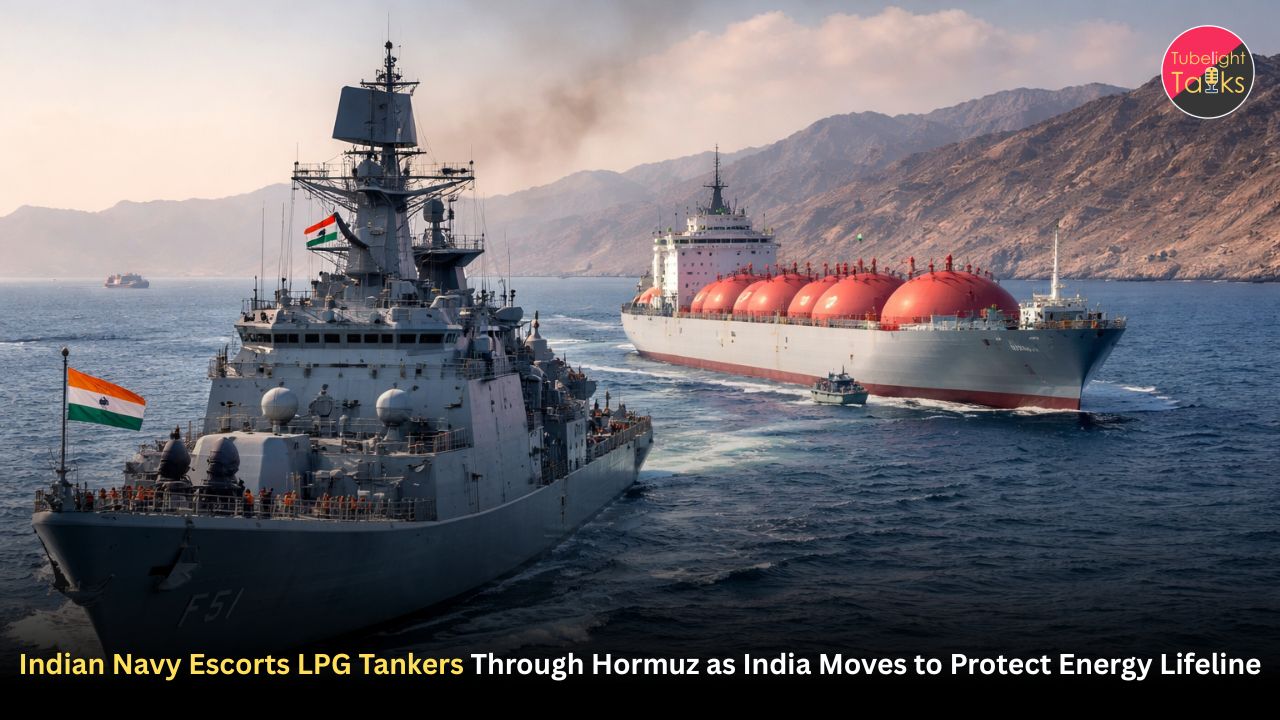
Indian Navy Escorts LPG Tankers Safely Through Volatile Strait of Hormuz
Indian Navy Escorts LPG Tankers: India’s energy-security strategy is no longer only about diplomacy and domestic fuel management. It is now visibly maritime. Reuters reported on March 28 that two India-bound LPG tankers, BW Elm and BW Tyr, were transiting the eastern Strait of Hormuz amid heightened tensions. That development came after earlier successful movements of India-bound LPG carriers and amid a continuing effort to move stranded energy cargo out of the Gulf.
The significance of this movement becomes clearer when read together with an earlier Reuters report from March 13. That report said Iran had allowed two Indian-flagged LPG tankers, Shivalik and Nanda Devi, to sail toward India through Hormuz, and it specifically said Shivalik passed through the strait under Indian Navy escort. That is the strongest wire-service confirmation in the reviewed sources that Indian naval escort has already played a direct role in protecting LPG movement through the chokepoint.
Why this matters so much for India
Hormuz is not just another shipping corridor for India. It is one of the country’s most critical energy lifelines. Reuters has reported that India imports about 60% of its LPG needs, and around 90% of those imports had been coming from the Middle East before the present crisis. When Hormuz becomes unstable, India does not face an abstract foreign-policy problem. It faces a direct risk to cooking gas supply, fuel planning, freight costs, inflation and public confidence.
That is why even a small number of successful tanker passages matters. Each tanker getting through safely reduces pressure on India’s energy system. Each delay or stranding increases the sense of crisis. Reuters reported that India has been dealing with its worst gas crunch in decades and has had to prioritize household LPG supplies over industrial consumption.
Also Read: Fuel Excise Duty Cut India as Government Expands LPG Supply Amid Oil Shock
What the current tanker movement shows
Reuters’ March 28 report said India was gradually moving its stranded LPG cargoes out of the Gulf and had already successfully dispatched four tankers — Shivalik, Nanda Devi, Pine Gas and Jag Vasant — before the current movement of BW Elm and BW Tyr. That means India is no longer relying on one-off exception passages. It is trying to establish a pattern of cautious but continuing movement through a very fragile corridor.
At the same time, the crisis is far from over. Reuters said 20 Indian-flagged vessels, including five LPG carriers, still remained stranded in the Gulf as of March 28. So the story is not that India has solved the Hormuz problem. The story is that India is actively managing it ship by ship, with naval support, diplomatic engagement and emergency cargo planning all working together. This is an inference based on the vessel count and the sequence of successful crossings.
The Navy’s role is part of a bigger national response
The maritime protection effort fits into the broader response led by the Centre. After PM Modi’s March 27 meeting with Chief Ministers, the PMO said India’s priorities include energy security, economic and trade stability, shipping and maritime operations, and constant coordination between the Centre and states. The official readout also stressed vigilance, anti-hoarding measures and uninterrupted essential supplies.
That official language matters because it shows the government is treating shipping risk as part of a whole-of-system crisis response. Maritime protection is not happening in isolation. It sits alongside higher LPG allocation, tax changes on fuels, diplomatic outreach and state-level preparedness. The Navy’s escort role therefore represents one arm of a larger energy-stability strategy. This is an inference supported by the PMO readout and current energy-shipping reporting.
A note on “Operation Urja Suraksha”
Indian media reports, especially Times of India, have described the naval effort under the name Operation Urja Suraksha and said more than five frontline warships have been deployed to help guide India-bound cargo after vessels clear Hormuz.
In the reviewed sources, I found that description in Indian media reporting, but I did not find an official Indian Navy or PIB release independently confirming the operation name. So the escort activity is well-supported, but the specific mission label should be treated as media-reported unless officially published later.
Why this is bigger than one shipping story
When the Indian Navy helps secure LPG carriers through Hormuz, it is doing more than protecting two vessels. It is helping preserve domestic energy confidence. A safe passage today can mean reduced panic tomorrow, fewer supply fears next week, and less inflationary stress if cargo keeps moving.
In a crisis like this, maritime security becomes household economics very quickly. This is an inference from India’s LPG dependence and the government’s broader crisis-management posture.
The duty to protect essential life systems
Teachings associated with Sant Rampal Ji Maharaj emphasize responsibility, compassion and the protection of human welfare. In that spirit, safeguarding essential supplies during a crisis reflects a deeper moral duty. Strength is most meaningful when it is used to preserve stability, reduce suffering and protect ordinary households from fear and disruption.
FAQs: Indian Navy Escorts LPG Tankers Through Hormuz as India Moves to Protect Energy Lifeline
1. Are Indian LPG tankers actually moving through Hormuz right now?
Yes. Reuters reported on March 28 that two India-bound LPG tankers, BW Elm and BW Tyr, were transiting the eastern Strait of Hormuz.
2. Has the Indian Navy really escorted LPG tankers there?
Yes. Reuters reported on March 13 that the Indian-flagged LPG tanker Shivalik passed through Hormuz under Indian Navy escort.
3. Which tankers had already moved successfully before the latest pair?
Reuters said India had already dispatched Shivalik, Nanda Devi, Pine Gas and Jag Vasant before BW Elm and BW Tyr.
4. How many Indian-flagged ships are still stranded in the Gulf?
Reuters reported that 20 Indian-flagged vessels, including five LPG carriers, remained stranded as of March 28.
5. Why is Hormuz so important to India?
Because India depends heavily on Middle East energy imports. Reuters reported that around 60% of India’s LPG demand is met by imports, and roughly 90% of those imports had been coming from the Middle East.
6. Is “Operation Urja Suraksha” officially confirmed?
I found that name in Indian media reports, but not in an official Navy or PIB release among the reviewed sources. The escort activity itself is supported; the operation name is currently best treated as media-reported.
Related Stories










Discussion (0)