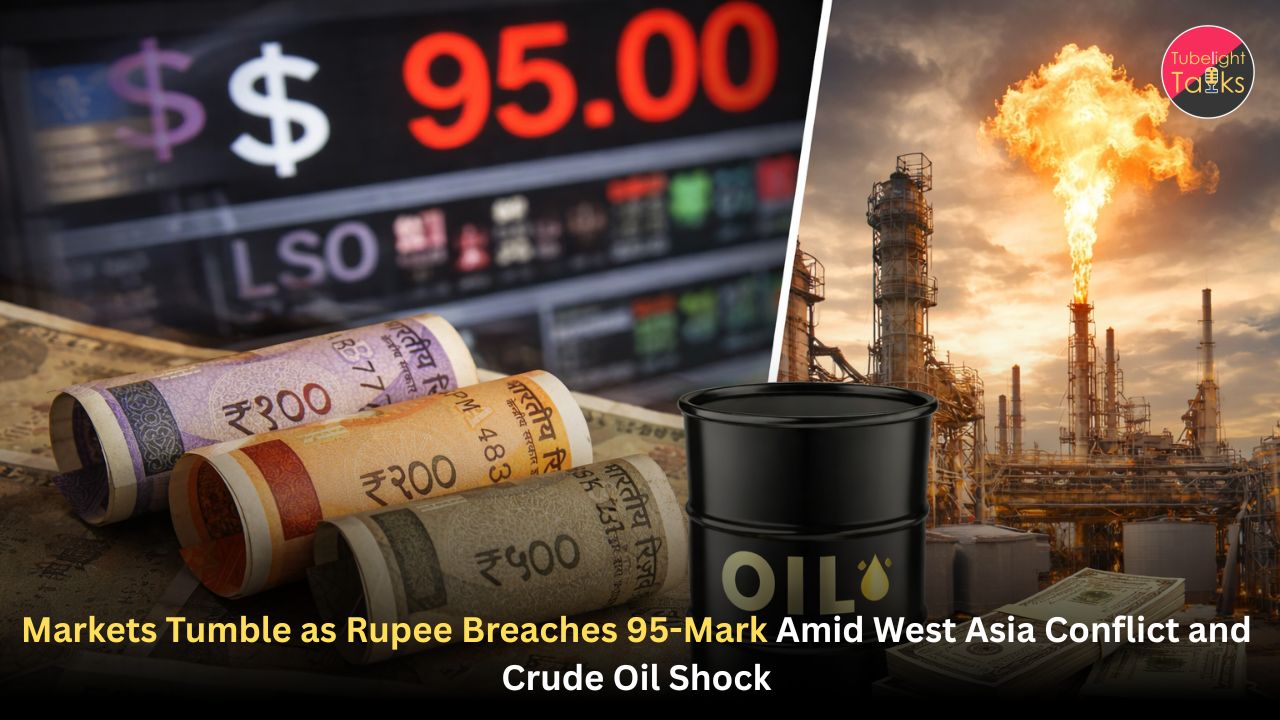
Markets Reel as Rupee Breaches 95-Mark, but the Bigger Story Is India’s Oil Shock Exposure
Rupee Breaches 95-Mark: India’s financial markets closed FY 2025-26 under severe pressure as the rupee breached the 95-per-dollar mark for the first time and equities registered their weakest fiscal-year performance since 2020. The trigger was not one isolated event. It was a damaging combination of rising crude oil prices, escalating conflict in West Asia, heavy foreign investor outflows, and weakening confidence in India’s near-term external balance.
There is one factual caution, though: while the crash was undeniably sharp, the most strongly verified descriptions from major reporting are “worst March in six years” and “worst fiscal year since 2020,” rather than a firmly established “two-year low.” That distinction matters in serious financial reporting.
The Rupee Breach Was Real, Historic, and Symbolically Important
95 per dollar is more than a number
On March 30, 2026, the Indian rupee fell to a record intraday low of 95.21 against the U.S. dollar before recovering somewhat to close around 94.83, according to Reuters. That move made headlines because 95 is not just another round figure. In currency markets, such psychological thresholds often influence trader sentiment, import-cost expectations, and public perception of macroeconomic stress. Reuters described the rupee’s FY26 decline at about 11%, the worst fiscal-year fall since 2011-12.
The breach of 95 also confirmed that the strain had gone beyond a temporary fluctuation. Earlier in the month, the rupee had already slipped past 94 as fears grew over a prolonged Iran-linked conflict and the energy risks flowing from it. By the time the fiscal year closed, the market was no longer debating whether pressure existed. It was debating how deep the damage could go if the conflict and oil shock persisted.
Also Read: Rupee Falls to Record Low as India Activates Fuel Relief Measures
Why the rupee weakened so sharply
The main drivers were external and structural at the same time. Reuters pointed to a combination of surging oil prices, capital outflows, and weakening investor confidence. India imports the overwhelming bulk of its crude oil, so a sudden jump in global prices widens the import bill, pressures the current account, and makes the rupee more vulnerable. At the same time, foreign investors sold Indian equities aggressively, adding fresh demand for dollars and intensifying downward pressure on the currency.
This is why the rupee story cannot be separated from the oil story. A weaker rupee makes imports more expensive, and expensive oil increases the demand for foreign exchange to pay for those imports. When both happen together during geopolitical stress, the feedback loop can become brutal for a market like India’s.
Markets Did Sink Hard, but “Two-Year Low” Needs Caution
What is fully verified
The market selloff itself is beyond dispute. Reuters reported that Indian equities posted their worst fiscal-year performance since 2020, with the Nifty 50 down 5.1% and the Sensex down 7.1% in FY26. It also said March was the sharpest monthly fall for the Nifty since March 2020. That is a stronger and cleaner factual basis than repeating an unverified phrase about a two-year low.
Other market reporting said Sensex fell over 1,600 points on March 30 and closed at 71,947.55, while Nifty slipped below 22,350. Bank stocks also came under pressure after the RBI’s forex-position curbs created concern about treasury and profit impacts on lenders. These moves show broad-based stress, not a narrow correction limited to one sector.
Why “two-year low” is not the safest wording
I could verify that the rupee hit a record low and that markets logged their worst March in six years and worst fiscal year since 2020. I could not verify from the strongest available sources that benchmark indices had definitively hit a literal two-year closing low on March 30, 2026. Since financial wording matters, the more responsible headline is that markets tumbled sharply under oil-war pressure rather than claiming a two-year low without solid confirmation.
That does not reduce the seriousness of the event. If anything, “worst fiscal year since 2020” is a broader and more economically meaningful description than a narrow one-day low comparison. It captures the sustained stress that built over months rather than just the final dramatic session.
West Asia Conflict and Crude Oil Were the Central Triggers
Oil shock changed the market mood
The most immediate transmission channel from West Asia to Dalal Street was crude oil. Reuters said Brent crude hit about $115 per barrel as the conflict widened and attacks linked to the regional escalation intensified. A PIB release from March 27 went even further, saying international crude had surged from roughly $70 per barrel to around $122 in under four weeks, prompting the government to cut excise duty on petrol and diesel by ₹10 per litre each.
For India, this matters profoundly because oil is not just another commodity. It influences transport costs, industrial input prices, household inflation expectations, fiscal management, and the trade deficit. When crude jumps violently during a geopolitical crisis, investors quickly reassess the outlook for inflation, the rupee, and company earnings. That reassessment was visible across markets on March 30.
Also Read: Sensex Slumps and Nifty Falls as Oil Shock and War Jolt Markets
India’s exposure is structural
Reuters noted that India imports about 90% of its oil needs. That dependency means West Asia conflict does not remain a distant geopolitical headline for India; it gets priced into domestic fuel economics, currency stability, and market sentiment almost immediately. The market reaction in late March was therefore not an overreaction to headlines alone. It was a repricing of India’s external vulnerability under a worsening energy shock.
PIB’s sector updates confirm that the government has been actively managing fuel supply, pipeline expansion, and retail stability amid the disruption. One official release said adequate supplies of petrol and diesel were available and retail prices would remain unchanged despite the global surge because of the excise-duty cut. That policy response may help consumers at the pump, but it does not instantly remove the deeper macro pressure markets were reacting to.
Foreign Investor Exit Made the Selloff Worse
FIIs amplified the pain
Reuters reported net foreign investor equity outflows of $19.69 billion during the fiscal year. That matters because foreign selling does not just drag indices lower; it also increases demand for dollars when money exits the country, which can intensify pressure on the rupee at exactly the wrong moment. In March 2026, the market faced both effects together.
Additional market reporting called March 2026 the worst-ever monthly FII exodus from Indian equities, with over ₹1.2 lakh crore sold. Whether one uses the yearly or monthly lens, the conclusion is the same: foreign capital was leaving India in size just as oil was rising and the rupee was weakening. That is a classic recipe for market instability.
Sector damage was uneven but broad
Reuters said IT stocks were among the worst-hit groups in FY26, falling more than 21%, while financials also came under late pressure. Market reports on March 30 showed all 14 Bank Nifty constituents declining after RBI’s forex-position move sharpened concern around bank treasury profits. In other words, this was not only a war-and-oil trade. It became a broad market de-risking event.
What the RBI and Government Have Already Done
RBI tried to stabilize the currency
Reuters reported that the RBI intervened and also imposed a temporary cap on banks’ net open forex positions at $100 million, replacing the earlier capital-based limit. The idea was to reduce speculative and arbitrage-driven pressure between onshore and offshore markets and slow the rupee’s slide. The measure produced some relief, but Reuters also noted that banks warned of profit pressure and implementation strain.
This is an important reminder that crisis-management tools often come with trade-offs. A move that helps stabilize the currency can also hurt bank earnings or disrupt market behaviour in the short term. That tension became visible immediately in banking stocks.
Government moved on fuel taxes and supply messaging
The Centre also responded on the consumer side. PIB said the government reduced excise duty by ₹10 per litre on both petrol and diesel with immediate effect because of the sharp international crude surge caused by the West Asia conflict. Another official update said petrol and diesel supplies remained adequate and that infrastructure expansion and supply-side management measures were underway.
These steps are politically and economically significant because they aim to soften the pass-through from global oil shock to domestic consumers. But markets were not judging only pump prices. They were judging the broader impact on inflation, government finances, current-account stress, and future interest-rate risk. That is why the selloff continued despite policy action.
What This Means for Ordinary Indians
A weaker rupee reaches daily life quickly
When the rupee weakens sharply, the impact is not confined to forex dealers. Imported goods become costlier, companies face higher input bills, and inflation pressure can spread through fuel, transport, manufacturing, aviation, chemicals, and consumer products. Even if retail fuel prices are temporarily cushioned through tax action, the broader economy still absorbs some of the stress.
For households, the first signs may appear as market volatility, anxiety around savings, and concern over prices rather than as a direct currency event. For businesses, the pain can show up in imported raw material costs, squeezed margins, and pressure on planning. That is why the breach of 95 was treated as a national economic warning sign rather than merely a trader’s headline.
What to watch next
The next big variables are crude oil, the course of the West Asia conflict, foreign capital flows, and the RBI’s ability to manage expectations without burning excessive reserves or distorting bank behaviour too sharply. Reuters reported that some analysts were already warning the rupee could weaken further if the conflict persisted through 2026. That does not make further depreciation certain, but it shows how fragile sentiment remains.
Stability Outside Begins With Stability Inside
Financial turbulence exposes how vulnerable material life can become when fear, greed, and uncertainty rise together. That broader lesson aligns naturally with the teachings of Sant Rampal Ji Maharaj, who emphasizes a disciplined life rooted in truth, restraint, and devotion rather than panic and attachment to temporary worldly swings.
In a time when markets can fall, currencies can weaken, and global events can overturn personal plans overnight, inner stability becomes as important as economic stability. A person who lives with spiritual understanding does not become careless about worldly duties, but remains balanced even when conditions become volatile. That balance is what society also needs in moments of collective anxiety.
Call to Action
Read the warning beneath the market selloff
The real lesson from this episode is not just that the rupee crossed 95 or that indices fell sharply. It is that India remains deeply exposed to external oil shocks and sudden global-risk episodes. Citizens, investors, and policymakers should treat this as a reminder to strengthen energy resilience, improve financial discipline, and watch external vulnerabilities closely.
Rather than chasing panic or rumor, readers should follow verified reporting, official government updates, and policy responses that affect fuel, inflation, and the rupee.
Calm decisions matter more than dramatic headlines
This is also a moment to resist exaggerated language. The market fall was real. The rupee breach was historic. But precision matters. A disciplined reading of events helps people respond wisely instead of emotionally. India has already begun policy responses, and the path ahead will depend heavily on geopolitics, oil prices, and capital flows. Staying informed, accurate, and calm is the most useful public response right now.
FAQs: Markets Tumble as Rupee Breaches 95-Mark Amid West Asia Conflict and Crude Oil Shock
1. Did the rupee really breach 95 per U.S. dollar?
Yes. Reuters reported that the rupee hit an intraday record low of 95.21 on March 30, 2026 before recovering somewhat by the close.
2. Did Indian markets hit a confirmed two-year low?
I could verify a severe selloff and the worst fiscal-year performance since 2020, but not a clearly established benchmark “two-year low” from the strongest available sources. That phrase should therefore be used cautiously.
3. Why did West Asia conflict hurt Indian markets so badly?
Because the conflict pushed crude oil sharply higher, and India is highly dependent on imported oil. That raised concerns over inflation, the current account, the rupee, and corporate earnings.
4. What did the government do in response to rising crude prices?
The government cut excise duty by ₹10 per litre on petrol and diesel and said retail pump prices would remain unchanged despite the oil shock.
5. What did the RBI do to support the rupee?
Reuters reported that the RBI intervened and capped banks’ net open forex positions at $100 million to reduce market pressure and speculative strain.
6. Why were foreign investor flows so important in this selloff?
Heavy foreign selling weakened equities and increased demand for dollars, worsening pressure on both markets and the rupee at the same time.
Related Stories










Discussion (0)