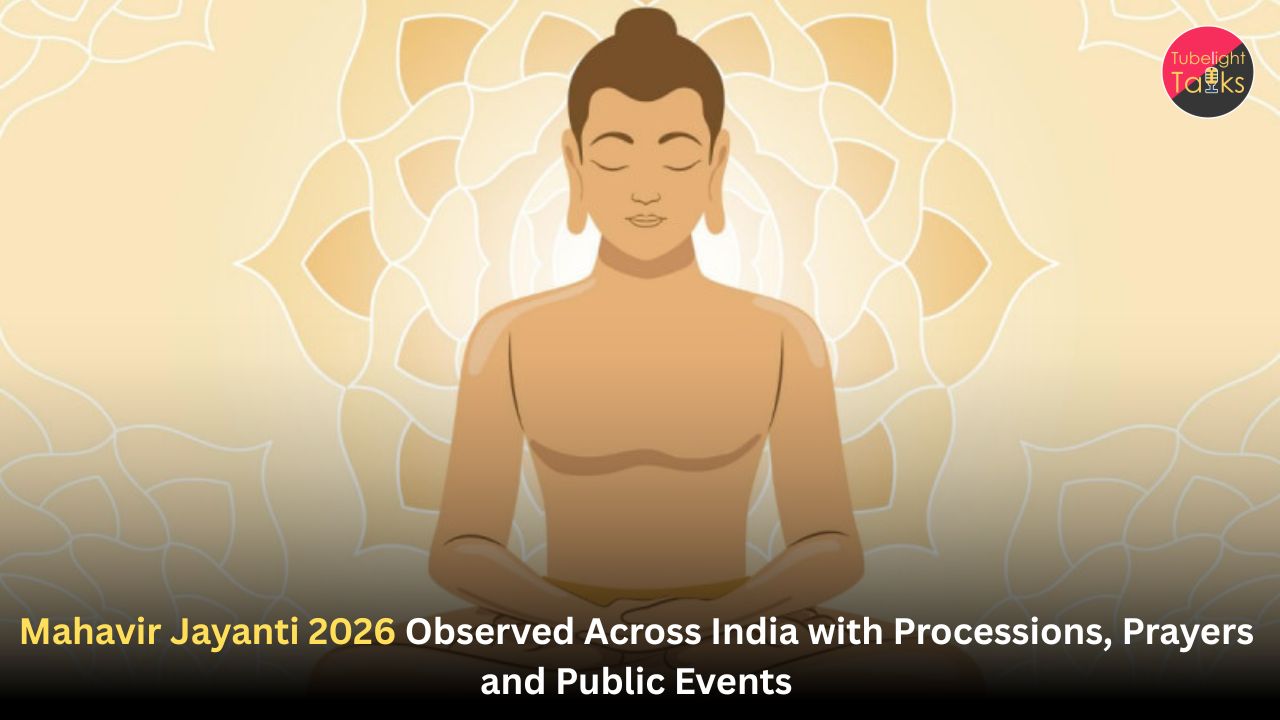
Mahavir Jayanti 2026 Observed Across India with Processions and Prayers Marking Lord Mahavir’s 2624th Birth Anniversary
Mahavir Jayanti 2026 was observed on Tuesday, March 31, with Jain devotees across India marking the 2624th birth anniversary of Lord Mahavir, the 24th and final Tirthankara of Jainism. The day brought together temple prayers, community processions, charitable acts and public messages focused on non-violence, truth, restraint and compassion.
It was also nationally visible because President Droupadi Murmu and Prime Minister Narendra Modi issued official greetings, while the Prime Minister’s Gujarat programme linked the festival to a major cultural event: the inauguration of the Samrat Samprati Museum in Gandhinagar, dedicated to Jain history and heritage.
Mahavir Jayanti 2026 Became a Nationally Visible Religious Observance
Why this year’s festival was significant
This year’s observance carried both spiritual and public importance. Multiple current reports identified March 31, 2026 as Mahavir Jayanti and described it as marking Lord Mahavir’s 2624th birth anniversary. At the national level, the President’s Secretariat released a message on the eve of the festival, while the Prime Minister’s Office issued greetings on the day itself, underscoring that the festival’s core values remain relevant far beyond the Jain community.
President Droupadi Murmu highlighted Bhagwan Mahavir’s five principles—ahimsa, satya, asteya, brahmacharya and aparigraha—and said these ideals can make life meaningful and bring positive change to society.
Prime Minister Modi similarly said Lord Mahavir’s teachings continue to illuminate the path of truth, non-violence and compassion, and added that his emphasis on equality and kindness remains deeply relevant in the present age. These official messages gave the day a distinctly national moral tone, not just a ceremonial one.
A festival observed widely, though not identically in every state
Mahavir Jayanti was widely observed across India, but not every administrative detail looked identical everywhere. Reports described it as a gazetted public holiday in many places, with schools, colleges and government institutions closed in several states and cities, while some state-level schedules varied.
Because March 31 was also the last day of the financial year, agency banks were directed to remain open for government business even where Mahavir Jayanti holiday observance applied more broadly. That nuance mattered because it showed how a major religious observance coexisted with year-end administrative obligations.
The same pattern appeared in financial markets. The National Stock Exchange’s official holiday calendar listed March 31, 2026 as a trading holiday for Shri Mahavir Jayanti, confirming the day’s recognition at the level of national market operations as well. In public life, then, Mahavir Jayanti was not confined to temples or community halls; it visibly shaped civic schedules, trading activity and official messaging.
Also Read: Shivaji Maharaj Jayanti 2026: Complete Biography, Quotes, Wishes and Mumbai Holiday Update
Processions, Temple Prayers and Community Gatherings Defined the Day
Traditional observance remained central
Mahavir Jayanti is celebrated not merely as a memorial date but as a living expression of Jain values. Contemporary festival coverage described the day as one marked by prayers, temple visits, processions and charitable acts. That pattern remained visible in 2026 as communities used the festival to reflect on Lord Mahavir’s teachings of non-violence, truth, non-stealing, celibacy and non-possession—principles that continue to define Jain ethical life.
This matters because the festival’s endurance comes from its moral content. Lord Mahavir is not remembered only as a religious figure from the past, but as a teacher whose ideas still speak to modern anxieties—conflict, excess, intolerance, greed and loss of restraint. That is one reason Mahavir Jayanti often feels larger than a community observance; it carries an ethical message that travels widely.
City processions showed the festival’s public character
Ahmedabad offered one of the clearest illustrations of the day’s public scale. Local reporting said the city’s Jain community planned a major celebration including a concert, a kavi sammelan, visual depictions connected to Lord Mahavir’s birth narrative, and a city-wide procession involving multiple organisations on March 31. That kind of organised shobha yatra remains one of the most visible ways the festival enters the public sphere, making spiritual memory visible on ordinary streets.
Reports from Rajasthan similarly described planned kesariya processions in Jaipur and Jodhpur, along with devotional programmes, service activities and public remembrance of the principle often associated with Lord Mahavir—“live and let live.” Taken together, these city-level examples support the broader description of Mahavir Jayanti 2026 as a festival observed through collective prayer, procession and community outreach across different parts of India.
Public respect extended beyond Jain neighbourhoods
The observance also affected local public regulation in places outside traditional Jain centres. In Varanasi, for example, meat and fish shops within the municipal limits were ordered shut for the day, with officials explicitly linking the action to respect for religious sentiments and public peace on Mahavir Jayanti. Such administrative decisions show how the festival receives recognition beyond the immediate Jain community and enters the wider civic environment.
This wider respect reflects the stature of Lord Mahavir in India’s civilisational life. Even where the number of Jain devotees may be smaller, the values associated with Mahavir—self-restraint, compassion and non-violence—carry a broad moral legitimacy. That helps explain why the festival repeatedly draws acknowledgements from national leaders and state authorities alike.
The Gandhinagar Museum Event Added National Cultural Weight
Jain heritage was placed at the center of a major public event
Mahavir Jayanti 2026 did not remain limited to greeting messages and devotional observance. The Prime Minister’s official Gujarat programme for March 31 placed Jain heritage at the centre of the day by scheduling the inauguration of the Samrat Samprati Museum at Koba Tirth in Gandhinagar. The PMO described the museum as a showcase of the historical, cultural and spiritual legacy of Jainism, with seven distinct wings and more than two thousand rare treasures, including artefacts, manuscripts, paintings, silver chariots and idols.
By linking this inauguration directly to Mahavir Jayanti, the government turned the day into not only a devotional observance but also a cultural statement. Jainism’s contribution to India’s civilisational memory—especially its emphasis on ahimsa and disciplined living—was presented in museum form, with modern audio-visual installations designed for visitors, scholars and researchers. That made the festival visible in a way that extended from ritual into heritage preservation.
The inauguration reinforced the relevance of Jain philosophy
Current reporting later in the day said Prime Minister Modi did inaugurate the Samrat Samprati Museum in Gandhinagar. News on AIR described it as an important step in giving new identity to India’s rich cultural and spiritual heritage, while other coverage noted that the museum is dedicated to Jain history, the life of Samrat Samprati and the message of non-violence. This was symbolically fitting on Mahavir Jayanti, because it connected Lord Mahavir’s moral legacy to a contemporary effort at cultural conservation and public education.
The museum event also showed something deeper: Mahavir Jayanti is increasingly being framed not only as a community festival, but as a national occasion to reaffirm India’s long relationship with philosophies of restraint, peace and ethical discipline. In an age dominated by noise, speed and conflict, that framing feels especially powerful.
Why Lord Mahavir’s Message Still Resonates in 2026
The core teachings remain urgently contemporary
The official messages issued this year did not treat Lord Mahavir’s teachings as historical abstractions. Both the President and the Prime Minister framed them as active guidance for present society. That is why Mahavir Jayanti continues to matter.
Ahimsa speaks directly to violent public discourse. Satya challenges manipulation and moral compromise. Aparigraha questions excess, greed and compulsive accumulation. Brahmacharya and asteya call for discipline and ethical self-control. These are not outdated religious rules; they are social correctives.
The festival’s continued relevance lies in this moral precision. Lord Mahavir’s message does not flatter the individual ego. It asks for restraint, responsibility and awareness of other living beings. That is one reason the day carries emotional depth for devotees and intellectual significance for a wider audience interested in ethics, peace and Indian philosophical traditions.
A message of peace in an unsettled time
The broader media framing of the festival also emphasized peace, compassion and goodwill. DD News described the national mood around the day through greetings that repeatedly returned to those themes. That is telling. In 2026, when public life often feels polarised and impatient, the continued appeal of Lord Mahavir’s teachings suggests that India still turns instinctively toward non-violence and moral clarity in moments of reflection.
Beyond Celebration, the Discipline of Compassion
The spirit of Mahavir Jayanti flows naturally into the teachings of Sant Rampal Ji Maharaj, which repeatedly emphasize righteous living, compassion, non-violence and equality among human beings. Official material associated with his mission describes true spiritual life as one rooted in peaceful conduct, brotherhood and moral discipline rather than aggression, ego or discrimination.
That makes the connection smooth rather than forced: a festival honouring Lord Mahavir’s path of ahimsa and restraint also reminds seekers that spiritual wisdom must be lived, not merely praised. Real devotion shows itself in how gently a person speaks, how honestly one lives and how seriously one avoids causing pain to others.
Call to Action
Let the festival continue after the procession ends
Mahavir Jayanti should not remain only a one-day observance of prayers, processions and greetings. The real tribute to Lord Mahavir is to carry at least one of his teachings into daily life with seriousness. This could mean choosing non-violence in speech, practicing truth in difficult situations, rejecting unnecessary consumption, or becoming more compassionate toward humans and other living beings.
The President and Prime Minister both framed the day as an opportunity to adopt Mahavir’s values in practical life, and that is the strongest call the festival offers.
Respect the teaching, not just the tradition
Public celebration has value, but transformation begins when the message enters conduct. Mahavir Jayanti 2026 showed that Lord Mahavir is still remembered across India with reverence. The next step is personal application. A society that truly absorbs ahimsa, truth, self-restraint and kindness will not only honour Lord Mahavir more honestly; it will also become calmer, fairer and more humane.
FAQs: Mahavir Jayanti 2026
1. When was Mahavir Jayanti observed in 2026?
Mahavir Jayanti in 2026 was observed on Tuesday, March 31.
2. Which birth anniversary of Lord Mahavir was marked in 2026?
Current festival coverage identified 2026 as Lord Mahavir’s 2624th birth anniversary.
3. How is Mahavir Jayanti usually celebrated?
It is commonly observed through temple prayers, processions, charitable acts and community gatherings focused on Lord Mahavir’s teachings.
4. What did President Droupadi Murmu emphasize in her Mahavir Jayanti message?
She highlighted Lord Mahavir’s five principles: ahimsa, satya, asteya, brahmacharya and aparigraha, and said they can bring positive change to society.
5. What did Prime Minister Narendra Modi say on Mahavir Jayanti 2026?
The Prime Minister said Lord Mahavir’s teachings continue to illuminate the path of truth, non-violence and compassion, and stressed their relevance in today’s world.
6. What major public event in Gujarat was linked to Mahavir Jayanti this year?
On the occasion of Mahavir Jayanti, the Samrat Samprati Museum at Koba Tirth in Gandhinagar was inaugurated, highlighting Jain history, heritage and the message of non-violence.
Related Stories




Discussion (0)