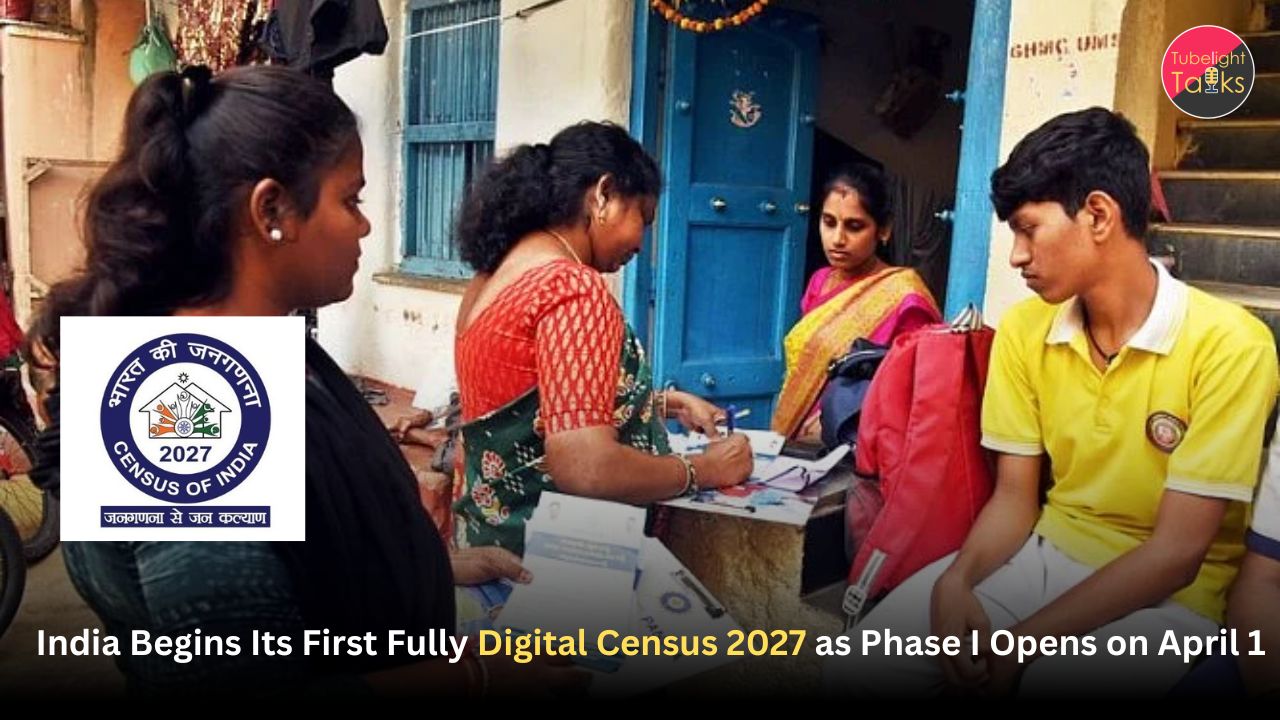
India Launches Its First Fully Digital Census 2027, but the First-Phase Rollout Begins in Stages
India’s Digital Census 2027 has entered execution mode on April 1, 2026, marking the launch of the country’s first fully digital census. Yet the most accurate version of the story is slightly different from the dramatic headline. Officially, what starts now is the first phase of the world’s largest census, but not as a uniform nationwide door-to-door exercise on day one.
Instead, the rollout is phased by state and Union Territory, with self-enumeration opening first in the initial set of jurisdictions and house listing following soon after. The government’s own description is “India’s first fully digital census” and the “world’s largest census,” which is the stronger verified framing here.
Census 2027 Has Begun, but Not as a One-Day Nationwide House-to-House Drive
What officially starts on April 1
The Registrar General and Census Commissioner of India announced that the first phase of Census 2027 begins from April 1, 2026. This phase is the House Listing and Housing Census, and it includes a self-enumeration option that opens before enumerators begin door-to-door houselisting in each state or Union Territory. The official release makes clear that the first phase runs over six months, from April to September 2026, in 30-day state-specific windows rather than through a single synchronized national start for field visits.
That means the phrase “begins nationwide today” is only partly correct. The census process has indeed begun nationally in legal and administrative terms, but the door-to-door component does not start everywhere on April 1. The initial April 1 start applies to self-enumeration in the first group of states and Union Territories, while house listing in those areas begins on April 16.
Where the rollout starts first
According to the official schedule, the first group includes Andaman and Nicobar Islands, NDMC and Delhi Cantonment Board, Goa, Karnataka, Lakshadweep, Mizoram, Odisha, and Sikkim. In these areas, self-enumeration runs from April 1 to April 15, 2026, and the House Listing and Housing Census follows from April 16 to May 15, 2026. A second group, including Madhya Pradesh, Andhra Pradesh, Arunachal Pradesh, Chandigarh, Chhattisgarh, and Haryana, begins self-enumeration from April 16 and field houselisting from May 1.
This phased structure is not a sign of delay. It is the design of the operation itself. The government has said the first phase will run across six months to suit the convenience of state and Union Territory governments, which is practical for a data exercise of this scale.
Why Census 2027 Is a Major Break from the Past
India’s first fully digital census
Officially, Census 2027 is being described as India’s first fully digital census. The March 30 PIB Bengaluru release says it is India’s first-ever fully digital census, moving away from traditional paper-based methods. Enumerators will collect information using specialized mobile applications under a bring-your-own-device model, while citizens also have the option to submit their information themselves through the dedicated self-enumeration portal.
This is a historic change because previous Indian censuses depended on paper-heavy field systems and much slower data processing. The digital approach is meant to improve speed, reduce manual handling, and create a more efficient path from enumeration to usable statistics. The March 30 national briefing similarly said that, for the first time, the census will be conducted digitally and, for the first time, self-enumeration will be available.
What the government is not officially claiming
There is one important accuracy point. I could verify official claims that this is India’s first fully digital census and that it is the world’s largest census. I could not verify an official or reliable global-source claim that it is the world’s first fully digital census. So the most defensible headline is that India has launched its first fully digital census, not necessarily the world’s first.
That distinction matters because census reporting influences public understanding, trust, and participation. A strong story does not need exaggeration. India’s move is already historically significant on its own terms.
How the First Phase Works
What Phase I collects
The first phase of Census 2027 is the House Listing and Housing Census. The official national release says this phase collects information about the condition of houses, amenities available to the household, and assets possessed by the household. The Karnataka census release adds more practical examples, including housing characteristics, access to drinking water, electricity, cooking fuel, internet availability, and household assets.
This makes Phase I far more than a simple headcount. It is a national mapping exercise of living conditions and basic household infrastructure. That is why this phase matters so much for future welfare planning, housing policy, infrastructure targeting, and development priorities.
What happens in Phase II
Phase II is the Population Enumeration stage and is scheduled for February 2027, with some snow-bound and non-synchronous areas such as Ladakh and parts of Jammu and Kashmir, Uttarakhand, and Himachal Pradesh following a different schedule.
The official release says Phase II will collect demographic, socio-economic, education, migration, fertility, and related information from each individual, and it also notes that caste enumeration will be done in the second phase as decided by the Cabinet Committee on Political Affairs.
This division between Phase I and Phase II is important because many people treat “the census” as one single event. In reality, the operation is split into distinct stages with different purposes, timelines, and data fields.
The New Self-Enumeration Option Changes Citizen Participation
How self-enumeration fits into the process
For the first time, respondents can submit their information themselves online before the enumerator’s house visit. The official description calls this a secure web-based facility available in 16 languages. In Karnataka, for example, citizens can submit their information online from April 1 to April 15, after which enumerators will visit homes and verify the details.
This is one of the most important changes in the new census model. It gives digitally comfortable households more flexibility and may reduce duplication and time spent during physical visits. It also signals a shift in the relationship between citizens and the census system, moving from passive response to optional digital participation.
Why this could speed up data use
The digital model is expected to improve timeliness because enumerators are not filling paper schedules for later manual processing. The system is designed around mobile-app capture, web self-enumeration, and digital monitoring. Even though the government has not yet published full data-release timelines in the official briefings I reviewed, the structure clearly aims to reduce delay between collection and analysis.
For a country of India’s size, this matters enormously. Faster, cleaner data can improve the quality of policy decisions, especially in areas like housing, amenities, service delivery, and demographic planning.
The Scale of the Exercise Is Enormous
More than 3 million officials will be involved
The government has said more than 3 million enumerators, supervisors, and other officials will be involved across the country. That figure alone explains why the census cannot be treated as a simple survey. It is one of India’s largest administrative exercises, carried out under the Census Act, 1948 and the Census Rules, 1990.
The official release also notes that Census 2027 will be the 16th census in the series and the 8th since independence. That gives the exercise historical continuity even as its methods change dramatically. India is not abandoning its census tradition. It is digitizing it.
The reference date and legal framework are already fixed
The government had already notified its intention to conduct Population Census 2027 in the Gazette of India on June 16, 2025. The official reference date for Census 2027 is 00:00 hours of March 1, 2027, with a separate October 1, 2026 reference date for Ladakh and certain snow-bound areas. These details show that the current rollout is part of a legally structured and pre-notified national process, not a last-minute administrative push.
Privacy, Security, and Public Trust Will Shape the Success of the Digital Census
What the government says about confidentiality
A digital census can only work at national scale if people trust the system. The Karnataka census release says personal information provided by the public is secure and confidential under the Census Act, 1948, will not be shared with courts or other government departments, and that only aggregate statistical data will be published. The national press conference also said all necessary provisions have been made to ensure data security.
These are critical assurances because a digital census naturally raises more public questions about privacy than older paper systems did. The success of Census 2027 will depend not only on software and enumerators, but on whether households believe that their information is protected and used only for legitimate statistical purposes.
Why trust matters as much as technology
Technology can make data collection faster, but it cannot replace public confidence. If people hesitate, mistrust the portal, or fear misuse of information, participation quality may suffer. That is why the government’s repeated emphasis on legal confidentiality, secure data handling, and limited publication of only aggregate information is so significant.
In a digital-first census, trust is not a side issue. It is a core part of the infrastructure.
Why Accurate Counting Matters Beyond Numbers
A census is not only a technical count. It is a moment when a nation tries to see itself truthfully. That deeper idea connects naturally with the teachings of Sant Rampal Ji Maharaj, which stress truthful living, moral discipline, and responsible conduct in everyday life. A society that counts honestly, responds honestly, and plans honestly is stronger than one built on confusion or neglect.
In that sense, Census 2027 is not just about data collection. It is also a reminder that truth, clarity, and responsibility are the basis of both good governance and a balanced life.
Call to Action
Check your state’s schedule before assuming the field visit starts today
Citizens should not assume that enumerators will begin door-to-door house listing in every location on April 1 itself. The official rollout is staggered, so households should check the applicable window for their state or Union Territory, use the self-enumeration option where available, and cooperate fully when enumerators visit. The better informed the public is, the smoother the process will be.
Participate carefully, because the quality of future planning depends on it
The first phase of Census 2027 will influence how India understands housing conditions, amenities, and household assets. That information feeds policy, welfare design, and development priorities. A digital census can be faster and more efficient, but only if citizens participate truthfully and carefully. This is one of those national exercises where everyday accuracy creates long-term public value.
FAQs: India’s Digital Census 2027
1. Has Census 2027 started on April 1, 2026?
Yes. The first phase of Census 2027 officially begins from April 1, 2026.
2. Is this India’s first fully digital census?
Yes. Official releases describe Census 2027 as India’s first fully digital census.
3. Is the first phase a nationwide door-to-door operation starting everywhere on April 1?
No. The rollout is phased. Self-enumeration begins first in selected states and UTs, while house listing starts later in scheduled state-wise windows.
4. What does Phase I collect?
Phase I collects information on housing conditions, household amenities, and assets, including items such as water, electricity, cooking fuel, internet availability, and housing characteristics.
5. How will data be collected in the digital census?
Enumerators will use mobile applications on smartphones, and citizens also get a self-enumeration option through a secure web-based portal available in 16 languages.
6. What has the government said about data privacy?
The government says necessary provisions have been made for data security, and census information is confidential under the Census Act, with only aggregate statistical data to be published.
Related Stories








Discussion (0)