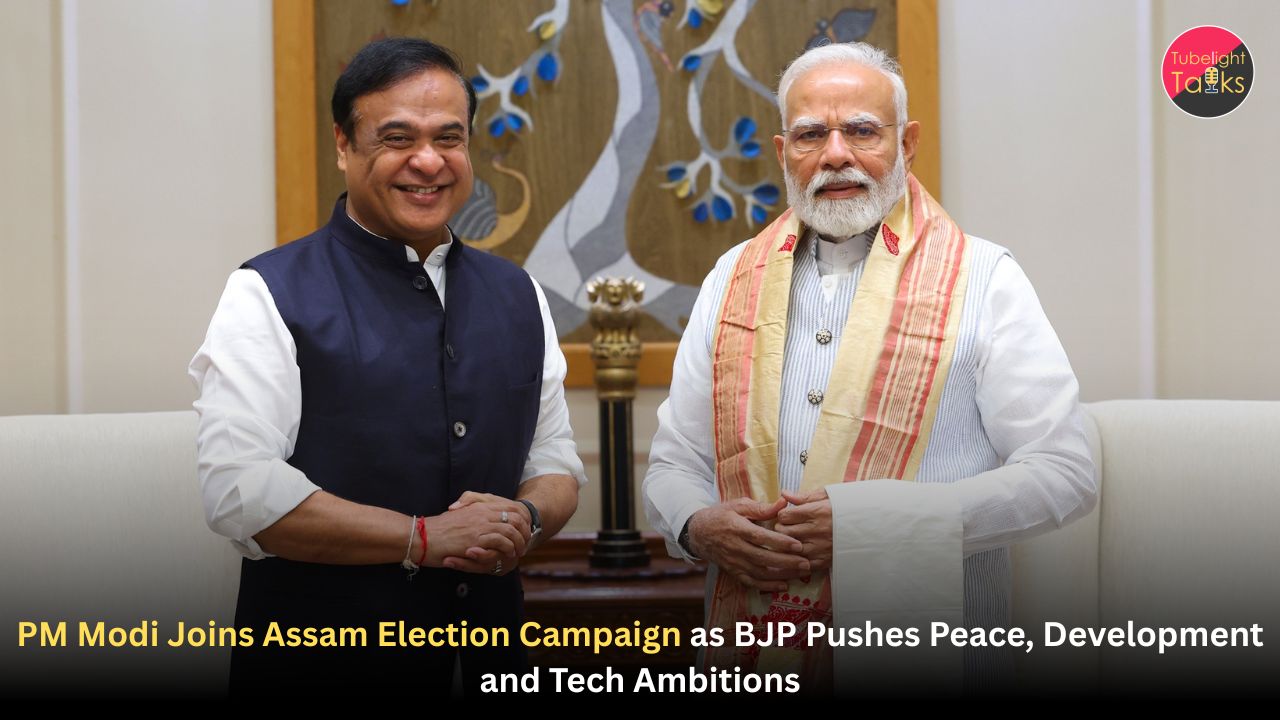
PM Modi Joins Assam Election Campaign as BJP Blends Peace, Development and Technology Messaging
Prime Minister Narendra Modi has entered the decisive stretch of the Assam Assembly election campaign, but not in the exact form a dramatic headline might suggest. The BJP’s statewide push is indeed being driven by major rallies from national leaders, yet Modi’s own first major intervention in this phase came through a direct NaMo app interaction with booth-level workers and voters across Assam on March 30, just days before the April 9 poll.
In that outreach, he said Assam had moved from instability and violence to peace, progress and prosperity under the “double engine” BJP government. At the same time, the broader development story surrounding his campaign message has drawn from two recent themes he has highlighted publicly: that Assam is becoming an important part of India’s semiconductor sector, and that this decade is India’s “Techade,” powered by AI, semiconductors and critical technologies.
The Assam Campaign Is in Its Final Stretch Ahead of April 9
The election schedule is already in motion
The Office of the Chief Electoral Officer, Assam lists the 2026 Legislative Assembly election schedule on its official page and shows April 9, 2026 as the polling date. That means every campaign move in the final days is highly strategic, especially from star campaigners. With the voting window now close, national leaders are not merely holding symbolic appearances; they are shaping turnout, cadre energy and the last phase of voter mood.
Modi’s entry came through digital outreach, not a first-day roadshow
The most accurate account is that Modi’s campaign entry in this phase came through a large digital connect rather than a conventional rally caravan. The Times of India reported that the Assam BJP billed his March 30 NaMo app interaction as a “unique digital connect” aimed at workers and the people of the state.
The same report also showed that the wider BJP campaign machine was being expanded simultaneously through rallies by Amit Shah, Rajnath Singh and other national leaders across multiple constituencies. So the campaign is high-voltage, but Modi’s own opening move was digital and organisational rather than an immediate mass ground rally.
That distinction matters because it reflects how modern campaigns now work. A leader can enter the campaign not only through a giant stage rally, but also through direct mobilisation of booth workers and digitally amplified messaging. In a tightly fought state election, that kind of organisational intervention can be as important as public spectacle.
Also Read: PM Modi Targets LDF-UDF “Corruption” and Promises “Viksit Keralam” at Palakkad Rally
Modi’s Core Message in Assam: From Violence to Progress
The BJP is pitching transformation as its main political argument
According to Economic Times’ report on Modi’s March 30 interaction, the Prime Minister told booth-level workers that Assam had moved from “instability and violence” to “peace, progress, and prosperity” in the last ten years under BJP rule. He credited peace agreements for lasting stability, especially in Bodoland, and told party workers that booth-level strength and household-level connection remain the BJP’s biggest campaign advantage.
This is not just rhetoric. It is the BJP’s principal framing for Assam in 2026: that the state under earlier regimes was trapped in unrest and uncertainty, while the current period represents political order, infrastructure push and economic opening. Modi’s appeal to first-time voters, as reported by ET, was also rooted in this contrast. He urged party workers to explain the difference between Assam’s troubled past and its present political climate.
Identity and security remain part of the campaign message
The same interaction also showed that Modi’s development message is not separate from the BJP’s identity and security politics. ET reported that he underlined the need to protect Assam’s identity and address illegal infiltration, describing it as an issue of security, culture and justice. That means the campaign is being built on a twin track: developmental gains on one side, demographic and security concerns on the other.
This blend has long been central to the BJP’s politics in Assam. What appears different in 2026 is the effort to attach a more future-facing economic story to it, especially around technology, investment and next-generation sectors. That is where AI and semiconductors enter the campaign narrative. This is partly a political inference from Modi’s recent speeches, but it is well supported by the themes he has chosen to foreground.
Why AI and Semiconductors Are Now Part of the Assam Story
Modi has explicitly linked Assam to India’s semiconductor rise
In his March 14 speech in Silchar, posted on the Prime Minister’s official website, Modi said that Assam was becoming “an important part of India’s semiconductor sector” and that the ecosystem and talent connected to next-generation technology were getting ready in the state. He paired this with a broader claim that youth in Assam now have an “open sky” of opportunity in the semiconductor and tech sectors.
That is a highly consequential political statement. It means Assam is no longer being spoken of only as a border state, a security-sensitive region, or an infrastructure-development case. It is also being projected as a participant in India’s high-technology future. For a state election campaign, that is a striking shift in vocabulary.
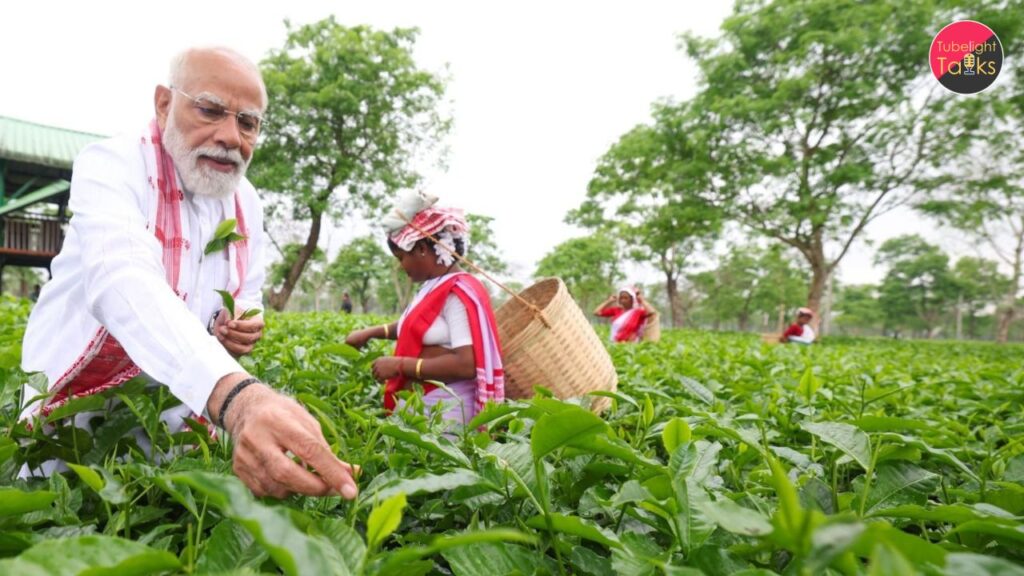
The semiconductor promise in Assam is backed by real policy movement
This narrative is not being built from thin air. Official material around India Semiconductor Mission 2.0 says Tata Electronics is establishing a semiconductor manufacturing facility in Assam with an investment of ₹27,120 crore and a production capacity of 48 million units per day. Earlier official communication also described the Jagiroad facility in Assam as the nation’s first indigenous semiconductor assembly and test unit designed to serve domestic and global markets.
That gives political credibility to Modi’s campaign argument. When he says Assam is becoming part of India’s semiconductor ecosystem, he is referring to a real industrial project with national strategic significance. In electoral terms, this allows the BJP to tell voters that Assam’s next chapter is not only about roads, welfare and peace agreements, but about participation in advanced manufacturing and the technology economy.
The AI and “Techade” Message Comes from Modi’s National Pitch
Modi is framing India’s current decade around technology
On March 31, at the inauguration of the Kaynes Semicon plant in Sanand, Modi said this decade is India’s “Techade” and that India’s AI ecosystem will gain strength from the rise of the semiconductor sector. His official website and PIB-linked reporting describe him as saying India is leading in AI adoption and emerging as a strong semiconductor partner globally.
This is important for the Assam campaign because it supplies the national frame into which Assam is being placed. The Prime Minister is effectively saying two things at once: India is moving into an AI-and-semiconductor future, and Assam is becoming one of the places where that future is taking shape. That makes the Assam election narrative more aspirational than many regional campaigns usually are. This is an inference, but it is directly supported by the content of Modi’s recent speeches in Assam and Gujarat.
The Assam pitch is therefore both local and national
Locally, the BJP is asking voters to compare unrest with stability, stagnation with development, and old political models with what it calls double-engine governance. Nationally, Modi is embedding Assam into a larger story about India’s technological rise, especially in semiconductors and AI-enabled growth. This dual framing helps the party speak both to immediate governance concerns and to youth aspirations.
That can be politically effective because voters often respond not only to what has been delivered, but also to whether they believe their state has a place in the country’s future. Assam’s semiconductor positioning gives the BJP a concrete symbol for that future-facing promise.
What This Means for the Assam Election
BJP is trying to elevate the campaign beyond conventional state issues
Most state elections are fought on roads, welfare, price concerns, social coalitions and local leadership. Those elements are still present in Assam. But the BJP is also trying to add a premium layer to the contest: peace, identity protection, investment credibility and high-tech opportunity. Modi’s campaign language shows that the party wants Assam voters to see the state as a future industrial and strategic node, not just a politically sensitive frontier.
Youth voters are central to this message
When Modi speaks of semiconductor and tech opportunities in Assam, the natural audience is the younger voter. His Silchar speech explicitly linked these sectors to the future of Assam’s youth. In a state where first-time and younger voters can influence margins, that emphasis is not accidental. It is designed to convert abstract industrial policy into a personal aspiration story: jobs, skills, pride and future participation in a new economy.
But the campaign still rests on trust in delivery
Technology language alone does not win elections. What matters is whether voters believe the promise connects to visible delivery. That is why BJP leaders in Assam are pairing tech talk with peace agreements, infrastructure, welfare and regional investment. The AI and semiconductor messaging works only if voters see it as part of a broader record rather than a slogan detached from the ground.
When Progress Needs Moral Direction
Development becomes truly meaningful only when it creates peace, dignity and right conduct in society. That is where the teachings of Sant Rampal Ji Maharaj fit naturally into this discussion. His message emphasizes truthful living, social harmony, non-violence and disciplined conduct rather than hatred, division or ego-driven politics.
A state may advance through investment, technology and infrastructure, but its people benefit most when growth is guided by morality and inner balance. Real progress is not only faster industry or better systems; it is also a society in which people live with restraint, truth and compassion. That deeper foundation is what turns development into lasting welfare.
Call to Action
Voters should look beyond slogans and test the full record
As Assam moves toward polling day, citizens should assess campaign claims carefully. They should ask not only who speaks most effectively, but who has delivered peace, infrastructure, economic opportunity and credible future planning. The semiconductor and AI messaging is ambitious, but voters should judge whether it is supported by real projects, skills development and ground-level opportunity.
The bigger choice is about Assam’s direction
This election is not only about changing or continuing a government. It is also about whether Assam’s future is imagined mainly through old fault lines or through a more stable, investment-driven and technology-linked path. Modi’s campaign message makes that choice explicit. The final verdict will depend on whether voters believe the state has indeed moved from conflict to confidence and whether they trust that this trajectory can continue.
FAQs: PM Modi Joins Assam Election Campaign
1. Has PM Modi officially entered the Assam election campaign?
Yes. He addressed BJP booth-level workers and voters across Assam through a NaMo app interaction on March 30, which state BJP leaders presented as a major campaign outreach.
2. Is Assam voting on April 9, 2026?
Yes. The official Chief Electoral Officer, Assam page lists April 9, 2026 as the polling date for the Assembly election.
3. Did Modi actually mention semiconductors in relation to Assam?
Yes. In his March 14 Silchar speech, he said Assam is becoming an important part of India’s semiconductor sector and that a next-generation tech ecosystem and talent pool are getting ready in the state.
4. What did Modi say recently about AI and semiconductors?
At the March 31 inauguration of the Kaynes Semicon plant in Sanand, he said this decade is India’s “Techade” and that India’s AI ecosystem will gain strength from the rise of the semiconductor sector.
5. Is there really a major semiconductor project in Assam?
Yes. Official India Semiconductor Mission material says Tata Electronics is establishing a semiconductor manufacturing facility in Assam with an investment of ₹27,120 crore.
6. Were PM Modi’s first campaign moves in Assam traditional rallies?
Not exactly. His major intervention in this phase was a digital NaMo app interaction, while the BJP’s wider on-ground campaign has included rallies by other national leaders across Assam.
Related Stories





Discussion (0)