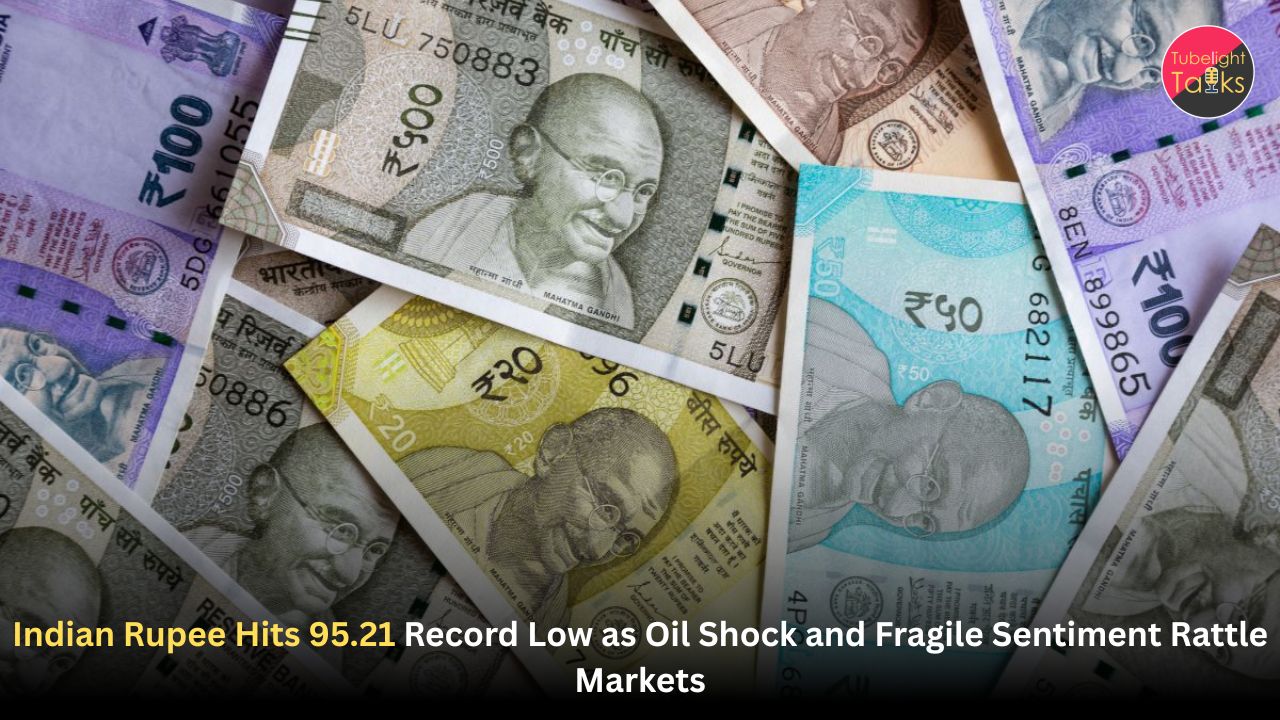
Indian Rupee Hits 95.2 and Briefly Touches Record 95.21 as Oil Volatility and Fragile Sentiment Weigh on India
Indian Rupee Hits 95.21: The rupee story at the start of FY 2026-27 is more serious than a routine currency dip. In the final session of the previous financial year, the Indian rupee fell to an all-time intraday low of 95.21 per U.S. dollar before closing at 94.83, capping its worst fiscal-year decline in over a decade. The pressure came from a harsh combination of surging crude oil prices, foreign investor outflows, geopolitical risk linked to the West Asia conflict, and a broad loss of conviction in Indian assets.
While April 1 brought some relief in equities and calmer oil prices, the rupee’s record slide showed how fragile underlying sentiment remains.
The Rupee Did Not Just Drift Toward 95.2. It Touched 95.21
The exact market move matters
The most accurate description of this episode is stronger than saying the rupee merely slipped toward 95.2. Reuters reported that on March 30, 2026, the rupee actually fell to a record intraday low of 95.21 per U.S. dollar before ending the session at 94.83. That made the level historically significant, because it was not just a forecast zone or market fear. It was a traded reality.
The fall also completed a grim annual picture. Reuters said the rupee lost about 11% over FY 2025-26, making it the currency’s worst fiscal-year performance since 2011-12. Economic Times separately described the rupee as the worst-performing Asian currency in FY26, though the exact percentage cited there differs somewhat from Reuters’ calculation. The broader conclusion remains the same: the rupee ended the year as one of the region’s weakest currencies.
Why the 95 mark carries psychological weight
Round-number currency levels often become psychological barriers in financial markets. When such barriers break, importers rush to hedge, traders become more defensive, and market commentary itself can intensify the perception of stress. In the rupee’s case, the move beyond 95 came after weeks of consecutive pressure, record lows at lower levels such as 93 and 94, and a steady worsening of the energy and geopolitical backdrop.
That is why this move resonated so strongly. It was not one isolated bad session. It was the visible peak of a longer unraveling in which the rupee had already been repeatedly pushed lower by oil, outflows and deteriorating risk appetite.
Also Read: Markets Reel as Rupee Breaches 95-Mark, but the Bigger Story Is India’s Oil Shock Exposure
Crude Oil Was the Central Trigger Behind the Currency Shock
India’s external vulnerability became impossible to ignore
Reuters tied the rupee’s plunge directly to surging oil prices caused by the West Asia conflict. On March 30, Brent crude hit around $115 per barrel, sharply worsening India’s outlook because the country imports the overwhelming majority of its crude oil needs. Reuters has described India’s dependence at roughly 85% to 90% of crude consumption, which means sudden oil spikes almost immediately pressure the import bill, inflation outlook and currency.
This is why crude oil matters so much to the rupee. When oil prices jump, India needs more dollars to pay for imports. That increases demand for the U.S. currency just when investor confidence is already weak. The result is a double strain: a higher import bill and a weaker exchange rate.
Volatility, not just high prices, has made the problem worse
The concern is not only that oil became expensive. It is that oil became violently unstable. Reuters reported that by April 1, Brent had cooled to around $105 per barrel as hopes rose that military operations involving Iran might ease within weeks. Yet that relief came only after a period of intense market swings, and the government’s own latest monthly economic review warned that the conflict had disrupted a route carrying about 20% of global oil supply.
For India, such volatility is dangerous because it makes planning harder for importers, refiners, investors and policymakers alike. A stable but high oil price is already painful. A violently fluctuating one creates even more uncertainty around inflation, current-account pressure and the rupee’s fair value.
Foreign Investor Exit Turned Pressure Into a Full Market Stress Event
Outflows from Indian assets accelerated the rupee’s decline
Reuters reported that foreign investors sold more than $19 billion of Indian stocks over the fiscal year, while another Reuters report said foreign investors dumped a record $12.14 billion in Indian equities after the Iran conflict intensified. Such outflows hurt the rupee because investors exiting Indian assets typically buy dollars to take money out, increasing pressure on the local currency.
This foreign selling did not happen in a vacuum. It came at a time when India’s growth outlook was being reassessed, oil prices were rising sharply, and markets were increasingly worried that the current account deficit would widen. When these forces combine, the currency becomes a fast and visible pressure point.
Hedging costs and weak conviction added to the damage
Reuters also noted that hedging costs rose and that investor conviction in Indian assets had weakened. Its “perfect storm” analysis described the rupee as battered by foreign outflows, an oil shock from the Iran war, and fading investor confidence.
That phrase matters because it captures the difference between a normal correction and what happened here. The rupee was not reacting to one negative signal. It was reacting to several adverse signals at once.
That broader loss of conviction is why the rupee remained vulnerable even when the RBI intervened or when equities later rebounded. Sentiment had already been damaged at a structural level, and markets were pricing in a harder external environment for India.
The Government and RBI Are Not Ignoring the Problem
RBI has already tightened forex-position rules
One of the clearest official-style responses came from the Reserve Bank of India’s decision to cap banks’ net open rupee positions in the onshore deliverable foreign exchange market at $100 million by the end of each business day, effective April 10. Reuters reported that the move was meant to reduce stress created by arbitrage between the offshore NDF market and the onshore market, where banks had built up large positions estimated at roughly $25 billion to $50 billion.
The policy gave the rupee some temporary relief, but it also created pain for banks. Reuters said banks warned that the sudden rule would hit treasury earnings and force an abrupt unwind of profitable trades. In other words, the central bank acted to stabilise the currency, but not without collateral strain in the financial system.
The government has acknowledged broader economic risks
India’s own monthly economic report, as summarized by Reuters, warned that the country’s growth forecast of 7.0% to 7.4% for the fiscal year beginning April 1 is under threat because of rising energy costs and conflict-linked disruption. The report also said the current account deficit, already 1.3% of GDP in the last quarter, is expected to widen further in the new fiscal year.
That official warning matters because it shows the rupee slide is not being treated as a standalone market fluctuation. It is being understood as part of a wider macroeconomic risk set involving imports, inflation, growth and external balances.
April 1 Brought Relief in Stocks, but Not a Full Reset in Risk
Equity markets bounced as oil cooled, yet the rupee story remains unfinished
On April 1, Reuters reported that Indian shares rose sharply, with the Nifty 50 up 2.42% and the Sensex up 2.52%, helped by hopes that tensions in the Middle East might ease and with Brent crude stabilizing around $105 per barrel. The India VIX also dropped to about 25.1, suggesting lower immediate panic.
That rebound is important, but it should not be read as proof that the rupee problem is solved. Markets often recover part of their losses when geopolitical fears ease temporarily, yet currencies under structural pressure can remain fragile. The same Reuters reporting that described the rebound also made clear that the earlier selloff had been driven by the worst March shock in years.
Fragility remains the right word
The reason fragility still defines the moment is simple. Oil remains elevated relative to earlier levels, foreign investor confidence is not fully repaired, and the macro risks highlighted in the government’s own report have not disappeared. Even if the rupee does not instantly return to 95.21, the conditions that drove it there have only partially eased.
That is why this story is best understood as a warning, not just a market milestone. The rupee’s record low exposed how quickly India’s external balance can come under stress when energy shocks, capital outflows and geopolitical conflict arrive together.
Why the Rupee Slide Matters to Ordinary Indians
Currency weakness does not stay inside forex markets
A weak rupee raises the domestic cost of imports. In an economy where oil matters to transport, logistics, manufacturing, aviation and household inflation expectations, that can affect daily life even if many people never directly trade currency. A weaker rupee can eventually feed into higher prices, squeezed company margins, and caution in investment planning.
For households, the effects may appear indirectly: pricier travel, costlier imported products, or rising pressure on local business pricing. For businesses, especially those dependent on imported raw materials or energy, the rupee’s fall can change the economics of planning very quickly.
This is also a reminder about India’s energy dependence
Reuters’ energy and currency reporting together underline one hard fact: India remains highly vulnerable to external oil shocks. Even with diversified suppliers and efforts to secure inventory, large and sudden crude-price spikes still transmit quickly into the currency, bonds, inflation worries and risk sentiment.
That means the rupee story is not merely a market story. It is also an energy-security story, an inflation story and a resilience story. The more exposed a country is to imported energy shocks, the more quickly its currency becomes a frontline indicator of stress.
Inner Stability Matters When External Conditions Turn Uncertain
Currency stress reminds people how unstable material life can become when global events suddenly shift prices, trade and confidence. In that sense, the rupee’s record slide also carries a deeper lesson. The teachings of Sant Rampal Ji Maharaj emphasize disciplined living, truthfulness, restraint and inner balance rather than panic and attachment to temporary worldly conditions.
That connection fits naturally here. Economic uncertainty can test the mind as much as the wallet, and a spiritually steady person remains more balanced in times of volatility. Material prudence is necessary, but lasting strength comes when the mind is not shaken by every external disturbance.
Call to Action
Watch the underlying drivers, not just the headline number
The most useful way to read this rupee episode is not to fixate only on 95.21. Citizens, investors and businesses should track the real drivers: crude oil prices, foreign portfolio flows, RBI actions and the durability of geopolitical relief. If those do not improve sustainably, the pressure on the rupee can return even after short-term rebounds.
Calm analysis is more valuable than panic
A record low currency can create dramatic headlines, but the wiser public response is measured attention. This is a moment to follow verified developments, understand India’s exposure to external shocks and avoid exaggerated conclusions based on a single session alone. The rupee touched 95.21 for real, but the bigger issue is whether India can navigate the oil-driven external stress now facing the new financial year.
FAQs: Indian Rupee Hits 95.21 Record Low as Oil Shock and Fragile Sentiment Rattle Markets
1. Did the Indian rupee actually reach 95.2 against the U.S. dollar?
Yes. Reuters reported that the rupee touched a record intraday low of 95.21 per dollar on March 30, 2026.
2. What did the rupee close at after hitting the record low?
It closed at 94.83 on the same day after a volatile session.
3. Why did the rupee weaken so sharply?
The main reasons cited were surging crude oil prices, foreign investor outflows, geopolitical risk from the West Asia conflict and weakening investor confidence in Indian assets.
4. How important was crude oil in this fall?
Very important. Reuters linked the rupee’s pressure directly to oil prices, and India’s heavy crude-import dependence means higher global oil costs quickly worsen the currency outlook.
5. What has the RBI done in response?
Reuters reported that the RBI capped banks’ net open rupee positions at $100 million, effective April 10, to reduce market stress linked to large arbitrage positions.
6. Did markets improve at all on April 1?
Yes. Reuters reported that Indian equities rebounded strongly on April 1 as fears around the Middle East eased somewhat and Brent crude stabilized around $105, though broader fragility remains.
Related Stories










Discussion (0)