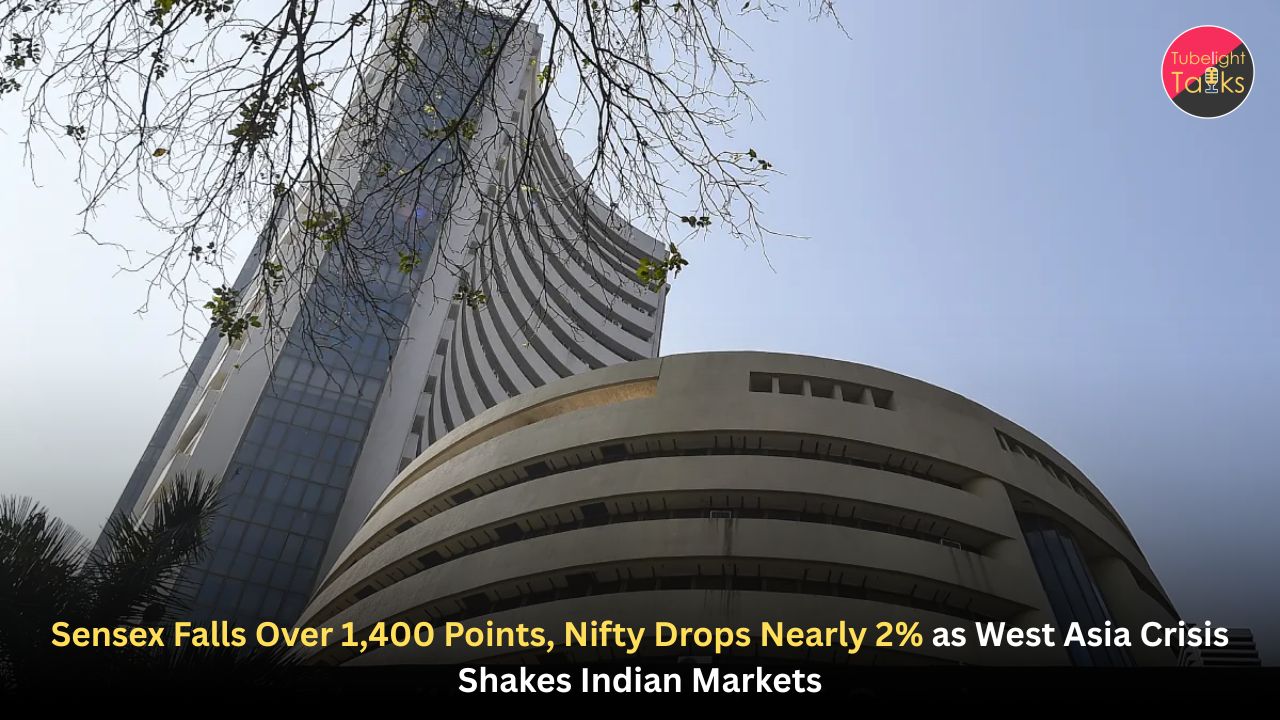
Indian Stock Markets Witness Sharp Decline as Sensex Falls Over 1400 Points and Nifty Nearly 2% Amid Global Cues and West Asia Crisis
Indian stock markets opened the day under severe pressure on April 2, with the BSE Sensex down 1.95% at 71,710.72 and the NSE Nifty 50 down 1.95% at 22,236.80 by around 9:50 a.m. IST. Compared with the previous day’s close, that translates to a fall of roughly 1,423.6 points on the Sensex and 442.6 points on the Nifty.
The immediate trigger was a renewed escalation in global anxiety after U.S. President Donald Trump said the United States would continue to hit Iran “extremely hard,” undermining hopes of a quick end to the conflict and sending crude oil prices higher again.
Dalal Street’s sharp fall was broad and not limited to one sector
The decline spread across large-caps, banks, mid-caps and small-caps
Reuters reported that all 16 major sectors were in the red on April 2. Financials and banks were down about 2.5% each, while small-caps and mid-caps dropped roughly 3% apiece. This shows the fall was not driven by one isolated earnings miss or one stock-specific event. It was a broad market selloff shaped by global fear, sector-wide risk reduction and domestic macro worries.
Banking shares were hit especially hard. A separate Reuters report said the Nifty Bank index slid as much as 2.8% to 50,004.30, its lowest level since April 9, 2025. Private lenders such as HDFC Bank and ICICI Bank fell about 1.4% each, while state-run names like SBI, Punjab National Bank, Canara Bank and Union Bank of India dropped even more sharply.
The market erased the optimism seen just one session earlier
The sharp fall also stood out because it came immediately after a relief rally on April 1, when the Nifty had risen 1.56% to 22,679.40 and the Sensex had added 1.65% to 73,134.32 on hopes that the Iran war might end sooner than feared. That optimism did not last. By the next morning, Trump’s new remarks and the jump in oil prices had flipped sentiment back into full risk-off mode.
West Asia tensions and crude oil remain the biggest external shock
Trump’s latest Iran remarks rattled global markets
Reuters said Indian shares fell in line with weaker Asian markets after Trump declared that the U.S. would hit Iran “extremely hard” in the coming weeks, dimming hopes of near-term de-escalation. AP reported that in his national address, Trump said military operations could wrap up soon but did not provide a clear path to ending the disruption around the Strait of Hormuz, a vital route for oil and gas transport. That lack of clarity unsettled markets rather than calming them.
AP also reported that Asian markets fell broadly after the speech, with South Korea’s Kospi down 3.6%, Japan’s Nikkei down 1.9% and Hong Kong’s Hang Seng down 0.9%. U.S. futures were also lower, showing that the market stress was global rather than India-specific. Indian equities were therefore reacting both to domestic vulnerability and to a wider international selloff.
Also Read: Sensex Slumps and Nifty Falls as Oil Shock and War Jolt Markets
Rising crude oil is especially dangerous for India
Brent crude rose 4.9% to $106.16 a barrel after Trump’s remarks, according to AP. Reuters said Nomura downgraded Indian equities to “neutral” from “overweight,” warning that prolonged disruption in oil and energy flows could keep prices elevated and hurt earnings and valuations. For India, which remains highly dependent on imported crude, this is one of the most serious macro risks because it affects inflation, company margins, the current account and investor confidence at the same time.
Domestic pressures made the global shock worse
RBI’s forex tightening added stress to banking counters
The market was not dealing only with geopolitical shock. Reuters said the selloff also followed tighter Reserve Bank of India rules in the forex derivatives market. Banks were required to close certain contracts in open markets and were stripped of some flexibility in selling these exposures to corporate clients. Analysts quoted by Reuters said the measures could increase losses for banks, which is one reason bank stocks came under exceptional pressure.
Jefferies estimated that banking-sector losses linked to the RBI’s crackdown could rise to about 40 billion to 50 billion rupees. Reuters also noted that the rupee had already suffered its worst monthly fall in six years in March before rebounding in early trade on April 2. That means market participants were simultaneously absorbing geopolitical risk, energy inflation risk and financial-system adjustment risk.
Pharma stocks faced an additional tariff scare
Reuters said pharma shares fell 3.75% after reports that the Trump administration could announce tariffs on imported branded and patented medicines, with the U.S. considering duties as high as 100%. This added one more layer of anxiety to an already weak session and reinforced the sense that Indian markets were being hit by multiple external shocks at once.
Also Read: Sensex Nifty Fall as Dalal Street Faces War Pressure and Rupee Weakness
The fall reflects a larger pattern, not a one-day accident
Indian markets have already been under pressure through the Iran war
Reuters reported last week that the Nifty and Sensex had already fallen about 9.5% each since the U.S.-Israeli war on Iran began on February 28. It also said record foreign outflows worth $12.14 billion had added to the strain, while Goldman Sachs cut India’s 2026 growth forecast to 5.9% from 7% and downgraded Indian equities. That means the April 2 plunge is not an isolated shock. It is part of a sustained period of weakness linked to oil, capital flight and global uncertainty.
Reuters also reported on March 30 that FY 2025-26 turned into the worst fiscal year for Indian benchmark equities since 2020, with the Sensex settling at nearly a two-year low and the Nifty at nearly a one-year low. So the current selloff is landing on a market that was already bruised and fragile.
What this means for investors and the wider economy
This is not only a stock-market story
When markets fall this sharply because of oil and war fears, the consequences go beyond portfolio values. Higher crude prices can pressure transport, manufacturing, aviation and consumer inflation. Weak equities can hurt corporate sentiment and delay investment decisions. Banking-sector stress, even if temporary, can also darken the broader risk mood.
In short, Dalal Street is reacting to a wider economic problem, not just to trading noise. This is an inference based on the market drivers cited by Reuters and AP, especially oil, banking stress and India’s vulnerability to energy shocks.
Sentiment remains hostage to the next geopolitical signal
The biggest immediate variable is still the direction of the West Asia conflict. If oil remains above $100 and there is no credible roadmap for de-escalation, Indian markets may remain vulnerable to further bouts of selling. If energy prices cool and war fears ease, some rebound is possible, as seen on April 1. But for now, the dominant mood remains fragile rather than confident.
Stability in uncertain times
When markets swing violently, they expose how uncertain material life can become in a short span of time. That naturally connects with the teachings of Sant Rampal Ji Maharaj, which emphasize inner steadiness, truthful living and freedom from panic-driven thinking. Financial caution matters, but a balanced mind matters too.
A person grounded in discipline and spiritual understanding is less likely to be shaken by every external rise and fall, and that kind of inner stability becomes especially valuable in times of public uncertainty.
Call to Action
Watch the real triggers, not just the headline loss
Investors and ordinary readers should focus on the underlying drivers of this fall: crude oil prices, the path of the Iran conflict, RBI’s forex measures, banking-sector stress and the direction of foreign flows. A 1,400-point fall in the Sensex is dramatic, but the bigger issue is whether the pressures that caused it start easing or intensifying in the days ahead.
Calm and informed analysis matters more than panic
The sharp drop in Indian markets is serious, but reacting only to fear rarely helps. This is a moment to track verified developments, understand India’s exposure to oil shocks and avoid mistaking every intraday collapse for a permanent trend. Markets may recover quickly if geopolitics cool, but they can also deepen losses if energy and war risks worsen. Precision and patience are more useful than panic right now.
FAQs: Sensex Falls Over 1400 Points, Nifty Drops Nearly 2%
1. How much did the Sensex and Nifty fall on April 2, 2026?
By around 9:50 a.m. IST, the Sensex was down 1.95% at 71,710.72 and the Nifty 50 was down 1.95% at 22,236.80, equivalent to losses of about 1,423.6 points and 442.6 points respectively from the previous close.
2. Why did Indian markets fall so sharply?
The main triggers were Trump’s renewed threat of heavy U.S. action against Iran, higher oil prices, weaker Asian markets, and domestic pressure from RBI’s tighter forex-derivatives rules.
3. Which sectors were hit the hardest?
Reuters said all 16 major sectors fell, with financials and banks down about 2.5%, mid-caps and small-caps down about 3%, and pharma stocks down 3.75%.
4. Why are higher crude oil prices such a problem for India?
Because India is highly dependent on imported crude, so higher oil prices quickly worsen inflation, earnings outlook, current-account pressure and investor sentiment.
5. What role did the RBI’s forex measures play in the selloff?
Reuters said tighter RBI rules on forex derivatives and bank positions increased concerns about potential losses for banks, pushing banking stocks toward one-year lows.
6. Is this just a one-day fall or part of a larger trend?
It appears to be part of a broader weak phase. Reuters reported that Indian benchmarks had already fallen about 9.5% each since the Iran war began on February 28, and FY 2025-26 was their worst fiscal year since 2020.
Related Stories








Discussion (0)