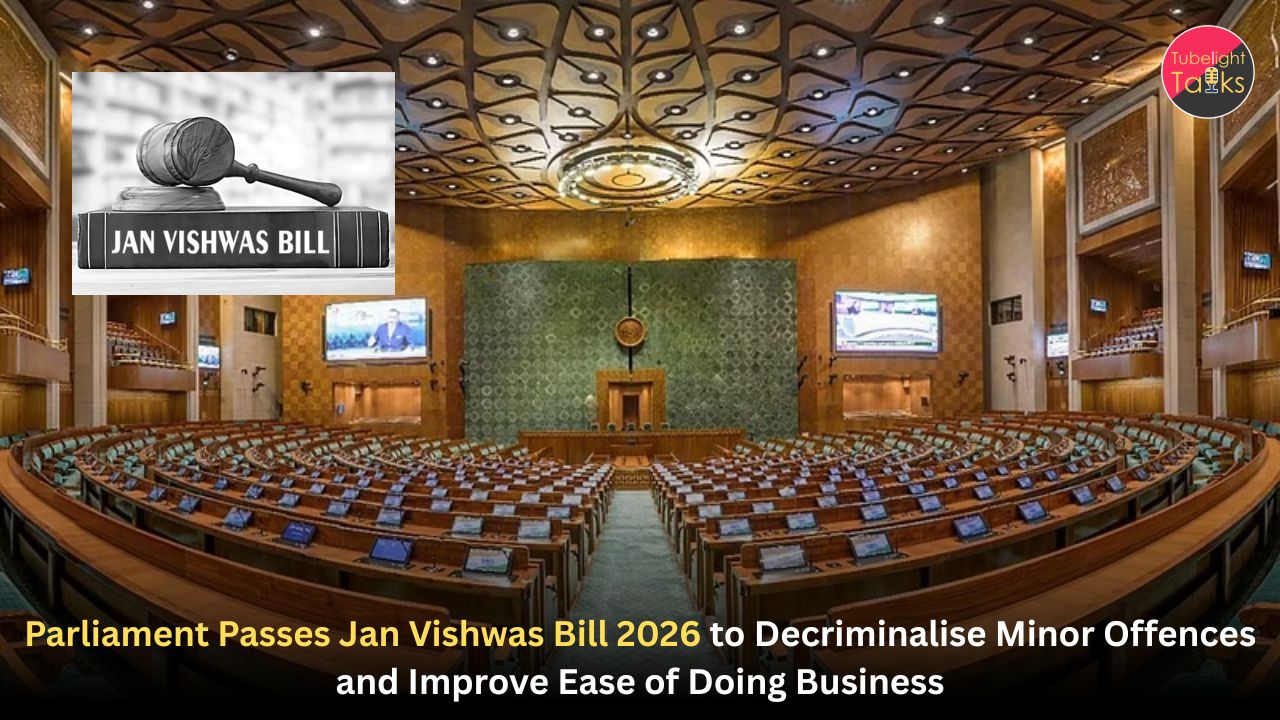
Indian Parliament Passes Jan Vishwas Bill 2026 to Decriminalise Minor Offences and Strengthen Ease of Doing Business
India’s Parliament has passed the Jan Vishwas Bill, 2026, with the government framing it as a major reform aimed at reducing criminal penalties for minor violations and making the regulatory environment less punitive for businesses and citizens. The Ministry of Commerce and Industry said both Lok Sabha and Rajya Sabha have approved the Bill, marking what it described as an important step toward improving both Ease of Doing Business and Ease of Living.
A wide-ranging decriminalisation exercise
The official PIB release says the Bill amends 784 provisions spread across 79 Central Acts administered by 23 Ministries. Of these, 717 provisions have been decriminalised to promote Ease of Doing Business, while 67 provisions have been amended to facilitate Ease of Living. The government also says the larger effect of the Bill is to rationalise more than 1,000 offences by removing minor criminal provisions and replacing fear-heavy compliance with proportionate regulation.
This scale is what makes the Bill politically and administratively significant. Rather than targeting only one ministry or one narrow sector, it operates across dozens of laws and departments. That means its effect is intended to be systemic: fewer unnecessary criminal consequences for technical or low-severity defaults, a lighter compliance environment for enterprise, and a governance structure that relies more on penalties proportionate to the violation than on criminal prosecution by default.
The government’s core argument: trust-based governance
The PIB release describes the Bill as part of the government’s effort to create a “trust-based governance framework” and ensure “proportionate regulation.” In practical terms, that means the state is trying to move away from criminalising minor, procedural, or technical breaches that may not deserve the weight of criminal law. Instead, the emphasis is on rationalisation, simplification and lower compliance burden.
That matters for business confidence. Criminal provisions, even when rarely used, create fear, legal uncertainty and higher transaction costs. By removing or softening such provisions, the government is trying to tell investors, entrepreneurs and smaller businesses that India’s regulatory system is becoming more practical and less adversarial. This is partly an inference, but it is directly supported by the government’s stated focus on Ease of Doing Business and compliance reduction.
The Bill grew substantially after committee scrutiny
One of the most important details in the official account is that the Bill did not remain in its original form. PIB says it was first introduced in the Lok Sabha on August 18, 2025 as the Jan Vishwas (Amendment of Provisions) Bill, 2025. At that stage, it proposed amendments to 355 provisions across 16 Central Acts administered by 10 Ministries or Departments. It was then referred to a Select Committee of the Lok Sabha chaired by Shri Tejasvi Surya.
The committee process appears to have significantly expanded the Bill’s scope. According to PIB, the Select Committee held 49 sittings and submitted its report on March 13, 2026. During that process, it not only examined the original provisions but also considered additional provisions within the same Acts and recommended decriminalisation across 62 additional Central Acts. That helps explain how the final Bill grew from 355 provisions across 16 Acts to 784 provisions across 79 Acts.
Why this matters for Ease of Doing Business
The stated purpose of the Bill is not merely legal housekeeping. The government is explicitly linking it to India’s business climate. According to PIB, 717 provisions have been decriminalised specifically to promote Ease of Doing Business. That means the reform is intended to reduce the fear of criminal liability for low-level violations, cut compliance friction, and create a more business-friendly operating environment.
This could matter especially for smaller firms and first-generation entrepreneurs. Large companies usually have legal teams and compliance capacity, but smaller businesses often struggle under complex rules and the risk of disproportionate penalties. When minor violations are criminalised, even a technical lapse can create reputational and procedural damage far beyond the underlying issue.
Decriminalisation does not remove regulation, but it can make regulation less intimidating and more manageable. This is an inference from the government’s stated objectives and the nature of decriminalisation reform.
Not only business reform, but also “Ease of Living”
The Bill’s framing goes beyond commerce. PIB says 67 provisions have been amended to promote Ease of Living. That phrasing suggests the reform is not only about corporate or industrial convenience, but also about reducing unnecessary legal burden on ordinary people where the law has become too punitive or outdated for minor violations.
This is politically important because it broadens the Bill’s appeal. A regulatory reform presented only as pro-business can sometimes seem narrow or elite. By adding Ease of Living to the official rationale, the government is saying the law should be proportionate not only in how it treats firms, but also in how it treats citizens.
A continuation of a broader reform pattern
The 2026 Bill also appears to build on the earlier Jan Vishwas reform model rather than starting from scratch. PIB notes that the government’s objective is to rationalise outdated legal provisions and foster a more conducive ecosystem for businesses and citizens alike. The final form of the Bill shows a deeper second-stage expansion after committee review, which suggests the government is using Jan Vishwas as an ongoing framework for cleaning up old penal provisions across multiple laws.
That matters because legal reform often stalls when it is attempted one law at a time. A bundled amendment approach across many Acts can move faster and have broader effect, provided the drafting is sound and enforcement agencies actually adapt to the new philosophy. The Bill’s ultimate success will therefore depend not only on passage, but also on implementation across the Ministries and regulators whose laws are being amended. This is an inference grounded in the Bill’s cross-ministerial scope.
A more humane legal culture
A legal system should maintain order, but it should not punish beyond reason. That thought connects naturally with the teachings of Sant Rampal Ji Maharaj, which emphasize justice, truth, compassion and proportionate conduct rather than harshness driven by ego or power. The smoother social meaning of this reform is that governance becomes healthier when it distinguishes between serious wrongdoing and minor error.
A state that acts with fairness earns more trust than one that threatens criminal punishment for every small lapse. This is why proportionate regulation is not only administrative reform, but also a moral improvement in public life.
Call to Action
The passage of the Jan Vishwas Bill 2026 should now be judged by what happens after Parliament. Businesses, citizens, legal professionals and industry bodies should watch closely to see how quickly departments update compliance systems, forms, enforcement manuals and penalty practices in line with the new framework. Decriminalisation on paper is important, but ease in real life will depend on whether regulators actually behave differently.
FAQs: Parliament Passes Jan Vishwas Bill 2026 to Decriminalise Minor Offences and Improve Ease of Doing Business
1. Has Parliament passed the Jan Vishwas (Amendment of Provisions) Bill, 2026?
Yes. PIB says both Lok Sabha and Rajya Sabha have passed the Bill.
2. What is the main purpose of the Bill?
The government says it aims to reduce compliance burden, decriminalise minor offences, rationalise legal provisions and improve Ease of Doing Business and Ease of Living.
3. How many provisions and laws does the Bill cover?
According to PIB, it amends 784 provisions across 79 Central Acts administered by 23 Ministries.
4. How many provisions have been decriminalised?
PIB says 717 provisions have been decriminalised to promote Ease of Doing Business.
5. Does the Bill also affect ordinary citizens, not just businesses?
Yes. PIB says 67 provisions have been amended to facilitate Ease of Living, indicating a citizen-facing component as well.
6. Was the Bill changed after being introduced?
Yes. It was introduced in August 2025 in a narrower form, then expanded substantially after review by a Lok Sabha Select Committee that held 49 sittings and submitted its report in March 2026.
Related Stories









Discussion (0)