Government Waives Duty on Petrochemical Imports, Raises LPG Allocation to 70%
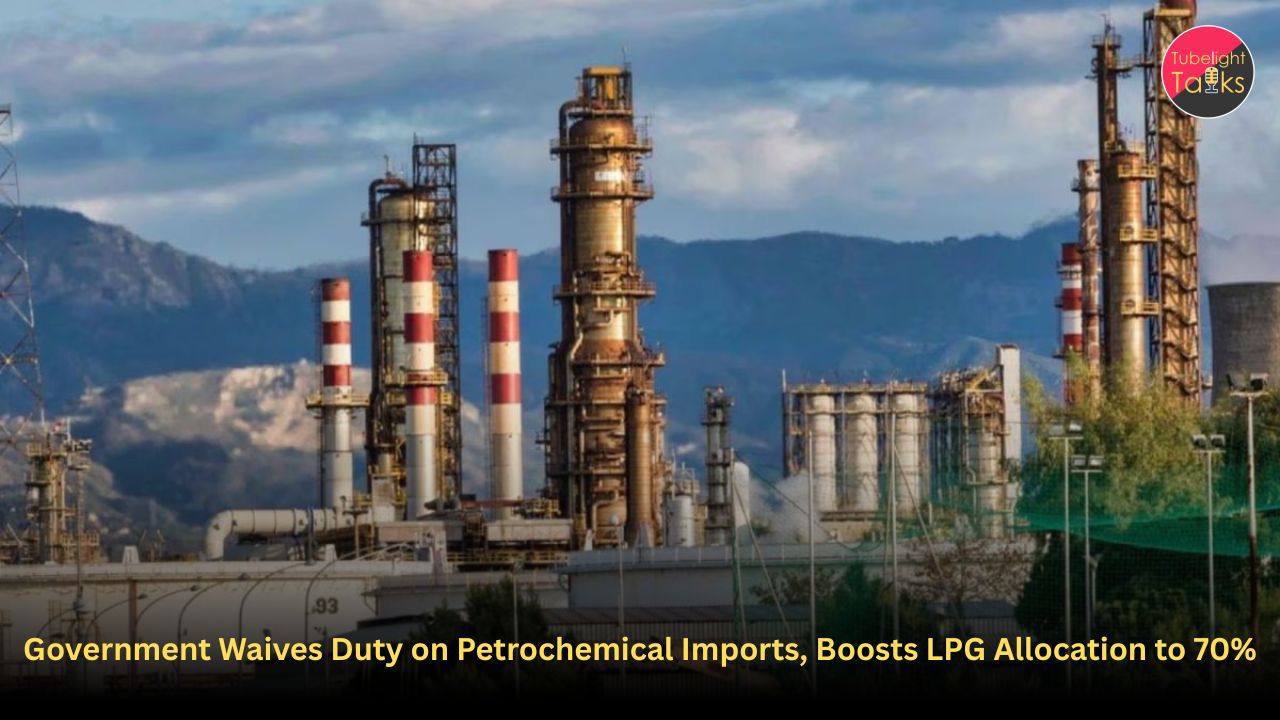
India has rolled out fresh economic relief measures to cushion the domestic impact of the ongoing West Asia conflict, as the Government Waives Duty on Petrochemical Imports and increases commercial LPG allocation to 70% of pre-crisis levels. The two most important steps are a full customs duty exemption on 40 critical petrochemical imports until June 30, 2026, and an increase in commercial LPG allocation.
Together, these measures show that the government is trying to contain both industrial input stress and energy-supply disruption before they spread more deeply into prices and production.
The customs-duty waiver is real, targeted and time-bound
Reuters reported that India has abolished import tax on petrochemicals used in plastics and pharmaceutical goods, with the exemption covering 40 products and remaining valid until June 30, 2026. PIB search results also describe the move as a “targeted relief” granted in view of the ongoing conflict in West Asia. This means the measure is not a general tariff overhaul, but a temporary intervention focused on critical industrial inputs.
That time-bound structure matters. A three-month exemption suggests the government sees the problem as urgent but potentially fluid, and wants to bridge a period of acute disruption without permanently rewriting the tariff framework. It also leaves room for extension or revision if the war-driven supply stress lasts longer than expected. This is an inference, but it is directly supported by the limited validity period reported by Reuters.
Why petrochemical imports suddenly became a policy priority
Reuters said the Iran war and related energy disruption led India to redirect some domestic petrochemical components toward LPG production in order to deal with cooking-gas shortages. That in turn squeezed feedstock availability for local petrochemical manufacturers, pushed up costs, and created pressure across downstream sectors. The duty waiver is therefore meant to compensate for a shortage created not only by global turmoil, but also by India’s own emergency rebalancing of supplies.
This is why the relief is economically significant. Petrochemicals are not isolated industrial goods. They sit inside plastics, chemicals, pharmaceuticals and several other manufacturing chains. When those inputs get expensive or scarce, the effects spread beyond factories into consumer-facing products and wider inflation concerns. The government’s response appears designed to stop that chain reaction early.
The LPG measure is specific to commercial allocation, not all LPG supply
The second part of the headline also needs careful wording. The verified official formulation is not that “LPG allocation” in general has been raised to 70%, but that commercial LPG allocation has been increased to 70% of pre-crisis levels. PIB’s Ministry of Petroleum and Natural Gas update states exactly that and adds that 33,781 metric tonnes of non-domestic LPG had already been uplifted by commercial entities since March 14, 2026.
PIB’s related sector-specific notes explain the mechanics more precisely. They say an additional 20% commercial LPG allocation was approved, taking total commercial allocation to 70% of the pre-crisis level, including 10% reform-based allocation. The same official notes say priority is being given to industries such as steel, automobiles, textiles, dyes, chemicals and plastics, especially process industries where LPG cannot be easily replaced by natural gas.
The government is trying to protect both household stability and industrial continuity
PIB’s petroleum update says domestic LPG cylinder delivery remains normal, with more than 54 lakh refills delivered in a single day, while commercial LPG allocation has been increased separately. That split is important. It suggests the government is trying to preserve household cooking-gas stability while also preventing industrial disruption from becoming severe.
In policy terms, that is a balancing act. On one side, domestic fuel reliability is politically and socially sensitive. On the other, commercial LPG shortages can hit restaurants, small businesses and process industries quickly. By increasing commercial allocation while maintaining normal domestic delivery, the government appears to be trying to contain pressure on both fronts at once. This is an inference, but it follows directly from the way the official update distinguishes domestic LPG delivery from commercial LPG allocation.
These measures are part of a broader crisis-response package
Reuters reported that New Delhi has already taken several steps to soften the economic blow of the West Asia war, including cutting excise duties on petrol and diesel and considering wider trade interventions. Another Reuters report said the petrochemical duty relief forms part of a support package worth roughly ₹18 billion. This shows the government is not treating the current shock as a narrow sector problem, but as a broader economic stability challenge.
Reuters also reported that the government is examining further import-duty cuts and even possible export restraints on some goods to safeguard domestic supplies. That means the customs-duty waiver and commercial LPG allocation increase may be only the first visible layer of a larger crisis-management strategy.
The downstream beneficiaries are likely to be immediate and wide
Reuters identified plastics and pharmaceuticals as clear beneficiaries of the petrochemical duty waiver. PIB’s LPG allocation update separately names chemicals and plastics among the sectors receiving priority under the increased commercial LPG framework. Put together, these two measures are likely to offer relief to industries that are especially exposed to feedstock stress, fuel costs and process disruption.
That overlap matters because it increases the chance of actual near-term stabilisation. If the government had cut import duties without addressing commercial LPG constraints, or increased LPG allocation without easing petrochemical import costs, the relief would have been partial. By acting on both sides, it is trying to support continuity in a more coordinated way. This is an inference, but it is strongly supported by the sector lists and the dual nature of the policy response.
A crisis response rooted in timely intervention
Economic shocks test whether policy can move quickly enough to prevent disruption from spreading. These measures show an attempt to respond before shortages and price pressure become more damaging. Wise intervention at the right moment can protect ordinary people, workers and industries from the worst effects of external turmoil.
Call to Action
Businesses in plastics, pharmaceuticals, chemicals and LPG-dependent process industries should review sourcing and production plans immediately while these relief measures remain in force. Citizens and market watchers should also track whether the government extends the duty waiver beyond June 30 or further adjusts commercial fuel allocation if the West Asia conflict continues to disrupt supply chains.
FAQs: Government Waives Duty on Petrochemical Imports
1. What petrochemical relief has the government announced?
India has granted full customs duty exemption on 40 critical petrochemical imports until June 30, 2026.
2. Is the exemption permanent?
No. Reuters reported that it is a temporary measure valid until June 30, 2026.
3. Has LPG allocation been increased to 70%?
Yes, but specifically for commercial LPG. PIB said commercial LPG allocation has been increased to 70% of pre-crisis levels.
4. How was the 70% level reached?
PIB says the government approved an additional 20% commercial LPG allocation, which takes the total to 70% of pre-crisis levels including 10% reform-based allocation.
5. Which sectors are expected to benefit most?
Reuters identified plastics and pharmaceuticals, while PIB said priority in commercial LPG allocation is being given to steel, automobile, textile, dye, chemicals and plastics industries.
6. Why were these measures needed?
Reuters reported that the West Asia conflict disrupted energy supplies, forced diversion of some domestic petrochemical streams toward LPG production, and raised cost and availability pressure for downstream industries.
Related Stories






Discussion (0)