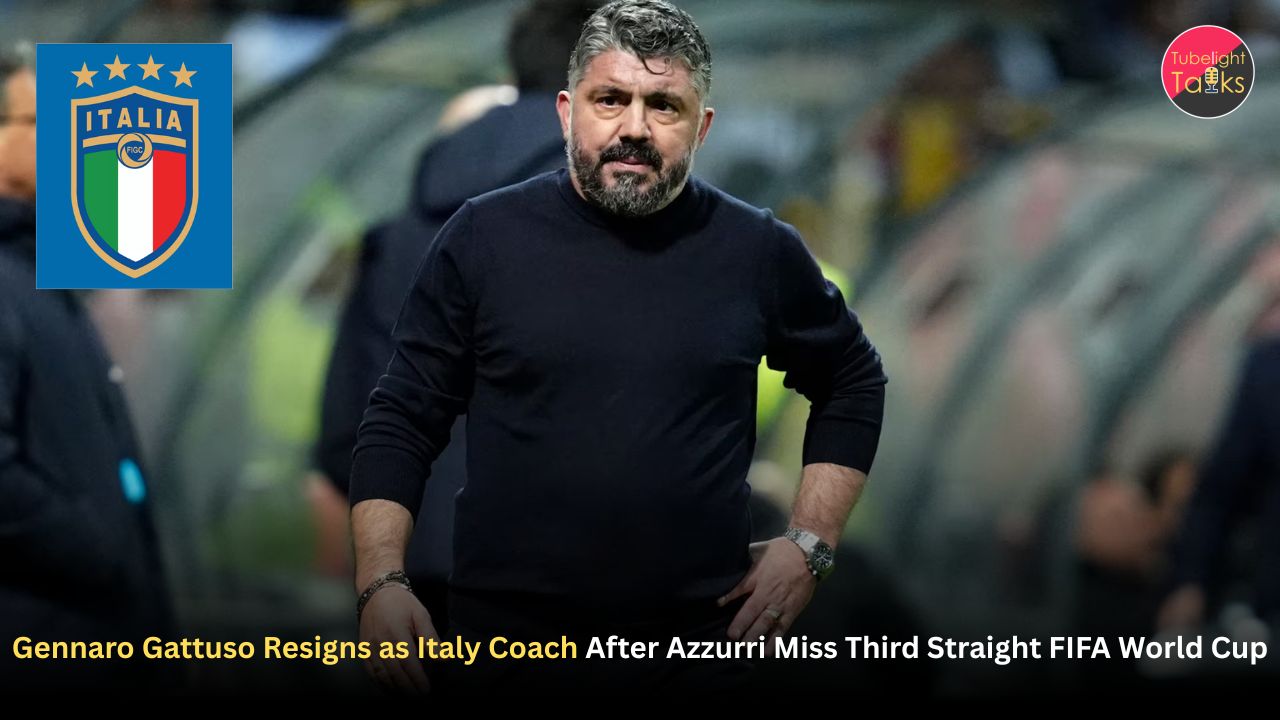
Gennaro Gattuso Resigns as Italy Coach After Azzurri Miss Third Consecutive World Cup
Gennaro Gattuso Resigns as head coach of Italy’s national football team after the Azzurri failed to qualify for the 2026 FIFA World Cup. Reuters reported that the resignation followed Italy’s playoff-final defeat to Bosnia and Herzegovina on penalties, a result that condemned the four-time world champions to a third consecutive World Cup absence after also missing the 2018 and 2022 editions.
Another World Cup failure has pushed Italian football deeper into crisis
Italy’s latest collapse has been widely treated as historic and humiliating. AP reported that Bosnia and Herzegovina beat Italy in a playoff after a 1-1 draw, winning the penalty shootout 4-1 and securing qualification while Italy were left out again. Reuters said Gattuso’s team had won five group matches but still fell short because Norway finished above them on goal difference, forcing Italy into the playoffs.
This is why the resignation matters so much. Italy is not dealing with one bad tournament cycle anymore. Missing three straight World Cups is a structural failure for a country with four global titles and one of football’s deepest traditions. AP described the latest miss as part of a broader national decline, and Reuters reported that the fallout has now spread beyond the coach to the federation’s leadership as well.
Gattuso’s tenure ended after less than a year
Reuters reported that Gattuso had been appointed in June 2025 on a one-year contract after Luciano Spalletti was sacked. His tenure therefore ended after roughly ten months, making it short both in duration and in legacy. He did manage to steady parts of the qualifying campaign, but the final outcome overwhelmed any partial gains.
In the Reuters account, Gattuso said it had been an honour to coach the national team but acknowledged that a fresh start was needed. That wording captures the mood of his departure well: not just disappointment, but a recognition that Italy’s problem now appears bigger than one manager alone.
The defeat to Bosnia became the breaking point
The immediate trigger for the resignation was the playoff loss to Bosnia and Herzegovina. AP reported that Italy had taken an early lead through Moise Kean, then lost control after Alessandro Bastoni was sent off, before eventually falling in the shootout. Reuters and other reports described the defeat as the final collapse in a qualification campaign already damaged by earlier failures.
That context matters because Gattuso did not lose his job after one isolated bad match in a vacuum. He lost it after a match that symbolized Italy’s larger pattern of fragility under pressure. A team once known for tournament ruthlessness is now repeatedly finding ways to fall short at the doorway to the World Cup. That is an inference, but it is strongly supported by the repeated qualification failures and the reported mood around the playoff defeat.
Also Read: Curaçao’s Giant Leap: Football’s Smallest Contender Reaches World Stage
The crisis has already spread beyond the coach
Reuters reported on April 2 that Italian football federation president Gabriele Gravina also resigned after the latest World Cup failure. Reuters further said Gianluigi Buffon stepped down from his national-team role, showing that the shock has triggered a broader institutional reset rather than a coaching change alone.
That makes this moment more serious than a routine post-defeat sacking. Italian football is not only searching for a new coach. It is confronting questions about leadership, infrastructure, planning and the national-team model itself. Reuters’ separate report on UEFA’s warning over Italy’s Euro 2032 co-hosting role adds to the sense that the crisis is both sporting and structural.
Italy’s image as a football superpower is under strain
AP noted that no current Italian player has experienced a World Cup finals appearance, which is a remarkable fact for a nation that won the tournament in 2006 and qualified consistently for decades before the recent collapse. The same AP reporting described Italy’s latest failure as its longest World Cup drought in generations.
This is why Gattuso’s resignation feels symbolic. He is leaving not just because a target was missed, but because Italy’s football identity is under question. A country that once defined tournament football is now dealing with absence, not ambition. That shift explains why the latest failure has been described in such dramatic national terms by international coverage.
What comes next for Italy
Reuters said speculation over Gattuso’s successor already includes names such as Massimiliano Allegri and Antonio Conte. Italy’s next scheduled match is a friendly against Greece on June 7, followed by the Nations League in September against Belgium, which means the federation does not have unlimited time to stabilise the situation.
The bigger challenge, however, is not only choosing a replacement. It is deciding whether Italy wants a short-term rescue or a deeper rebuild. Coaching changes can alter mood quickly, but repeated World Cup failures usually point to problems that sit below the touchline as well. This is an inference, but it follows from the repeated qualification collapse and the simultaneous resignations of the coach and federation leadership.
When prestige collapses, honesty matters most
Moments like this show how fragile worldly prestige can be. A nation celebrated for glory can still fall into crisis when complacency, confusion or poor direction take hold. The deeper lesson is that true strength is sustained only through discipline, humility and honest self-examination. Without those, even the proudest institutions drift into decline.
Call to Action
Italy’s next appointment should be judged not by reputation alone, but by whether it signals a serious plan to rebuild. Fans and observers should watch two things closely now: who takes over, and whether the federation treats this as a one-man failure or as a deeper football-system crisis that requires wider change.
FAQs: Gennaro Gattuso Resigns as Italy Coach
1. Did Gennaro Gattuso resign as Italy coach?
Yes. Reuters reported that Gattuso stepped down after Italy failed to qualify for the 2026 World Cup.
2. Why did he resign?
His resignation followed Italy’s playoff defeat to Bosnia and Herzegovina on penalties, which meant the Azzurri missed a third consecutive World Cup.
3. Has Italy really missed three straight World Cups?
Yes. Italy failed to qualify for the 2018, 2022 and 2026 FIFA World Cups.
4. When did Gattuso become Italy manager?
Reuters reported that he was appointed in June 2025 after Luciano Spalletti was sacked.
5. Who else has resigned in Italian football after the failure?
Reuters reported that federation president Gabriele Gravina and national-team delegation head Gianluigi Buffon also resigned.
6. Who could replace Gattuso?
Reuters said names being discussed include Massimiliano Allegri and Antonio Conte.
Related Stories







Discussion (0)