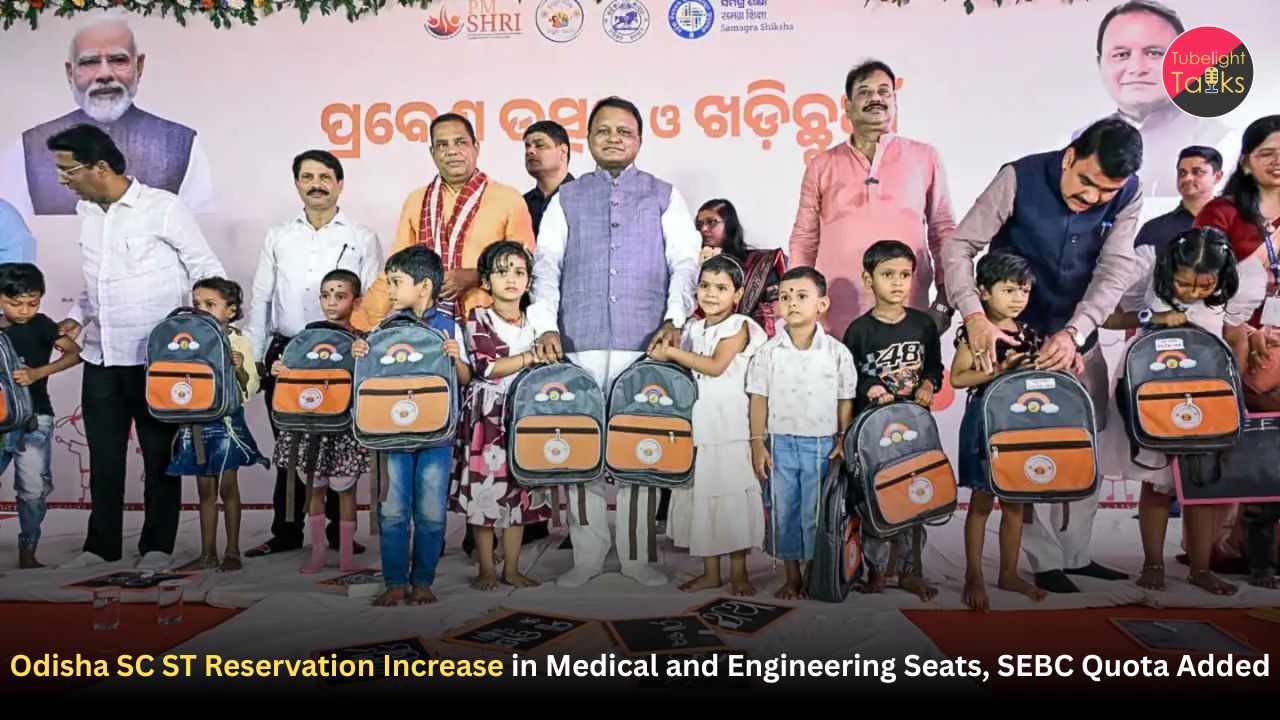
Odisha SC ST Reservation Increase in Medical and Engineering Seats, SEBC Quota Added
The Odisha Cabinet has approved a revised reservation policy for medical, engineering and other higher and technical education courses across the state, marking a major Odisha SC ST Reservation Increase. Under the new framework, ST reservation rises from 12% to 22.5%, SC reservation rises from 8% to 16.25%, and SEBC students receive 11.25% reservation for the first time. The total reserved share is capped at 50%.
A major shift in admission policy
The strongest current reporting describes this as a Cabinet decision, not merely a proposal. Indian Express reported that the BJP government in Odisha took the decision late Saturday, while Odisha TV said the revised policy has been approved for medical, engineering and other higher and technical education courses.
This means the user’s headline is directionally correct, but one detail deserves precision: the policy does not only affect medical and engineering seats. It also extends to a wider set of higher and technical education programmes across state institutions.
What exactly changes for SC and ST students
According to Indian Express, reservation for ST students increases from 12% to 22.50%, and for SC students from 8% to 16.25%. Odisha TV reported the same figures and said the revised structure applies across state universities, affiliated colleges, ITIs and polytechnics.
So while “doubles” works as a headline shorthand, the exact picture is slightly more nuanced. ST reservation rises by 10.5 percentage points and SC reservation by 8.25 percentage points, which is close to doubling in both cases but not mathematically identical.
Also Read: Gujarat UCC Bill Moment: Why Live-In Registration Clause Sparks Debate
SEBC students are being brought into the framework for the first time
A major new part of the policy is the addition of 11.25% reservation for Socially and Educationally Backward Classes. Indian Express reported that these students were not getting reservation earlier in these courses, and Odisha TV said the new quota is part of a 50% total reservation framework across the relevant institutions.
That makes this not only a quota increase for SC and ST students, but also a structural redesign of professional-course access in Odisha. The change broadens the reservation framework rather than simply adjusting two existing percentages.
The seat impact is substantial
Indian Express reported that, out of 2,421 UG and PG medical seats in the state, 545 will now be reserved for ST students, 393 for SC students and 272 for SEBC students. The same report said that, out of 44,579 engineering seats, 10,030 will be reserved for ST students, 7,244 for SC students and 5,015 for SEBC students. Odisha TV reported the same seat numbers.
These numbers show why the Cabinet move matters in practice. This is not a symbolic adjustment that affects only a few institutions. It changes the distribution of thousands of seats across major professional streams.
The government’s justification is social justice and population balance
Indian Express quoted officials and Chief Minister Mohan Charan Majhi as saying the previous quota structure left SC and ST reservation below their population share in the state, while SEBC students had no reservation in these courses. Odisha TV similarly reported that the Chief Minister framed the decision as a corrective move aimed at social justice and empowerment.
That framing matters because it shows the policy is being positioned not only as an education measure, but as a redistribution of opportunity in line with Odisha’s social composition. This is a political and administrative statement about who gets access to state-supported professional education.
The scope is wider than medicine and engineering alone
Indian Express reported that the new reservation policy will apply across engineering, technology, management, computer applications, medicine, surgery, dental, nursing, pharmacy, allied health sciences, veterinary science, ayurveda, homeopathy, agriculture and allied sciences, architecture, planning, cinematic art and technology, and similar bachelor’s and master’s courses. Odisha TV carried a matching description.
So the decision is best understood as a higher-education reservation overhaul with especially visible effects in medicine and engineering. Those two sectors attract the most attention, but the policy architecture is considerably broader.
Why this matters for inclusive growth
Professional education often shapes long-term income mobility, state capacity and representation in high-skilled sectors. By expanding reservation in medical and engineering streams, Odisha is intervening at a point where access can strongly affect future employment, professional status and social advancement. This is an inference, but it is directly grounded in the scale of the seat changes reported in current coverage.
The effect will now depend on implementation. Admission systems, prospectuses, counselling rules and institutional compliance all need to reflect the new framework cleanly for the policy to translate into real opportunity. This is an inference based on the fact that the decision is a Cabinet-approved framework that must still operate through admission machinery.
Equality in opportunity strengthens society
A policy like this also connects with a larger moral idea: access to education should not be blocked by inherited disadvantage. In the spirit of Sant Rampal Ji Maharaj’s teachings, social systems should move toward equality, dignity and the removal of discrimination based on caste or status. His official social-reform messaging emphasizes treating all individuals equally regardless of caste, religion or social position, which aligns naturally with the goal of widening educational opportunity.
Call to Action
Students, parents and educational institutions in Odisha should now watch for the detailed implementation guidelines for the upcoming admission cycle. The Cabinet decision is significant, but its real impact will depend on how quickly counselling systems, seat matrices and institutional rules are updated to reflect the revised reservation structure.
FAQs: Odisha SC ST Reservation Increase
1. Has Odisha officially doubled reservation for SC and ST students in medical and engineering courses?
The Odisha Cabinet has approved a major increase: ST reservation rises from 12% to 22.5% and SC reservation from 8% to 16.25%. That is close to doubling, though the exact percentages are slightly below a full doubling.
2. Is this only for medical and engineering seats?
No. Current reporting says the policy also covers other higher and technical education courses, including management, nursing, pharmacy, agriculture, architecture and more.
3. What is the new SEBC quota?
A new 11.25% reservation has been introduced for Socially and Educationally Backward Classes.
4. What is the total reservation cap under the new Odisha policy?
The total reservation has been kept at 50%.
5. How many medical seats will now be reserved?
Out of 2,421 UG and PG medical seats, 545 will go to ST students, 393 to SC students and 272 to SEBC students, according to current reporting.
6. How many engineering seats will now be reserved?
Out of 44,579 engineering seats, 10,030 will be reserved for ST students, 7,244 for SC students and 5,015 for SEBC students.
Related Stories





Discussion (0)