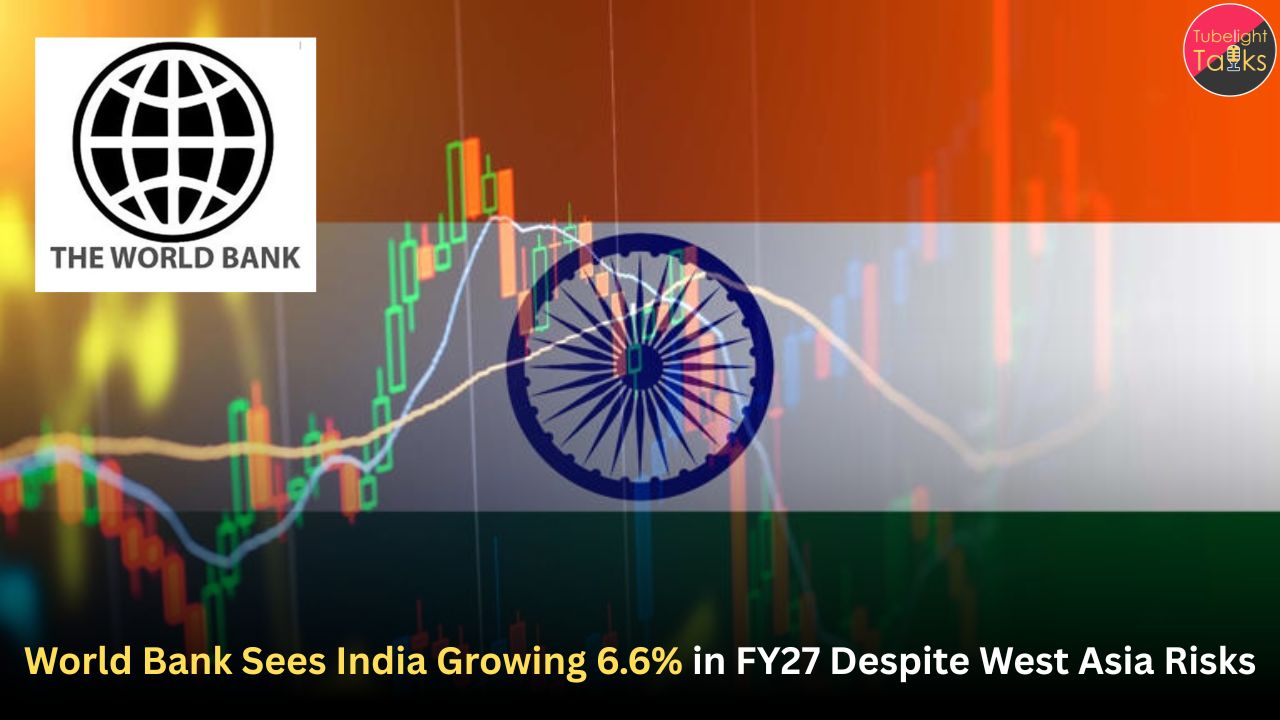
Economic Outlook: World Bank Projects India at 6.6% Growth in FY27
The World Bank has projected India’s economic growth at 6.6% in FY27, maintaining the country’s position among the world’s fastest-growing major economies despite the disruptive effects of conflict in West Asia. In its April 2026 update and related India press statement, the Bank said higher energy prices and supply-chain disruptions linked to the regional crisis would weigh on activity, but India’s growth base remained stronger than that of many peers.
Reuters added that India’s heavy dependence on oil imports leaves it vulnerable to energy shocks, even as strong banks and large foreign-exchange reserves provide important policy buffers.
Why 6.6% still matters
In an ordinary year, 6.6% might sound like a moderation rather than a triumph. But in the current context, the number is significant because it comes at a time of war-linked supply disruption, imported inflation risks and external uncertainty. The World Bank’s April 9 India press release explicitly said India remains among the fastest-growing major economies even with the slowdown. Reuters likewise reported that the Bank sees India holding up better than many other large economies despite downside risks from the Middle East conflict.
This matters because growth is relative as well as absolute. If many economies are slowing under energy stress, then a country that still grows above 6% and retains investment credibility stands out. For India, the message is not that risks have disappeared; it is that the economy still has momentum, scale and domestic demand capacity that can absorb at least part of the shock.
Also Read: Economic Milestone: World Bank Upgrades India’s Growth Outlook
The forecast is stronger than the Bank’s earlier view
Economic Times, citing the latest World Bank update, said the 6.6% FY27 number represents an upward revision from 6.3% projected earlier. That upward move suggests the Bank sees more resilience in India’s demand base and export performance than it did previously. It also implies that domestic fundamentals have improved enough to offset some external pressure, even if not all of it.
Forecast revisions matter because institutions like the World Bank do not revise casually. They adjust when incoming data, policy developments or macro assumptions materially shift. In India’s case, stronger domestic demand and solid export performance appear to have improved the medium-term view, even while West Asia creates new uncertainty.
What is supporting India’s resilience
One major support is domestic demand. India’s economy is not driven only by exports, and that gives it some insulation when the external environment deteriorates. Consumption, services activity, public investment and private sector adaptation all help keep momentum alive. The World Bank’s India press release and South Asia materials place India at the centre of regional growth performance, while Reuters highlights well-capitalised banks and large foreign-exchange reserves as important stabilisers.
Foreign-exchange reserves matter especially in periods of imported stress. If oil prices rise, the rupee can face pressure and external financing conditions can tighten. A country with deeper reserves and stronger banking buffers is better placed to manage volatility. Reuters reported India’s reserves at $697.1 billion, underlining the scale of the cushion available to policymakers.
South Asia’s broader slowdown makes India stand out even more
The World Bank’s regional update said South Asia’s growth is expected to slow to 6.3% in 2026 because of global energy-market disruption, before recovering later. Even in that slower regional picture, India remains the main growth driver. The Bank’s regional press release explicitly says South Asia remains the world’s fastest-growing emerging-market and developing-economy region due to India’s strong performance.
That does not mean India is immune. It means India is carrying more of the regional burden. In practical terms, investors, multilateral institutions and businesses will increasingly view India as the anchor economy in South Asia when assessing demand, supply-chain relocation, and medium-term recovery. That raises expectations as much as it raises prestige.
The risks are real and should not be ignored
The World Bank’s optimism is paired with caution. Reuters reported that risks to India’s projected 6.6% growth are skewed to the downside because of the West Asia crisis. India imports around 90% of its oil, which means any prolonged disruption in energy markets can feed into inflation, the current account deficit and fiscal stress. The same report said retail inflation in FY2026 is estimated at 4.9%, reflecting food and energy pressures and currency depreciation.
Higher energy prices can damage growth in several ways at once. They raise transport and production costs. They reduce household purchasing power. They can force governments to spend more on subsidies or tax relief. They also complicate central bank decisions because policymakers must balance inflation control with growth support. This is why external shocks are especially dangerous for import-dependent economies: even if domestic demand remains strong, energy stress can quietly erode that strength over time.
Growth quality matters as much as headline growth
A 6.6% forecast is encouraging, but the deeper question is what kind of growth India produces. Is it job-rich? Is it inclusive across states and income groups? Does it build productivity rather than only consumption? Does it strengthen manufacturing and logistics or leave the economy too exposed to external price shocks? Multilateral forecasts are useful, but they do not answer these structural questions by themselves.
This is where public policy becomes decisive. Strong growth during a volatile period should be used to deepen energy security, diversify trade, invest in logistics, protect macro stability and generate employment. Otherwise, a country can grow quickly and still remain fragile in the face of repeated external shocks. India’s resilience is real, but converting resilience into lasting strength requires policy discipline.
Prosperity, restraint and Sat Gyaan
In the light of Sat Gyaan, material growth has value, but it is not complete prosperity by itself. A nation may expand economically and still struggle with anxiety, greed and inequality if moral balance is missing. Sant Rampal Ji Maharaj teaches that real well-being comes when worldly progress is joined with truthful living, restraint and devotion. Economic success is strongest when it supports a more disciplined and compassionate society.
Call to Action
Read official economic updates, understand both strengths and vulnerabilities, and look beyond headlines. True economic confidence comes from facts, not hype.
FAQs: World Bank Sees India Growing 6.6% in FY27 Despite West Asia Risks
Q1. What is the World Bank’s FY27 growth forecast for India?
The World Bank projects India’s FY27 growth at 6.6%.
Q2. Why is this considered strong?
Because the Bank says India remains among the world’s fastest-growing major economies even amid regional conflict.
Q3. What is the biggest downside risk?
India’s heavy dependence on imported oil and energy-market disruption linked to West Asia.
Q4. Has the forecast been revised?
Yes. Reporting says the 6.6% forecast is higher than the World Bank’s earlier 6.3% view.
Q5. What supports India’s resilience?
Strong domestic demand, well-capitalised banks and large foreign-exchange reserves.
Related Stories







Discussion (0)