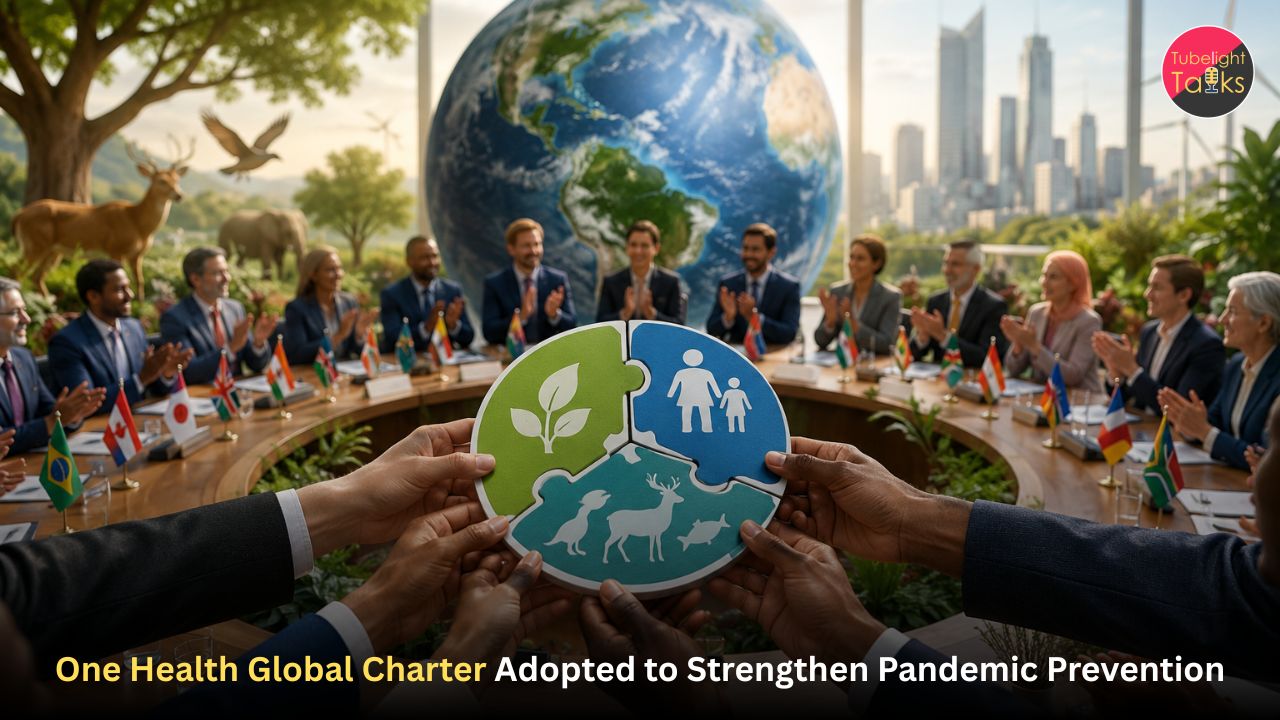
One Health Global Charter: World Health Leaders Adopt Unified Framework for Pandemic Prevention
World health leaders have adopted a new One Health global framework that integrates human, animal and environmental health into a single pandemic-prevention approach. The decision reflects a major shift in global health thinking after COVID-19, avian influenza outbreaks, antimicrobial resistance, climate-linked disease risks and repeated warnings about zoonotic spillover.
The One Health approach recognizes that the health of humans, domestic animals, wildlife, plants and ecosystems is closely connected. Future pandemics may not begin in hospitals; they may begin in forests, farms, markets, livestock systems, wildlife trade, polluted environments or climate-stressed regions. The new charter aims to make prevention faster, more coordinated and more equitable.
One Health Global Charter: Why It Matters Now
A New Model for Pandemic Prevention
The adoption of a One Health global framework is important because traditional health systems often respond after a disease has already spread. One Health tries to prevent crises earlier by monitoring the interfaces where diseases can move between animals, humans and the environment.
Most emerging infectious diseases in humans are linked in some way to animals or ecological disruption. When forests are destroyed, wildlife habitats shrink, livestock production intensifies, cities expand and climate patterns change, the chances of pathogen spillover can increase. The One Health model addresses these risks before they become global emergencies.
Instead of keeping health ministries, veterinary departments, environmental agencies and agricultural authorities in separate silos, the framework pushes them to share data, coordinate surveillance and act together.
Lessons From COVID-19
COVID-19 exposed major gaps in global preparedness. Countries struggled with delayed detection, poor coordination, unequal vaccine access, misinformation, weak health systems and lack of trust. The new One Health framework responds to that experience by emphasizing prevention, early warning and cross-sector cooperation.
A pandemic cannot be managed only by hospitals. It requires laboratories, public health teams, veterinarians, wildlife experts, farmers, border authorities, environmental scientists, local governments, researchers and communities. One Health gives these actors a common platform.
What Is One Health?
Human, Animal and Environmental Health Together
One Health is an integrated approach that aims to balance and optimize the health of people, animals and ecosystems. It recognizes that human survival depends on healthy animals, safe food, clean water, stable climate, functioning ecosystems and responsible land use.
For example, an outbreak in poultry farms can affect human health. Antibiotic misuse in animals can contribute to antimicrobial resistance in humans. Deforestation can increase contact between wildlife and communities. Climate change can expand mosquito-borne diseases. Polluted water can harm humans, livestock and wildlife together.
One Health does not treat these as separate problems. It studies them as connected risks.
From Concept to Action
The idea of One Health is not new, but the challenge has always been implementation. Many countries support One Health in speeches but continue to operate with fragmented systems. The new charter aims to move One Health from theory into action.
That means building joint surveillance systems, shared laboratories, common emergency protocols, integrated data platforms, coordinated funding and cross-ministry accountability. The real success of the charter will depend on whether countries implement these tools, not just whether they sign declarations.
Also Read: One Health Movement: Global Leaders Push Integrated Human, Animal and Environmental Health Action
Core Areas of the One Health Charter
Zoonotic Disease Surveillance
Zoonotic diseases are infections that can move between animals and humans. Examples include rabies, Ebola, avian influenza, coronaviruses and many emerging threats. The charter places strong emphasis on monitoring zoonotic risks in wildlife, livestock and human populations.
Better surveillance can detect unusual illness in animals before it spreads to humans. It can also help identify high-risk regions where human activity is increasing contact with wildlife.
Antimicrobial Resistance
Antimicrobial resistance, or AMR, occurs when bacteria, viruses, fungi or parasites no longer respond to medicines. AMR is worsened by overuse and misuse of antibiotics in humans, animals and agriculture. It is often called a silent pandemic because it can make common infections harder to treat.
The One Health framework treats AMR as a shared human-animal-environment problem. Hospitals, farms, pharmacies, veterinary systems, wastewater plants and food chains must all be part of the solution.
Food Safety and Agriculture
Food systems are central to One Health. Unsafe food, contaminated water, poor slaughter practices, overcrowded farms and weak animal-health monitoring can contribute to disease spread. The charter encourages stronger food safety systems, responsible farming, animal vaccination, veterinary services and biosecurity.
This is especially important for countries where livestock, poultry, dairy, fisheries and informal food markets are essential to livelihoods.
Climate and Health
Climate change is changing disease patterns. Warmer temperatures can expand the range of mosquitoes and ticks. Floods can increase waterborne disease. Droughts can stress livestock and human communities. Heatwaves can weaken health systems and increase vulnerability.
The One Health charter connects climate adaptation with health security. It recognizes that environmental protection is not separate from pandemic prevention.
Wildlife and Ecosystem Protection
The destruction of ecosystems can increase disease risk. When wildlife habitats are disturbed, animals may move closer to farms and human settlements. Wildlife trade and illegal markets can also increase pathogen transmission.
The charter supports stronger wildlife monitoring, habitat protection, biodiversity conservation and action against illegal wildlife trade. Protecting ecosystems is therefore part of protecting public health.
Why a Unified Framework Is Needed
Health Threats Cross Borders
Diseases do not respect national boundaries. A pathogen that appears in one village can spread globally through travel, trade and migration. This makes international cooperation essential.
A unified framework can improve communication between countries, support early alerts, reduce duplication and help weaker health systems receive support before outbreaks become disasters.
Fragmented Systems Delay Response
When ministries and agencies do not share information, outbreaks can be missed. A veterinary department may detect unusual animal deaths, but public health officials may not act quickly. Environmental changes may signal risk, but health systems may not monitor them.
One Health reduces these gaps by making joint action standard. The framework encourages countries to build permanent coordination systems rather than temporary crisis committees.
Also Read: Robotic Surgery Expansion: AI-Enabled and Robotic Systems Strengthen Public Healthcare in India
Benefits for Developing Countries
Stronger Local Preparedness
Developing countries often face higher exposure to zoonotic disease risks because of agriculture dependence, biodiversity-rich landscapes, informal markets, limited health infrastructure and climate vulnerability. A One Health framework can help build stronger local preparedness.
This includes training community health workers, veterinarians, forest officials, laboratory staff and local governments to detect risks early.
More Equitable Global Health
One concern after COVID-19 was inequality. Richer countries gained faster access to vaccines and medical supplies, while poorer countries waited. A strong One Health framework must be supported by fair financing, technology transfer and equitable access to diagnostics, vaccines and treatments.
Pandemic prevention cannot be effective if poorer countries are expected to monitor global risks without resources.
India’s Role in One Health
National One Health Mission
India has been developing its own One Health approach through national coordination across human, animal and environmental health sectors. This is especially important because India has a large population, diverse ecosystems, major livestock systems, wildlife-rich regions and high climate vulnerability.
A strong One Health system can help India improve disease surveillance, veterinary public health, food safety, laboratory networks, antimicrobial resistance control and outbreak response.
Rural and Local Governance
In India, One Health must reach villages, Panchayats, farms, animal shelters, wildlife areas, dairy networks and local clinics. Disease risks often begin locally. Therefore, district-level and village-level coordination is essential.
Panchayats, ASHA workers, veterinarians, forest guards, farmers and local health departments can become important partners in early warning and prevention.
Challenges Ahead
Funding Gaps
One Health requires money. Surveillance systems, laboratories, field teams, data platforms, training and emergency response all need long-term funding. Without finance, the charter may remain only a statement of intent.
Data Sharing
Countries may hesitate to share outbreak information because of trade losses, tourism concerns or political pressure. But delayed reporting can worsen global risk. The framework must encourage trust, transparency and fair support for countries that report early.
Coordination Across Ministries
Human health, animal health, agriculture, environment and climate agencies often have different priorities. Effective One Health governance requires clear authority, shared budgets and regular coordination.
Community Trust
No framework can succeed without public trust. Communities must understand why surveillance, vaccination, safe farming, wildlife protection and responsible antibiotic use matter. Public communication must be clear and respectful.
One Health and Spiritual Responsibility
The One Health Global Charter reminds humanity that life is interconnected. Human beings cannot harm animals, pollute water, destroy forests, misuse medicines and exploit nature without facing consequences. The teachings of Sant Rampal Ji Maharaj and Sat Gyaan emphasize truth, compassion, humility, righteous conduct and true worship according to holy scriptures. His teachings guide people away from intoxication, corruption, greed, dishonesty, violence and harmful habits.
In the context of One Health, this spiritual wisdom is deeply relevant. A healthy world requires responsible human behavior. Sat Gyaan teaches that outer purity and inner purity are connected. When human conduct becomes disciplined and compassionate, society naturally protects animals, nature and future generations. True health security must therefore include moral and spiritual reform along with scientific systems.
FAQs on One Health Global Charter
1. What is the One Health Global Charter?
The One Health Global Charter is a unified global framework that links human, animal and environmental health to strengthen pandemic prevention and health security.
2. Why is One Health important for pandemic prevention?
Many emerging diseases begin at the human-animal-environment interface. One Health helps detect and reduce risks before they become large outbreaks.
3. What issues does the One Health approach cover?
It covers zoonotic diseases, antimicrobial resistance, food safety, wildlife monitoring, climate-health risks, environmental protection, agriculture and public health surveillance.
4. How can One Health help control antimicrobial resistance?
It addresses antibiotic use in humans, animals, farming, food systems and the environment, making resistance control more coordinated and effective.
5. Why is the environment included in health planning?
Environmental damage, climate change, deforestation, water pollution and biodiversity loss can increase disease risks. Protecting ecosystems helps protect human and animal health.
6. What challenges can affect the charter’s success?
Major challenges include funding gaps, poor coordination, weak surveillance systems, limited data sharing, political mistrust, unequal resources and lack of community participation.
Related Stories







Discussion (0)