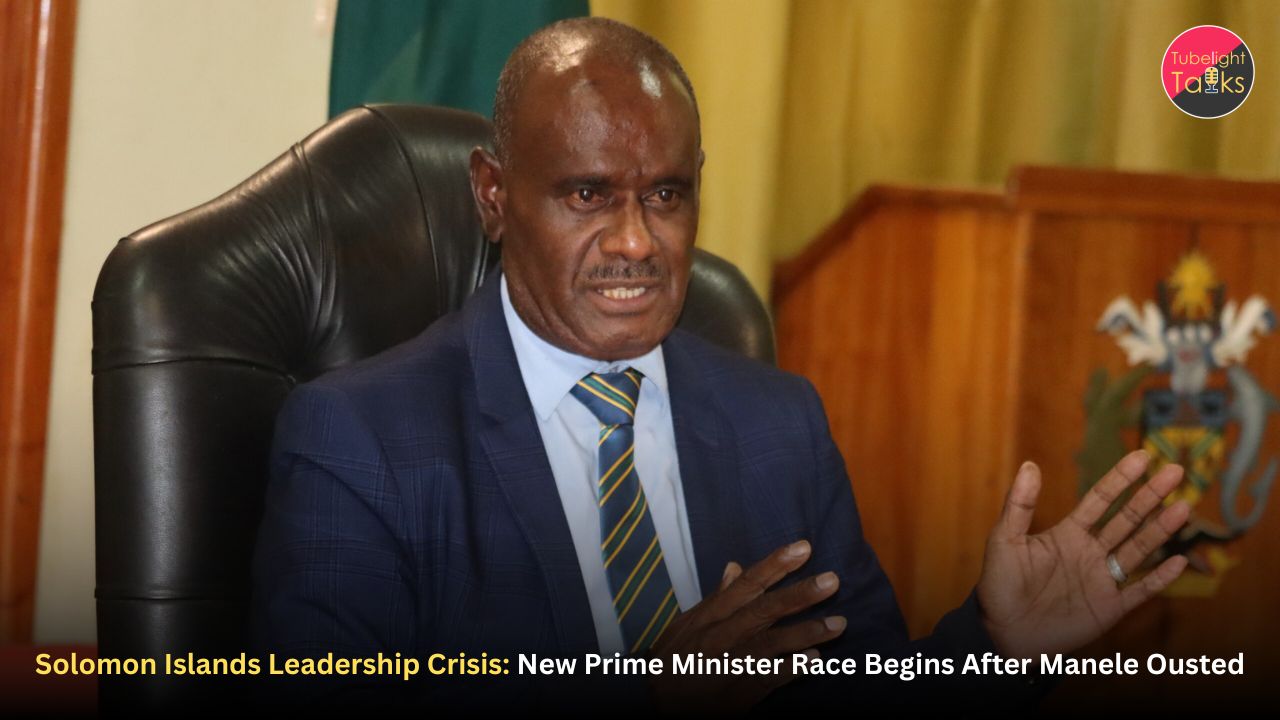
Solomon Islands Leadership: New Leader to Be Chosen After No-Confidence Vote Ousts Prime Minister Jeremiah Manele
Solomon Islands is preparing to appoint a new leader after Prime Minister Jeremiah Manele was removed through a parliamentary no-confidence vote, creating fresh political uncertainty in one of the Pacific’s most strategically watched nations. Manele lost the vote on May 7, 2026, by 26 votes to 22, with two lawmakers abstaining. He will remain in office until he is formally removed by the Governor-General, who represents King Charles III as the country’s head of state.
The leadership shift follows weeks of political instability after more than a dozen government ministers defected to the opposition. The change is being closely monitored by Australia, China, the United States and Pacific neighbours because Solomon Islands has become a key arena of geopolitical competition in the South Pacific.
Solomon Islands No-Confidence Vote: What Happened?
Manele Loses 26–22
Prime Minister Jeremiah Manele was ousted after losing a no-confidence vote in parliament by a margin of 26 to 22. Two legislators abstained. The vote ended a turbulent period in which Manele’s governing majority weakened after cabinet resignations and defections shifted parliamentary numbers against him.
In Solomon Islands’ parliamentary system, a prime minister depends on the confidence of the legislature. Once that confidence is lost, the government cannot continue as before. Manele’s defeat means the country must now move into the constitutional process of selecting a new leader.
Manele said after the vote that he hoped leaders would continue bipartisan work to improve the country. His tone was measured, but the political message was clear: the country now faces another leadership reset at a sensitive time.
Governor-General’s Formal Role
Manele remains in office until he is formally removed by the Governor-General. This procedural step matters because Solomon Islands is a constitutional monarchy and the Governor-General performs formal duties on behalf of the head of state. After Manele’s formal removal, parliament must move toward selecting a new prime minister.
The exact timeline for the next leadership decision will depend on parliamentary processes, coalition negotiations and which blocs can assemble a majority. In Pacific politics, leadership contests often involve intense negotiation among independents, party groups and coalition partners.
Why Manele Lost Power
Coalition Fractures and Ministerial Defections
Manele’s removal followed political turbulence sparked by the defection of more than a dozen government ministers to the opposition in March. Those defections stripped the government of its majority and left the prime minister vulnerable.
He initially resisted recalling parliament to face the no-confidence vote. However, court orders compelled the parliamentary session to proceed. That legal intervention added constitutional pressure to an already fragile political situation.
The defections suggest that dissatisfaction had been building inside the governing coalition. In small parliamentary systems, internal disputes over portfolios, development funds, policy priorities and personal alliances can quickly become government-ending crises.
Leadership Stability Has Long Been a Challenge
Solomon Islands has a history of political instability, with prime ministers often removed before completing full terms. Coalition politics can be fluid because parties are less institutionally rigid than in larger parliamentary democracies. Members of Parliament may shift support based on local interests, leadership confidence or development priorities.
This makes governance difficult. Long-term policy planning requires stability, but frequent leadership changes can disrupt budgets, infrastructure projects, foreign agreements, public-sector reform and service delivery.
Also Read: Benjamin Netanyahu Health Update: Leadership Amid Uncertainty
Who Could Become the Next Prime Minister?
Potential Candidates Under Discussion
The leadership race is now open. International reporting has mentioned possible contenders including former Prime Minister Manasseh Sogavare and former coalition member Peter Shanel Agovaka. Both are viewed by analysts as figures who could influence the direction of Solomon Islands’ relationship with China.
Sogavare remains one of the most influential figures in the country’s modern politics. His previous government switched diplomatic recognition from Taiwan to China in 2019 and later signed the 2022 security pact with Beijing. That decision transformed Solomon Islands into a major focus of regional geopolitical attention.
However, the next leader may not necessarily follow a simple pro-China or anti-China line. Solomon Islands politics is shaped by local constituency interests, development needs, parliamentary arithmetic and personal alliances. The final outcome may depend less on ideology and more on who can secure enough support.
Opposition Is Not Uniform
The opposition includes a range of figures with different views on China, Australia and domestic reform. Some may want closer engagement with Western partners. Others may favour stronger ties with Beijing. This means the new government’s foreign policy direction may not be immediately clear even after a new leader is chosen.
This uncertainty is why regional capitals are watching closely. The leadership outcome could affect security cooperation, policing agreements, infrastructure projects, port access, development aid and diplomatic alignments.
Geopolitical Importance of Solomon Islands
China-West Competition in the Pacific
Solomon Islands has become strategically important because of its location northeast of Australia and its role in the wider South Pacific. China’s growing presence in the region has raised concern in Australia, New Zealand, the United States and among some Pacific neighbours.
The 2022 China-Solomon Islands security pact was especially controversial because critics feared it could eventually allow Chinese security forces, police or even naval access in the region. Beijing and Honiara denied hostile intentions, but the agreement changed the strategic conversation across the Pacific.
Manele, a former diplomat, tried to balance relations between China and Western partners. As foreign minister, he was linked to the China security pact. As prime minister, he later secured a major security deal with Australia to strengthen the Solomon Islands police force.
Australia’s Major Stake
Australia considers Solomon Islands part of its immediate regional security environment. Canberra has invested heavily in policing support, development aid and diplomatic engagement with Honiara. A sudden leadership change could affect Australia’s Pacific strategy.
The A$190 million security deal signed under Manele was seen as an attempt to balance Beijing’s influence and strengthen local police capacity with Australian support. If a new leader shifts policy, that deal and future cooperation may face review or renegotiation.
U.S. Interest in the Pacific
The United States has also increased attention to Pacific island nations in recent years. Washington sees the region as vital to Indo-Pacific strategy, maritime access and competition with China. A leadership change in Solomon Islands could influence U.S. engagement and regional diplomacy.
For small island nations, this attention can bring opportunities and risks. Competition between major powers may increase aid, infrastructure and security support, but it can also create pressure, dependency and domestic political division.
Also Read: US Navy Secretary John Phelan Exits Amid Pentagon Shake-Up and Security Scrutiny
Domestic Issues Behind the Leadership Crisis
Governance and Service Delivery
While foreign policy receives international attention, ordinary Solomon Islanders are likely more concerned about jobs, education, healthcare, roads, fuel prices, climate vulnerability and public services. Political instability can weaken progress on these everyday needs.
The country faces challenges common to many island states: dispersed geography, limited infrastructure, high import dependence, climate risk, youth unemployment and fiscal pressure. A new prime minister will need to focus on domestic delivery, not only geopolitical balancing.
Fuel and Cost-of-Living Pressure
The Pacific region has been facing fuel-supply concerns and import-cost pressures. Solomon Islands, like many island economies, relies heavily on imported energy and goods. Leadership instability can complicate responses to such economic stress.
A government distracted by political survival may struggle to manage inflation, fuel shortages, transport costs and rural development needs.
What Happens Next?
Coalition Negotiations Begin
The immediate next step is coalition negotiation. MPs and political blocs will determine who can command majority support. Because the no-confidence vote was 26 to 22, the anti-Manele camp clearly had enough votes to remove him. But removing a leader is easier than agreeing on a replacement.
Different groups may support different candidates. Cabinet positions, policy promises, constituency development priorities and foreign-policy commitments may all feature in negotiations.
Formal Election of New Prime Minister
After the Governor-General completes the constitutional process, parliament will move toward choosing the next prime minister. The new leader must show majority support. Once elected, the prime minister will form a cabinet and set the government’s direction.
Policy Continuity or Realignment?
The big question is whether Solomon Islands will continue Manele’s balancing approach or shift more strongly toward one external partner. A Sogavare-linked leadership would likely be interpreted internationally as more China-friendly. A leader backed by anti-China MPs could signal closer alignment with Australia and Western partners. A compromise candidate may try to preserve flexibility.
Why Stability Matters for the Pacific
Small States, Big Strategic Pressure
Small island states often face intense pressure from larger powers. They need investment, climate finance, infrastructure and security support, but they also need sovereignty and policy independence.
Solomon Islands’ next government will have to manage these pressures carefully. A foreign policy based only on external competition could deepen domestic divisions. A policy based on national welfare, transparency and balanced partnerships may serve citizens better.
Democracy Requires Trust
No-confidence votes are constitutional tools, but frequent leadership changes can weaken public trust if citizens feel politicians are focused more on power than service. The new leadership must restore confidence by showing accountability, stability and practical governance.
Leadership, Power and the SatGyaan Message
The Solomon Islands leadership crisis shows that political power is temporary, and leadership becomes meaningful only when it serves people with truth, humility and justice. JagatguruRampalJi.org explains that Sant Rampal Ji Maharaj’s objectives include establishing peace and brotherhood, eradicating corruption, removing hypocrisy, ending discrimination and creating a clean society by eliminating social evils. This is directly relevant to political transitions like this one.
When leaders become attached to chair, prestige and external influence, governance becomes unstable. But when leadership is guided by truth, service and moral conduct, even a small nation can protect its dignity and welfare. Sant Rampal Ji Maharaj’s SatGyaan teaches that true reform begins when human beings reject greed, corruption and ego and follow the scripture-based path of righteousness and devotion to Supreme God Kabir.
For Solomon Islands, the deeper lesson is that foreign policy balance and parliamentary numbers will matter, but public welfare will succeed only when leadership is rooted in honesty and service.
FAQs on Solomon Islands Leadership Crisis
1. Who was removed as Prime Minister of Solomon Islands?
Prime Minister Jeremiah Manele was removed after losing a parliamentary no-confidence vote.
2. What was the vote margin?
Manele lost the vote 26 to 22, with two lawmakers abstaining.
3. Why did Manele lose power?
His government lost majority support after more than a dozen ministers defected to the opposition, creating a political crisis.
4. Who may become the next leader?
Possible contenders mentioned in reports include former Prime Minister Manasseh Sogavare and Peter Shanel Agovaka, though the final choice will depend on parliamentary support.
5. Why is the leadership change internationally important?
Solomon Islands is strategically important in the Pacific and has become a focus of competition between China, Australia, the United States and regional partners.
6. What happens next?
The Governor-General will complete the formal constitutional process, and parliament will move toward choosing a new prime minister who can command majority support.
Related Stories




Discussion (0)