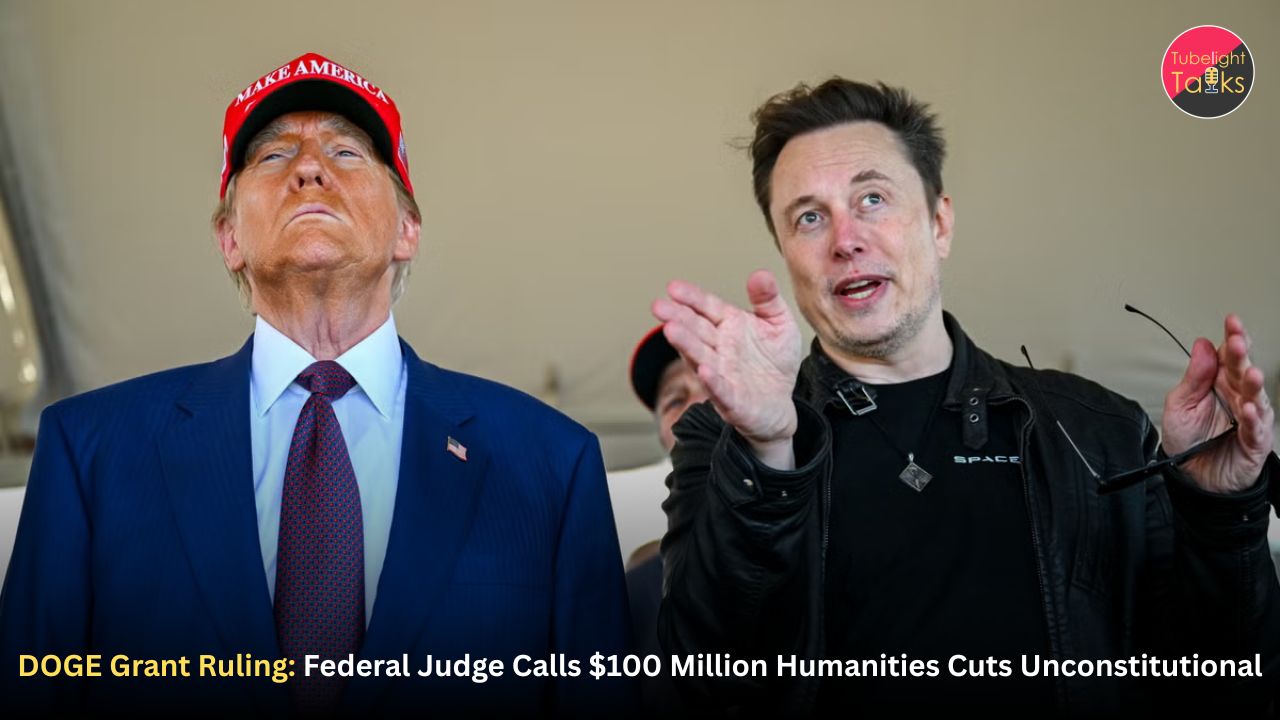
DOGE Grant Ruling: U.S. Federal Judge Says $100 Million Humanities Grant Cuts Were Unconstitutional
A U.S. federal judge has ruled that the Trump administration’s DOGE-led cancellation of more than $100 million in humanities grants was unconstitutional, unlawful and discriminatory. The grants, awarded through the National Endowment for the Humanities, supported scholars, writers, museums, archives, cultural institutions and research organizations. U.S. District Judge Colleen McMahon ruled that DOGE lacked statutory authority to terminate the grants and that the cancellations violated the First Amendment and the equal-protection component of the Fifth Amendment.
The court also strongly criticized DOGE’s use of ChatGPT to identify projects allegedly connected to diversity, equity and inclusion. The ruling is being seen as a major victory for academic freedom, cultural preservation, constitutional governance and transparency in public funding decisions.
DOGE Grant Ruling: What the Court Decided
More Than $100 Million in Grants Were Cancelled
The case centered on the cancellation of more than 1,400 National Endowment for the Humanities grants worth over $100 million. These grants had been awarded to scholars, writers, public-history projects, museums, universities, cultural groups and humanities organizations. The DOGE-led cuts were part of the Trump administration’s wider cost-cutting and anti-DEI push.
The grants were not merely future proposals waiting for review. Many had already been awarded, meaning recipients had planned research, hired staff, arranged programming, contracted vendors, scheduled exhibitions or started public projects. Sudden termination therefore caused direct financial, professional and institutional disruption.
Judge McMahon’s ruling said the government could not erase congressionally appropriated humanities funding through an unauthorized process. That is one of the strongest parts of the decision. It reaffirmed that federal agencies must act within law, and that a cost-cutting initiative cannot override constitutional rights or statutory limits.
DOGE Lacked Legal Authority
The court found that DOGE officials lacked statutory authority to direct the terminations. This matters because the Department of Government Efficiency was created as an administrative efficiency project, not as a body authorized by Congress to cancel legally awarded grants.
In a constitutional system, money appropriated by Congress and awarded through a legal agency process cannot be withdrawn simply because outside officials dislike the project’s subject matter. The National Endowment for the Humanities was established by law, and its grant programmes operate under statutory rules. DOGE’s intervention crossed that boundary, according to the court.
This ruling may influence other lawsuits involving federal grant cancellations because it challenges the idea that executive initiatives can freely dismantle already-approved funding streams.
First Amendment and Fifth Amendment Issues
Viewpoint Discrimination
The judge ruled that the grant cancellations violated the First Amendment because projects were targeted based on viewpoint and subject matter. Grants linked to race, ethnicity, religion, national origin, sex, sexual orientation, immigration, gender identity or diversity-related themes were flagged and terminated.
This is a serious constitutional issue. The government may set lawful funding priorities, but it cannot punish speech, scholarship or cultural work simply because it dislikes a viewpoint. Public funding cannot become a tool for ideological censorship.
Humanities projects often study difficult subjects: slavery, civil rights, migration, religion, genocide, Indigenous history, war, gender, democracy, literature and social change. If the government can cancel grants because such subjects are politically uncomfortable, academic freedom and public history suffer.
Equal Protection and Due Process
The court also found Fifth Amendment problems. Grant recipients were not given a fair process before termination, and the criteria used were discriminatory. The equal-protection component of the Fifth Amendment restricts the federal government from treating people or projects unfairly based on protected characteristics or biased classifications.
Due process matters because grant recipients need clear reasons, lawful standards and a meaningful opportunity to respond. A vague cancellation notice or automated classification cannot replace proper legal procedure.
Also Read: DOGE Humanities Ruling: Federal Judge Says $100 Million Grant Cancellations Were Unconstitutional
ChatGPT and AI Use Under Judicial Scrutiny
AI Used to Flag Grants
One of the most striking parts of the ruling was the court’s criticism of DOGE’s use of ChatGPT. Reports say DOGE staff used ChatGPT to identify grants connected to diversity, equity and inclusion. The judge found that DOGE used AI-generated outputs without meaningful legal review or a clear definition of DEI.
This raises a major question for modern governance: can government agencies use AI tools to make decisions that affect constitutional rights, funding, speech, scholarship and livelihoods? The answer from this case is clear: AI cannot become a shield for unlawful conduct.
Technology may help organize documents, but it cannot replace law, judgment, transparency and accountability. If an AI tool misclassifies a project, the human officials using it remain responsible.
AI Cannot Be Blamed for Government Decisions
The judge’s reasoning is important because it prevents a dangerous excuse. Government officials cannot say, “The AI selected it,” and avoid responsibility. If an official uses a tool to make a decision, that decision still belongs to the official and the government.
This matters far beyond humanities grants. AI is increasingly being considered for welfare screening, immigration processing, policing, benefit distribution, hiring, education and healthcare administration. The DOGE ruling warns that automated shortcuts can become unconstitutional if used without legal safeguards.
What Types of Projects Were Affected?
History, Culture and Public Memory
The cancelled grants included projects related to civil rights, Holocaust education, Indigenous knowledge, African American history, immigration, local museums, public archives and cultural preservation. Reports highlighted that some Jewish humanities grants and Holocaust-related research projects were also affected.
These are not abstract academic luxuries. They shape public memory. They help societies understand injustice, identity, suffering, resilience and moral lessons from history.
When a grant supporting Holocaust education or civil rights history is cancelled because it is flagged as politically disfavored, the issue becomes larger than budget efficiency. It becomes a question of what kind of history a society is willing to preserve.
Impact on Small Institutions
Large universities may sometimes absorb funding shocks, but small museums, local archives, independent scholars, historical societies and public humanities organizations often cannot. A cancelled grant can mean cancelled exhibitions, unpaid staff, abandoned research, broken contracts and lost educational programming.
Many humanities projects operate on modest budgets. A federal grant may be the difference between preserving a community archive and letting it disappear. That is why this ruling matters to small cultural institutions across the United States.
Why the Ruling Is a Major Legal Setback for DOGE
DOGE’s Efficiency Argument Faces Limits
DOGE was created to reduce government waste and improve efficiency. Efficiency can be a legitimate goal. Governments should prevent waste, fraud and misuse of funds. But efficiency cannot be used as a cover for unlawful discrimination or constitutional violations.
The court’s ruling draws a line: budget cuts must follow law. A programme can be reviewed, reformed or even reduced, but not through arbitrary, viewpoint-based and unauthorized cancellation.
Political Cost of Overreach
The ruling may also carry political cost. The administration presented DOGE as a symbol of strong executive action and cost control. But a court finding of unconstitutional conduct weakens that image. It suggests not discipline, but overreach.
For opponents, the ruling proves that DOGE acted ideologically rather than neutrally. For supporters, the decision may be seen as judicial interference. Either way, the case will remain politically charged.
Academic Freedom and Democratic Society
Why Humanities Matter
Humanities study what makes human society meaningful: history, language, ethics, philosophy, religion, law, literature, art and culture. They help citizens understand where they came from, what mistakes societies have made and how people can live together more wisely.
A democracy needs more than technology and economic growth. It needs memory, debate, moral reflection and historical honesty. Humanities funding helps preserve those foundations.
Public Funding Should Not Become Political Punishment
Governments may set public funding priorities, but they must not use funding power to silence disfavored ideas. If every new administration cancels scholarship it dislikes, universities, museums and cultural organizations will become politically unstable.
The court’s ruling protects a principle that benefits everyone: public funds must be administered according to law, not political revenge.
Also Read: Trump Questions $21 Million Voter Grant, Sparks Political Storm as DOGE Pulls Funding
What Happens Next?
Terminations Blocked
The ruling blocks the government from enforcing the challenged grant terminations. It also requires the administration to move away from the unlawful cancellation process. However, practical restoration may involve administrative steps, agency action and possibly further litigation.
Appeal Possible
The Trump administration may appeal. If it does, the case could move into higher courts and become a major test of executive authority over congressionally appropriated funds.
Wider Grant-Cut Cases May Be Affected
The decision may influence other challenges to federal grant cancellations. If courts continue to find that DOGE lacked authority or used unconstitutional criteria, more cuts could be reversed.
Lessons for AI Governance
Human Review Is Essential
AI tools must not be used as final decision-makers in matters involving rights, public funds or protected speech. Government use of AI must include human review, clear criteria, legal accountability and appeal mechanisms.
Transparency Matters
Citizens and organizations must know why decisions are made. If a grant is cancelled, the reason must be specific, lawful and reviewable. “The system flagged it” is not enough.
Bias Can Be Automated
AI can reproduce human bias or amplify vague political instructions. If a tool is asked to search for “DEI” without a clear legal definition, it may flag legitimate work on history, religion, race, gender, immigration or civil rights. That can turn technology into a weapon against knowledge.
Knowledge, Fairness and the SatGyaan Message
The DOGE grant ruling is not only a legal issue; it is a reminder that power must be guided by truth, justice and moral responsibility. JagatguruRampalJi.org explains that Sant Rampal Ji Maharaj’s teachings aim to remove social evils such as corruption, bribery, cheating, discrimination, intoxication, dowry and other harmful conduct from society through True Spiritual Knowledge.
The same teachings emphasize that corruption and wrong conduct grow from ignorance, greed and deviation from moral values. In relation to this ruling, the relevance is direct: when public authority is used without fairness, when knowledge is suppressed because of political bias, and when technology is used without moral accountability, society moves away from truth.
Sant Rampal Ji Maharaj’s SatGyaan guides people toward honesty, discrimination-free conduct, scripture-based wisdom and righteous living. A society that values true knowledge will not misuse power to silence scholarship; it will use knowledge to uplift humanity.
FAQs on DOGE Grant Ruling
1. What did the federal judge rule?
The judge ruled that the Trump administration’s DOGE-led cancellation of more than $100 million in humanities grants was unconstitutional, unlawful and discriminatory.
2. Which grants were affected?
The grants were awarded through the National Endowment for the Humanities and supported scholars, writers, museums, archives, research institutions and public humanities organizations.
3. Why did the court say DOGE acted unlawfully?
The court found that DOGE lacked statutory authority to terminate the grants and used discriminatory criteria that violated constitutional protections.
4. Which constitutional rights were involved?
The ruling cited violations of the First Amendment and the equal-protection component of the Fifth Amendment.
5. Why was ChatGPT mentioned in the case?
DOGE reportedly used ChatGPT to identify grants connected to diversity, equity and inclusion, and the judge criticized the lack of meaningful legal review behind that process.
6. What is the broader significance of the ruling?
The ruling reinforces limits on executive power, protects academic freedom, warns against unlawful AI-driven government decisions, and supports transparency in public funding.
Related Stories









Discussion (0)