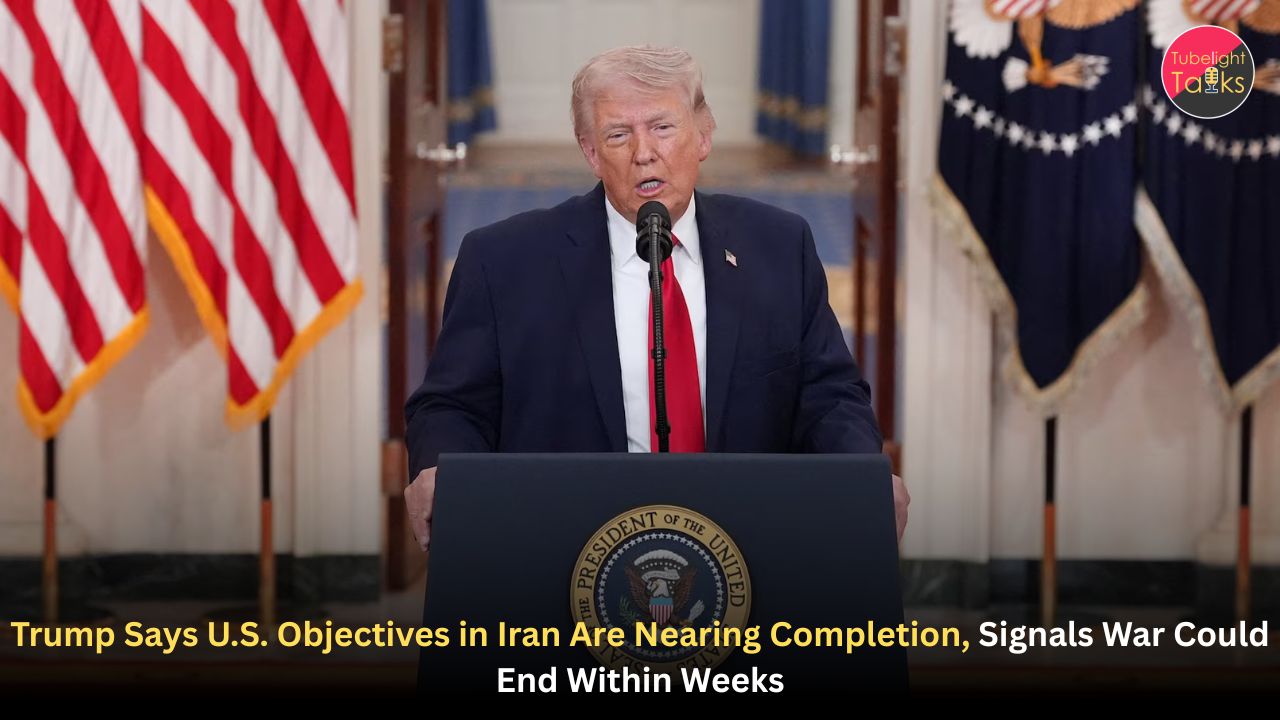
Trump Says U.S. Military Objectives in Iran Are Nearing Completion, but the Endgame Still Looks Unclear
U.S. President Donald Trump has moved from open-ended war messaging to a more defined endgame narrative on Iran. In a nationally televised address on April 1, 2026, he said America’s “core strategic objectives” were nearing completion. Around the same period, he also said the campaign could end within two to three weeks and made clear that the United States does not necessarily need a formal deal with Tehran in order to leave.
That combination of confidence and ambiguity is now shaping global understanding of the conflict: Washington is signaling that the military mission is almost done, but it is still leaving room for more strikes, more pressure, and a withdrawal on its own terms.
Trump’s message has shifted from escalation to an endgame claim
“Core strategic objectives” are now the center of his language
In Reuters’ April 2 report, Trump said the United States was close to achieving its “core strategic objectives” in the war with Iran. In his April 1 televised address, he claimed that Iran’s navy and air force had been destroyed and that its missile and nuclear capabilities had been severely crippled. The White House message was clear in tone even if not in detail: Washington wants the public and markets to believe the war is approaching a decisive phase rather than drifting into a prolonged conflict.
But the exact end-state is still not fully defined
That same messaging has left important questions unanswered. Reuters reported that Trump’s national address did not provide a clear timeline or a fully detailed exit plan, even as he spoke of nearing completion. AP similarly noted that he said U.S. forces would “finish the job” soon but did not offer a concrete resolution to the wider disruption surrounding the Strait of Hormuz. So while the President’s language suggests closure, the policy details still look unfinished.
Also Read: Global Relief as Trump Iran Strike Pause Eases Economic Pressure
The “within weeks” claim is real, and it was tied to a no-deal scenario
Trump explicitly floated a two-to-three-week timeline
Reuters reported on March 31 that Trump said the United States could end its military campaign against Iran within two to three weeks. That was one of his clearest comments yet on timing, and it suggested a faster withdrawal than many had expected from a war that began on February 28, 2026. AP’s subsequent coverage of his speech also described him as saying intensified strikes would continue over the next few weeks, reinforcing the idea that the administration sees the remaining military phase as short, even if still forceful.
He also indicated that a formal deal is not necessary
The most striking element of Trump’s line was his suggestion that the war does not need to end through a negotiated settlement. Reuters reported that he said Iran does not need to make a deal to end the conflict and that the U.S. objective is to cripple Iran’s capabilities, especially its ability to obtain nuclear weapons, and then leave. That makes the administration’s position unusual but clear: Washington appears willing to declare mission success and disengage based on military results rather than a signed diplomatic agreement.
Why this message matters globally
Markets are reading his words as much as his missiles
Trump’s comments are not being treated as mere rhetoric. AP reported that oil prices jumped and Asian markets fell after he said the U.S. would hit Iran hard and “finish the job.” Brent crude rose to around $106 per barrel in that reaction, while several Asian benchmarks fell sharply. That market response shows why his words matter: even a suggestion of a shorter war can be outweighed by fear that the campaign could intensify first or leave key energy routes insecure.
The Strait of Hormuz remains a central anxiety point
One reason for the uncertainty is that the conflict has never been only about Iranian military targets. It has also been about energy disruption and the Strait of Hormuz, a route vital to global oil transport. Reuters and AP both noted that Trump continues to frame the reopening of the strait as critical, while also insisting that the U.S. can finish its military mission soon.
That leaves a key question unresolved: can Washington really declare the campaign done if the broader strategic disruption to oil flows and regional security remains unsettled? This is an inference, but it follows directly from the tension between Trump’s completion claim and continuing market anxiety over Hormuz.
His speech tried to project victory, but skepticism remains
Public and allied concerns have not disappeared
Reuters reported that Trump’s April 1 address came as public support for the war was weakening, with a Reuters/Ipsos poll showing strong disapproval. The report also said the speech offered little new policy detail and did not do much to reassure Americans worried about rising fuel prices or allies looking for a clearer strategy. Washington Post and AP coverage pointed to the same problem in different words: Trump’s tone was confident, but confusion persists over what exactly counts as victory and how the U.S. intends to leave.
Also Read: Ali Khamenei Explained: Rise, Rule and Assassination of Iran’s Leader
Iran is not fully accepting the U.S. narrative
Trump suggested in public comments that Iran had asked for a ceasefire and that new leadership in Tehran might be less radical. But Iranian responses cited in current reporting rejected those claims. That means the American story of nearing completion is not being matched by a clearly acknowledged diplomatic closing sequence on the Iranian side. In practical terms, that makes the conflict’s final phase look more unilateral than mutually agreed.
The speech also reflects Trump’s political balancing act
He wants to look strong without looking trapped
Trump appears to be trying to manage two pressures at once. On one side, he wants to project military dominance and claim that Iran has been decisively weakened. On the other, he faces domestic political pressure over the economic consequences of war, especially rising fuel costs and wider instability. Reuters reported that many Americans want a swift end even if some administration goals are left incomplete. That helps explain why his message combines toughness with a promise of relative speed.
A short war narrative is politically useful, but strategically risky
Saying the war could end in weeks helps Trump present the conflict as controlled, finite and successful. But it also raises expectations. If the campaign drags on, if Iran or its allies continue disruptive action, or if oil markets remain chaotic, the White House may face harder questions about whether it promised too much too early. This is an inference, but it is strongly supported by the mismatch current reporting highlights between Trump’s compressed timeline and the still-volatile regional reality.
What the likely endgame looks like right now
Not a peace deal, but a claimed military finish
Based on Trump’s own recent comments, the most likely scenario he is trying to sell is not a classic peace accord. It is a U.S. declaration that Iran has been sufficiently degraded militarily and strategically, followed by a relatively quick American exit with the option to strike again if necessary. Reuters captured this logic directly in its April 1 interview report, saying Trump planned to leave “pretty quickly” but could return for targeted military action if needed.
That still leaves the region facing aftershocks
Even if active U.S. operations taper within weeks, the conflict’s consequences could last much longer. Oil-market volatility, shipping insecurity, proxy retaliation, regional realignment and the question of Iran’s remaining capabilities do not automatically disappear when one side announces completion. That is why the real end of the campaign may be easier to declare than to prove. This is an inference, supported by the continued focus in recent reporting on market stress, Hormuz disruption and unresolved strategic questions.
When power is not enough
Military power can destroy targets, but it cannot by itself create lasting peace. That deeper truth fits naturally with the teachings of Sant Rampal Ji Maharaj, which stress restraint, truth, compassion and the rejection of destructive ego. A nation may claim success through force, but lasting stability comes only when violence, pride and domination give way to wisdom and moral balance.
In that sense, this moment is a reminder that even when war appears to be nearing completion, humanity’s deeper need is still peace grounded in righteous conduct rather than fear.
Call to Action
The most important thing now is not only what Trump says, but whether events on the ground begin to match his timeline. Readers should watch for three signals in the coming days: whether U.S. strikes actually slow, whether oil-market and Hormuz tensions ease, and whether any clear diplomatic or military exit framework emerges. A war can be declared close to finished long before its real consequences are under control.
FAQs: Trump Says U.S. Objectives in Iran Are Nearing Completion, Signals War Could End Within Weeks
1. Did Trump really say U.S. objectives in Iran are nearing completion?
Yes. Reuters reported on April 2 that Trump said America’s “core strategic objectives” in the Iran war were nearing completion.
2. Did he say the war could end within weeks?
Yes. Reuters reported on March 31 that Trump said the U.S. campaign against Iran could end within two to three weeks.
3. Did Trump say a formal deal with Iran was necessary?
No. Reuters reported that he said Iran does not need to make a deal to end the conflict and that the U.S. could leave once its military objectives were achieved.
4. What did Trump say in his April 1 national address?
He said U.S. objectives were nearly achieved, claimed major damage to Iran’s military and nuclear capabilities, and promised to “finish the job” soon, though he did not fully spell out the end plan.
5. Why are markets reacting so strongly to his comments?
Because the conflict has disrupted oil flows and heightened fears around the Strait of Hormuz. AP reported that oil rose and Asian markets fell after Trump’s latest remarks.
6. Has Iran accepted Trump’s description of the situation?
No clear acceptance is visible in current reporting. Iranian responses cited in news reports rejected Trump’s claims about ceasefire outreach and mocked his suggestion of a changed regime.
Related Stories







Discussion (0)