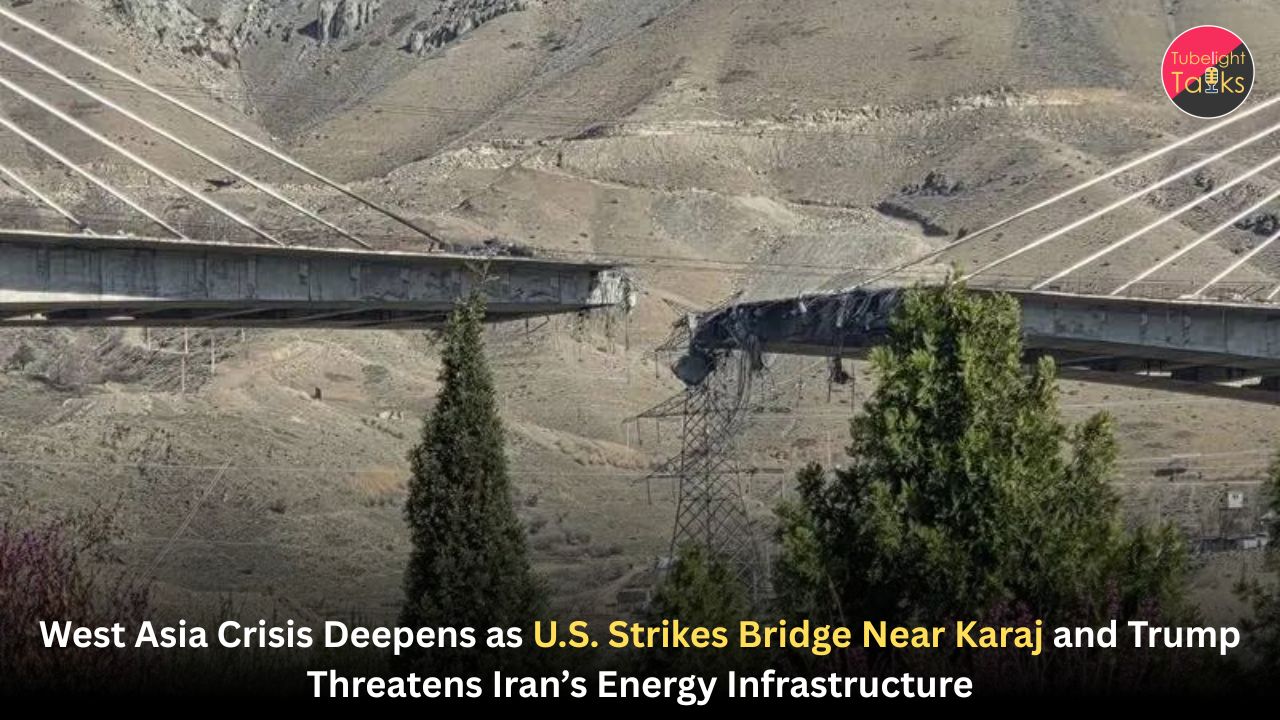
West Asia Crisis Escalates as U.S. Hits Karaj Bridge and Threatens Wider Iranian Infrastructure
U.S. Strikes Bridge Near Karaj: The West Asia conflict escalated sharply on April 2 and April 3 as the United States struck a newly built bridge between Tehran and Karaj and President Donald Trump followed with fresh threats against Iran’s bridges, electric power plants, and possible energy and oil infrastructure.
Reuters reported that the B1 bridge attack killed eight people and wounded 95, according to Iranian state media, while Trump’s later comments suggested the campaign could move further into civilian-linked infrastructure. Iran responded by warning of “more crushing, broader and more destructive” attacks, underscoring how quickly the conflict is widening beyond conventional military targets.
The Karaj bridge strike marked a major new stage in the war
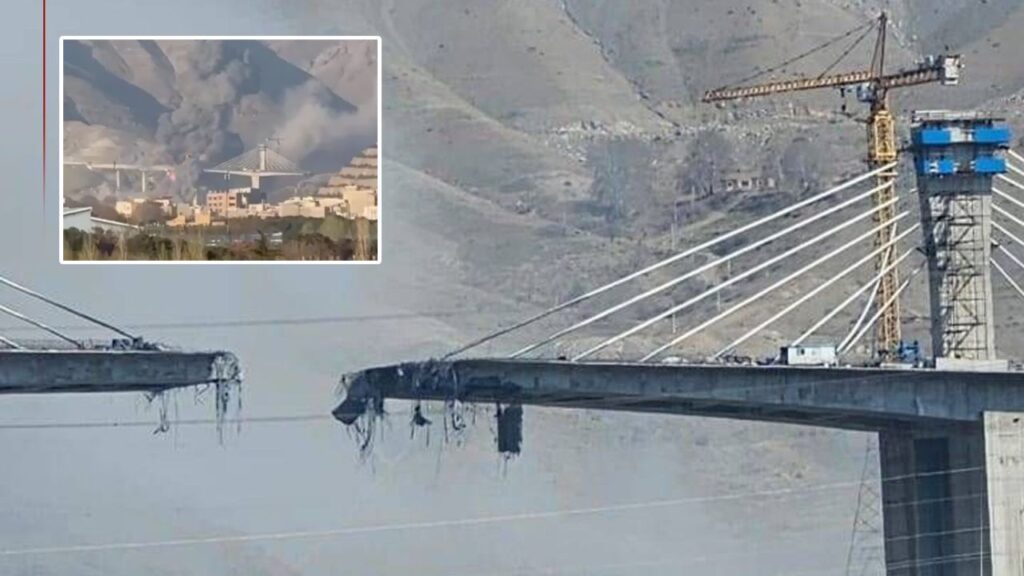
The most immediate flashpoint was the U.S. bombing of the B1 bridge linking Tehran to Karaj. Reuters reported that Trump posted video of the strike and that the bridge, which was due to open later this year, was hit in an attack that Iran says killed eight civilians and injured 95 others. Iranian Foreign Minister Abbas Araqchi said striking civilian structures would not force Iranians to surrender, highlighting how the attack has intensified legal and humanitarian concerns around the conflict.
This matters because the bridge strike looked different from earlier attacks framed as military or strategic. Reuters’ April 3 report says Trump explicitly threatened more attacks on bridges and electric power plants and said possible strikes on Iran’s energy and oil infrastructure were on the table. That language pushes the conflict closer to attacks on infrastructure vital to civilian life and economic continuity.
The wider war is still a joint U.S.-Israeli campaign, but the Karaj strike was specifically American
The broader conflict began on February 28 with joint U.S.-Israeli attacks on Iran, according to Reuters. Since then, Tehran has responded with missile and drone attacks on Israel and Gulf states hosting U.S. bases, turning the war into a regional confrontation rather than a contained bilateral exchange.
But it is important to be precise about this latest episode. Reuters specifically described the B1 bridge attack near Karaj as a U.S. bombing. So the most accurate framing is that the U.S.-Israeli war has escalated, while the Karaj bridge strike itself was an American action followed by Trump’s public threat of more infrastructure attacks.
Trump’s latest warning moved from military pressure to infrastructure pressure
Reuters quoted Trump as saying, “Bridges next, then Electric Power Plants,” and reported that in his televised remarks he also said strikes on Iran’s energy and oil infrastructure were possible. He further warned that the U.S. would hit Iran “extremely hard” over the next two to three weeks and said Washington could bring the country “back to the Stone Ages.”
That is a serious escalation in both rhetoric and target definition. The Reuters report notes that dozens of international law experts said U.S. strikes on Iran may amount to war crimes, and it restates the Geneva Conventions’ prohibition on attacks against civilian objects. When a war begins to focus on power plants, bridges, and energy systems, the humanitarian and legal stakes rise sharply because the fallout reaches ordinary civilians almost immediately.
Iran has answered with threats of harsher retaliation
Reuters reported that Iran’s armed forces warned of “more crushing, broader and more destructive” attacks in response to Trump’s speech and the U.S. strike. The statement, attributed to Ebrahim Zolfaqari, spokesperson for Iran’s Khatam al-Anbiya central headquarters, said the war would continue until the “permanent regret and surrender” of Iran’s enemies.
Reuters also reported that Iran’s Fars news agency listed bridges in Saudi Arabia, Kuwait, Abu Dhabi and Jordan as potential targets in response to the U.S. attack on the B1 bridge, and that the Revolutionary Guards said they had targeted an Amazon cloud computing centre in Bahrain. This indicates that Tehran is not treating the Karaj strike as an isolated battlefield event, but as a precedent that could justify retaliatory strikes on infrastructure across the region.
The Strait of Hormuz remains central to the crisis
Reuters said Iran has effectively shut down the Strait of Hormuz in retaliation for the U.S.-Israeli attacks, and that the waterway normally carries about one-fifth of the world’s oil trade. More than 40 countries joined talks led by Britain to explore how to restore freedom of navigation, but no specific agreement emerged.
This is why the crisis is no longer only a military story. It is now also an energy-security and global economic story. Reuters reported Brent crude jumping to around $108 per barrel as fears of a prolonged conflict and blocked energy routes deepened. That rise is already feeding inflation fears, market instability, and supply-chain stress far beyond the Middle East.
Global markets are reacting to the infrastructure escalation
Reuters said the renewed escalation sent oil prices higher again and helped depress share prices globally. The April 2 Reuters report noted that bond yields spiked and equity markets gave back recent gains as investors tried to assess how long the war might continue and how severe the damage to energy flows could become.
That reaction is logical. A war that threatens oil supply is already destabilizing. A war that also targets transport links, power systems and other core infrastructure becomes even more unpredictable. The more these attacks spread into civilian-linked systems, the harder it becomes for markets to believe any quick or orderly end is near. This is an inference, but it follows directly from the Reuters reporting on oil, stocks, and the shift toward infrastructure threats.
Why this latest step is especially dangerous
A bridge strike near a major urban zone such as Karaj carries both practical and symbolic weight. Practically, it can disrupt movement, logistics, and emergency access. Symbolically, it tells the other side that civilian-facing infrastructure is no longer outside the danger zone. Reuters’ coverage makes clear that Trump is now publicly linking the war’s next phase to bridges and electric power plants, which means the threshold has changed.
That change is what makes the situation so volatile. Iran has already promised wider retaliation. Gulf countries are trying to avoid full military escalation while preserving self-defense options. European leaders are resisting Iranian ideas that would formalize control over Hormuz traffic. And major economies are watching oil prices jump. This combination makes the conflict harder to contain with each passing day.
When destruction grows, the real need is restraint
This escalation shows how quickly conflict can move from military confrontation to wider suffering. When bridges, power systems and essential infrastructure become part of war planning, the pain reaches ordinary families first. Seen through a spiritual lens, this is a reminder that true strength does not lie in crushing others but in restraint, wisdom and compassion.
A society or nation guided by truth and righteousness seeks peace before destruction becomes irreversible.
Call to Action
The most important thing to watch now is not only who strikes next, but whether the target list keeps moving deeper into civilian infrastructure. That would mark a far more dangerous phase of the war with greater humanitarian and economic consequences.
Readers should follow verified reporting on three fronts: whether further U.S. attacks hit bridges or power plants, whether Iran acts on its threat of broader retaliation, and whether Hormuz shipping disruption worsens. Those three factors will shape the next stage of this crisis.
FAQs: West Asia Crisis Deepens as U.S. Strikes Bridge Near Karaj and Trump Threatens Iran’s Energy Infrastructure
1. Did the U.S. really strike a bridge near Karaj?
Yes. Reuters reported that the U.S. bombed the B1 bridge between Tehran and Karaj, and Iranian state media said eight people were killed and 95 wounded.
2. Were Iranian energy facilities in Karaj struck too?
I could verify a U.S. strike on the Karaj-area bridge and Trump’s threat that bridges, electric power plants, and possibly energy and oil infrastructure could be next. I could not verify a completed strike on energy infrastructure in Karaj from the strongest sources I checked.
3. Did Trump threaten to hit Iran’s power and energy systems?
Yes. Reuters reported that Trump said bridges and electric power plants would be next targets and that strikes on energy and oil infrastructure were possible.
4. What did Iran say in response?
Reuters reported that Iran’s armed forces warned of “more crushing, broader and more destructive” attacks in response to Trump’s threats and the bridge strike.
5. Why is the Strait of Hormuz so important in this story?
Reuters said Iran has effectively shut the Strait of Hormuz, which normally carries about 20% of the world’s oil trade, making the conflict a major global energy-security issue.
6. Why are legal experts worried about these attacks?
Reuters reported that dozens of international law experts said U.S. strikes on Iran may amount to war crimes and pointed to the Geneva Conventions’ ban on attacks against civilian objects.
Related Stories






Discussion (0)