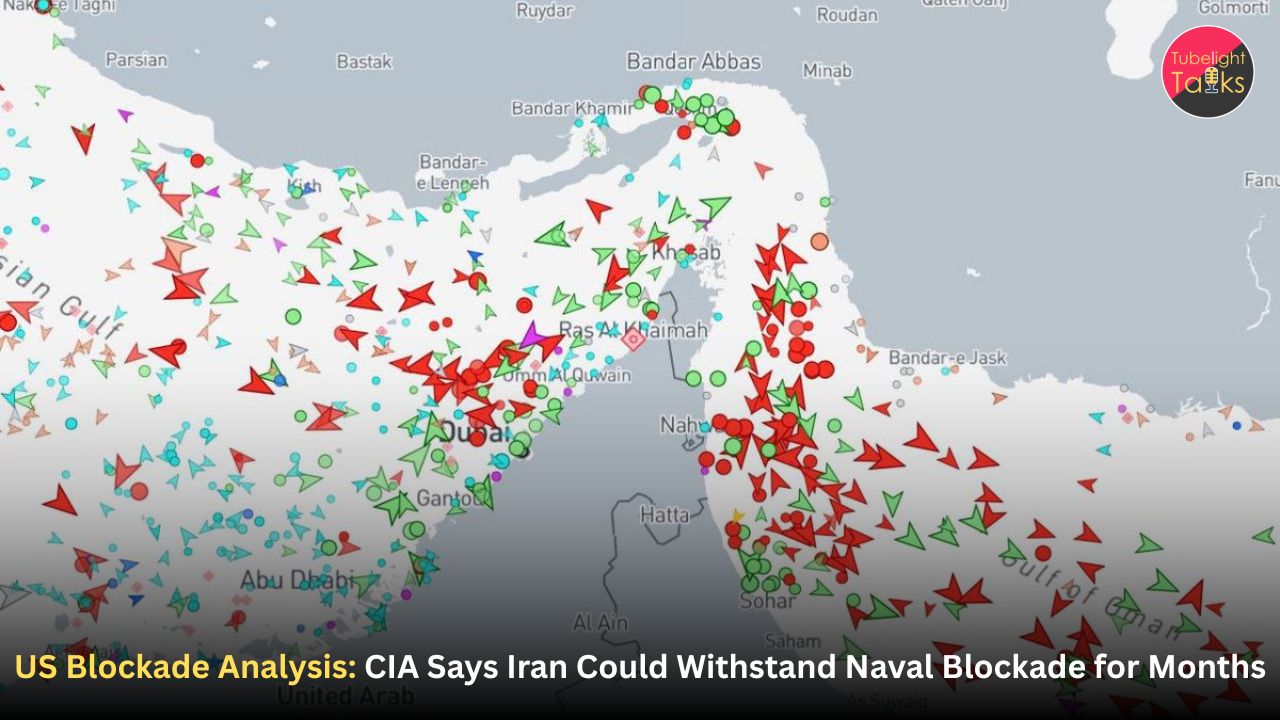
US Blockade Analysis: Leaked CIA Assessment Suggests Iran Could Withstand U.S. Naval Blockade for Months
US Blockade Analysis: A leaked U.S. intelligence assessment has raised serious questions about the effectiveness of Washington’s naval blockade against Iran. According to reporting by The Washington Post and Reuters, a confidential CIA analysis delivered to policymakers suggests Iran could withstand the current U.S. blockade for roughly three to four months before facing severe economic hardship.
The finding appears to challenge the Trump administration’s public claim that Tehran is close to economic collapse under “Operation Economic Fury.” U.S. officials continue to insist the blockade is inflicting major damage, but the assessment suggests Iran retains significant resilience, including oil-storage options, possible overland smuggling routes, and substantial remaining missile capacity. The report comes as U.S.-Iran clashes continue in and around the Strait of Hormuz.
CIA Blockade Assessment: What the Report Says
Iran May Endure Three to Four Months
The key finding is that Iran may not face severe economic pressure from the U.S. naval blockade for another three to four months. The Washington Post reported that a confidential CIA analysis concluded Iran could survive the blockade for at least 90 to 120 days, and possibly longer, before deeper hardship forces a major shift. Reuters also reported that a U.S. official familiar with the assessment said Tehran could withstand the blockade for about four months.
This is important because the Trump administration has repeatedly presented the blockade as a near-decisive tool. President Trump has described the Navy’s blockade as a “wall of steel,” while administration officials have argued that Iran’s economy is being strangled rapidly. The CIA’s reported view suggests that pressure is real but not immediately decisive.
In simple terms, the blockade may be hurting Iran, but it may not be enough to force Tehran to accept U.S. demands quickly.
Senior U.S. Official Pushes Back
The assessment has already triggered pushback. Reuters reported that a senior intelligence official called claims about the CIA analysis “false,” while arguing that the blockade is inflicting “real, compounding damage” by severing trade, crushing revenue and accelerating economic collapse.
This disagreement is politically significant. Intelligence assessments often present more cautious or complex conclusions than public messaging from political leaders. When such assessments become public, they can create tension between the military strategy being sold to voters and the classified analysis given to policymakers.
Also Read: US-Iran Missile Exchange: Gulf Tensions Remain High Despite De-escalation Efforts
Why the Blockade May Not Break Iran Quickly
Oil Storage and Reduced Output
The Washington Post reported that Iran has been storing some oil aboard tanker ships that would otherwise be empty because of the blockade. It has also reportedly reduced flows in some oil fields to keep wells functional. These steps can help Tehran manage pressure for a limited period.
This does not mean Iran is comfortable. A blockade damages revenue, restricts trade and strains domestic systems. But it does mean the country may have enough coping mechanisms to avoid immediate collapse.
Iran has lived under sanctions for many years. Its state system has developed survival methods, including rationing, informal trade, alternative routes, domestic repression, currency controls and smuggling networks. These mechanisms are inefficient and painful for ordinary citizens, but they can help a regime endure pressure longer than expected.
Possible Overland Smuggling Routes
The reported CIA assessment also suggests Iran could potentially move some oil through overland routes, including rail or truck corridors through Central Asia. These routes cannot replace open maritime exports, but they can create a limited economic cushion.
This is why blockades rarely work instantly unless they are paired with internal political collapse, overwhelming military defeat or diplomatic settlement. A country under pressure often finds partial alternatives, even if those alternatives are costly.
Iran’s Military Capacity Still Matters
Missiles and Launchers Remain Significant
The Washington Post reported that Iran still retains about 75% of its prewar mobile missile launchers and about 70% of its prewar missile stockpiles, according to a U.S. official. The report also said Iran has recovered and reopened many underground storage facilities and repaired some damaged missiles.
This finding is important because the blockade is not only an economic issue. It is part of a broader military strategy. If Iran still has substantial missile and drone capacity, it can continue threatening Gulf states, U.S. bases, shipping lanes and regional allies.
U.S. officials have said Iran’s military has been badly degraded. The intelligence assessment does not deny damage, but it suggests Iran remains dangerous. That distinction matters.
Drones Are a Strategic Problem
The Post also reported that analysts believe lower-cost drones may matter more than missiles for controlling traffic through the Strait of Hormuz. One expert noted that even one drone hitting a ship could make insurers refuse coverage for tankers.
This is a serious point. Maritime security is not only about sinking ships. It is about confidence. If insurance companies believe the waterway is unsafe, shipping slows. If shipping slows, oil markets react. If oil markets react, global prices rise.
Iran does not need to defeat the U.S. Navy to create disruption. It only needs to create enough uncertainty to make commercial shipping costly and risky.
What This Means for Trump’s Strategy
Pressure Without Immediate Capitulation
The blockade is designed to force Iran toward a deal by cutting revenue and isolating its ports. But if Iran can hold out for months, then Washington faces a strategic problem. The U.S. must either sustain the blockade longer, escalate militarily, offer diplomatic concessions, or accept a slower process.
A blockade that lasts months can also become politically difficult. It affects oil prices, global shipping, U.S. military readiness and domestic public opinion. If voters see rising energy costs or prolonged confrontation without clear victory, political pressure may increase.
Diplomacy Becomes More Important
Reuters reported that Washington is still waiting for Tehran’s response to a U.S. proposal that would formally end the war before addressing more contentious issues, including Iran’s nuclear programme. Secretary of State Marco Rubio said the U.S. expected a response, while Iran said it was still weighing the proposal.
The CIA assessment makes diplomacy more important because it weakens the assumption that economic pressure alone will quickly force surrender. If Iran believes it can outlast U.S. political patience, it may negotiate harder. If the U.S. believes the blockade is not fast enough, it may seek a different mix of pressure and compromise.
Also Read: Trump Pauses Project Freedom as US-Iran Diplomacy Enters Critical Breakthrough Phase
Gulf Clashes Add Urgency
Fighting Continues Around Hormuz
The reported CIA assessment emerged as fighting continued in and around the Strait of Hormuz. Reuters reported sporadic clashes between Iranian forces and U.S. vessels, with the U.S. saying it struck two Iran-linked vessels attempting to enter an Iranian port. Iran accused the U.S. of breaching the ceasefire.
This shows how unstable the situation remains. A blockade is not a passive economic measure when ships, jets, drones and missiles are involved. It is a military operation with constant risk of miscalculation.
UAE Also Comes Under Attack
Reuters also reported that the United Arab Emirates said its air defences engaged Iranian missiles and drones, with three people sustaining moderate injuries. Iran has repeatedly targeted Gulf states hosting U.S. military bases during the war.
This widens the danger. If Gulf states are pulled deeper into the conflict, the crisis could spread beyond U.S.-Iran confrontation and become a regional war. That would further threaten energy markets, civilian infrastructure and maritime security.
Global Oil Markets Under Pressure
Brent Above $100
Oil prices have already reacted. Reuters reported Brent crude futures above $101 a barrel amid renewed fighting and blockade uncertainty. The Strait of Hormuz previously handled about one-fifth of the world’s oil supply before the war disrupted traffic.
High oil prices affect ordinary people. Fuel, transport, food, fertilizer, aviation and manufacturing costs can rise. Import-dependent countries may face inflation pressure. Poor households often suffer first because energy costs enter almost every part of daily life.
Shipping Confidence Is Fragile
Even if the U.S. escorts merchant ships, commercial confidence does not return instantly. Shipowners, insurers and crews need repeated evidence that transit is safe. One drone strike, one tanker fire or one mining incident could reverse progress.
The CIA’s reported assessment reinforces this: Iran may not need to fully defeat the blockade. It may simply need to survive long enough while keeping enough threat alive to maintain uncertainty.
Risks of a Long Blockade
Humanitarian Pressure
Economic blockades often hurt governments, but they also affect ordinary people. Reduced trade, inflation, medicine shortages, fuel scarcity and unemployment can spread suffering among civilians. The longer a blockade continues, the more humanitarian concerns grow.
A strategy that relies only on pressure can become morally and politically complicated if civilians bear the heaviest burden.
Escalation Trap
A long blockade can also create an escalation trap. The U.S. may tighten enforcement. Iran may test the blockade. The U.S. may strike vessels or ports. Iran may retaliate with drones or missiles. Each step can be described as defensive by the side taking it, but the result can still be wider war.
This is why diplomacy must remain active even when military pressure continues.
What to Watch Next
Iran’s Response to U.S. Proposal
The most important immediate development is Iran’s response to the U.S. proposal. If Tehran accepts a framework, the blockade may become a bargaining chip. If Tehran rejects it, Washington may intensify pressure.
U.S. Domestic Reaction
If the blockade lasts months, U.S. public opinion will matter. Reuters noted that the conflict has been unpopular with U.S. voters. A long campaign with rising oil prices could become politically costly.
Gulf Shipping and Insurance
The next signal will come from shipping flows and insurance rates. If ships resume transit under escort, pressure eases. If insurers remain cautious, the crisis continues.
When Power Politics Meets Human Suffering
The blockade analysis shows that military and economic pressure may weaken a nation, but it rarely heals hatred, ego or distrust. War strategy calculates months, missiles and money; spiritual wisdom asks how many human lives are being crushed by pride and conflict. JagatguruRampalJi.org describes Sant Rampal Ji Maharaj’s teaching of True Spiritual Knowledge as a path that removes hatred from human hearts and reminds humanity that all are children of the same Divine Father.
The same source emphasizes that missiles, armies and hatred cannot bring lasting peace; peace begins when individuals transform from within. Another official JagatguruRampalJi.org resource states that Sant Rampal Ji Maharaj’s objectives include establishing peace and brotherhood, removing corruption, gambling, cheating, casteism, intoxication, dowry and other social evils, and promoting honesty, non-violence and devotion.
In relation to the U.S.-Iran blockade, this SatGyaan is directly relevant: a world ruled by greed, revenge and domination will keep producing blockades and wars, while a world guided by truth, compassion and true worship can move toward real peace.
FAQs on US Blockade Analysis
1. What does the leaked CIA assessment say?
The assessment reportedly says Iran could withstand the current U.S. naval blockade for about three to four months before facing severe economic hardship.
2. Why is the report important?
It challenges the Trump administration’s public claim that the blockade is close to forcing Iran’s economic collapse or quick surrender.
3. Is the blockade still damaging Iran?
Yes. U.S. officials say the blockade is causing serious economic damage, but the reported assessment suggests the damage may not force immediate capitulation.
4. How is Iran surviving the blockade?
Reports suggest Iran is storing oil on tankers, reducing oil-field flows to protect wells, and may attempt limited overland smuggling routes.
5. Does Iran still have military capacity?
According to reporting on the assessment, Iran still retains significant ballistic missile and mobile launcher capacity, along with drone capabilities.
6. What happens next?
The next key developments are Iran’s response to the U.S. peace proposal, continued Gulf clashes, shipping confidence in the Strait of Hormuz, and whether Washington changes its blockade strategy.
Related Stories





Discussion (0)