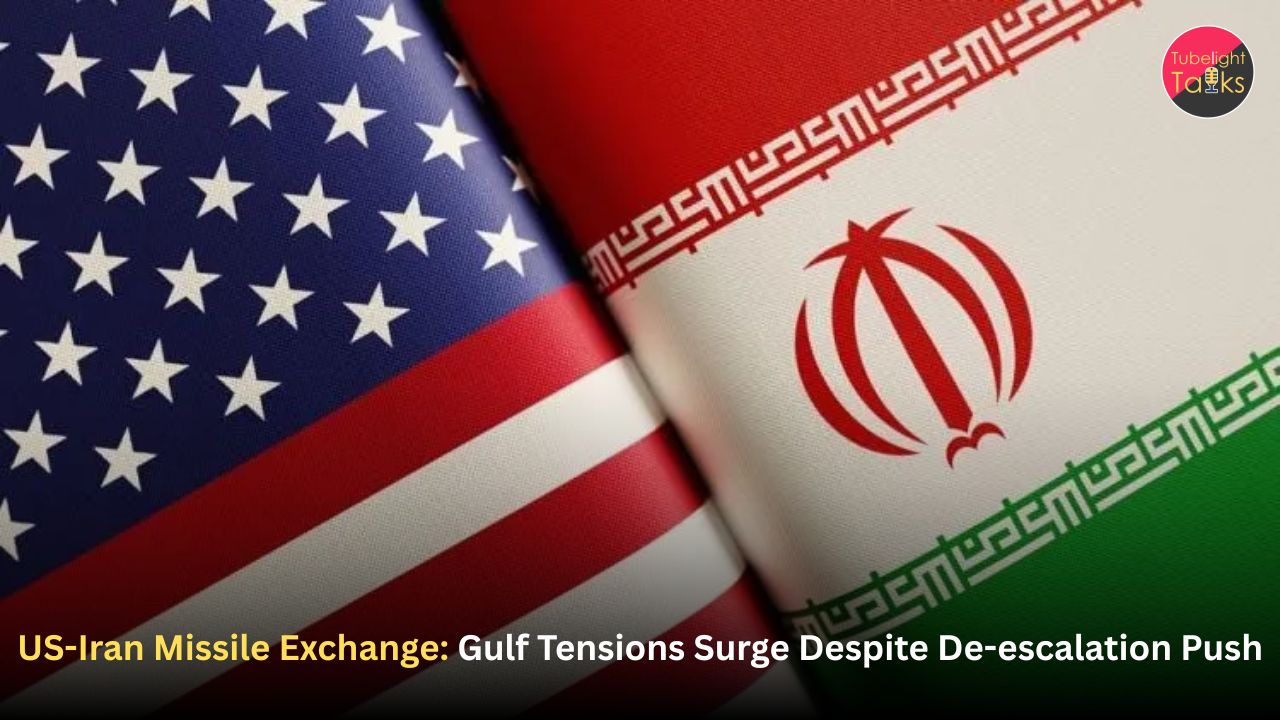
US-Iran Missile Exchange: Gulf Tensions Remain High Despite De-escalation Efforts
Tensions between the United States and Iran remain dangerously high after both sides exchanged fresh fire in the Gulf despite ongoing diplomatic efforts to preserve a fragile ceasefire. U.S. Central Command said Iranian forces launched missiles, drones and small boats toward three U.S. Navy destroyers—USS Truxtun, USS Rafael Peralta and USS Mason—as the warships transited the Strait of Hormuz. CENTCOM said no U.S. assets were hit and that American forces responded with self-defense strikes against Iranian military facilities linked to missile, drone, command and surveillance operations.
Iran has disputed Washington’s version and accused the U.S. of violating the ceasefire first. President Donald Trump insists the ceasefire remains in effect, but the latest clash has renewed global fears over shipping security, oil prices and wider escalation.
Gulf Missile Exchange: What Happened?
CENTCOM Says Iran Targeted U.S. Destroyers
According to U.S. Central Command, the latest exchange began when Iranian forces launched multiple missiles, drones and small boats toward three U.S. destroyers moving through the Strait of Hormuz toward the Gulf of Oman. CENTCOM described the attack as unprovoked and said U.S. forces eliminated inbound threats before striking Iranian military targets responsible for the attack. The command added that it does not seek escalation but remains prepared to protect American forces.
The ships involved—USS Truxtun, USS Rafael Peralta and USS Mason—are guided-missile destroyers capable of air defense, missile interception and escort operations. Their movement through the strait was highly symbolic because the U.S. has been trying to restore maritime passage after weeks of disruption linked to Iran’s control efforts and the American naval blockade.
U.S. Responds With Strikes on Iranian Military Sites
The U.S. response reportedly targeted Iranian military facilities, including missile and drone launch sites, command-and-control locations and intelligence, surveillance and reconnaissance nodes. CENTCOM framed the response as self-defense, while Trump later described the American action as limited and suggested that Washington still wants a diplomatic solution.
This distinction is important. The U.S. is trying to present its action as defensive rather than a return to full-scale offensive war. However, from Iran’s perspective, strikes on its territory or coastal military infrastructure can still be treated as escalation. That is why both sides are now accusing each other of violating the ceasefire while still claiming they do not want wider war.
Also Read: Trump Pauses Project Freedom as US-Iran Diplomacy Enters Critical Breakthrough Phase
Iran’s Response and Counter-Narrative
Tehran Accuses U.S. of Breaking the Truce
Iran has rejected the U.S. framing and accused Washington of violating the ceasefire first. Iranian state-linked reports described explosions around Qeshm Island and southern Iran, while Iranian officials accused the U.S. of attacking Iranian assets near its coastline. The disagreement over who fired first has become central to the diplomatic crisis.
In conflicts like this, battlefield facts quickly become political narratives. Washington says Iran attacked U.S. warships in international waters. Tehran says the U.S. carried out hostile military action near Iranian territory. Without independent verification, both versions will continue shaping domestic and international opinion.
Iran Still Reviewing U.S. Peace Proposal
Despite the exchange, diplomatic channels have not fully collapsed. Reports say Iran is still reviewing a U.S. peace proposal delivered through mediators, including Pakistan. The proposed framework reportedly includes ending hostilities, reopening the Strait of Hormuz, discussing nuclear-related issues and easing some economic pressure if Iran accepts the terms.
This creates a difficult balance for Tehran. If Iran accepts a deal after U.S. strikes, hardliners may claim it surrendered under pressure. If it rejects the deal and fighting resumes, Iran risks deeper military and economic damage. The coming days may determine whether diplomacy survives the latest missile exchange.
Trump Says Ceasefire Still Holds
“Ceasefire Is Still in Effect”
President Trump has insisted that the ceasefire remains in place despite the exchange of fire. Financial Times reporting noted that Trump described the U.S. response as limited while continuing to warn Iran against further attacks. His message is clear: the U.S. will respond militarily to threats, but Washington is not yet declaring the ceasefire dead.
This is a risky strategy. If Trump downplays the clash too much, critics may accuse him of tolerating Iranian attacks. If he escalates too aggressively, the ceasefire may collapse entirely. The administration is therefore trying to keep military pressure and diplomacy alive at the same time.
De-escalation Efforts Continue
Regional governments, including Saudi Arabia, have called for restraint and negotiation after the latest exchange. A senior Saudi diplomat reiterated support for de-escalation, reflecting Gulf states’ fear that a renewed U.S.-Iran war could threaten oil exports, ports, desalination systems and civilian infrastructure.
Gulf states are in a difficult position. Many rely on U.S. security guarantees, but they also fear being pulled into a wider conflict. Their priority is stability: safe shipping, predictable energy exports and no missile war across the region.
Strait of Hormuz: Why the Exchange Matters Globally
A Critical Energy Chokepoint
The Strait of Hormuz is one of the world’s most important energy corridors. A major share of global oil and liquefied natural gas moves through or near the waterway. Any military exchange in this zone immediately affects markets, shipping companies and insurance providers.
Recent clashes have already raised fears over oil prices and commercial transit. Financial Times reported that Brent crude moved above $100 per barrel amid renewed worries over the ceasefire and the safety of Gulf shipping.
Shipping Confidence Still Fragile
Even before the latest exchange, commercial shipping through the strait remained uncertain. Project Freedom, the U.S. escort mission for merchant ships, was designed to restore confidence. But repeated missile, drone and naval incidents make shipowners cautious.
A maritime route is not truly open unless civilian crews, insurers and companies believe it is safe. Warships can escort some vessels, but they cannot instantly restore normal commercial confidence if missiles and drones remain active.
Wider Regional Risks
UAE Attack Raises Alarm
The crisis widened after the United Arab Emirates reported Iranian missile and drone attacks. Reuters reported that the UAE said it was countering Iranian air attacks, and civilians were reportedly injured. This development is serious because it suggests the conflict may not remain limited to U.S. and Iranian assets.
If Gulf states are directly targeted, the crisis could expand rapidly. U.S. bases, energy facilities, ports and civilian infrastructure across the region may face higher alert levels. That is why calls for de-escalation are growing louder.
Blockade Pressure May Not Work Quickly
The U.S. naval blockade is designed to pressure Iran economically, but a reported CIA assessment suggests Tehran may be able to withstand the blockade for at least several more months. Reuters reported that the assessment could complicate U.S. efforts to force Iran into a quick agreement.
This matters because if Washington expects immediate Iranian economic collapse, it may misjudge Tehran’s willingness to endure pressure. A blockade that lasts months can damage Iran, but it can also harden positions and deepen conflict if not paired with credible diplomacy.
What Happens Next?
Scenario 1: Limited Clash, Talks Continue
The best-case scenario is that both sides treat the latest exchange as limited. The U.S. says it defended its ships. Iran says it resisted American aggression. Mediators then push both sides back toward talks. This would keep the ceasefire alive, though weakened.
Scenario 2: Retaliation Cycle
The dangerous scenario is a cycle of retaliation. Iran may strike another U.S. vessel or Gulf target. The U.S. may launch wider strikes. Gulf states may enter the crisis more directly. Oil prices may spike, and shipping through Hormuz may become even more restricted.
Scenario 3: Ceasefire Collapses
If either side formally declares the ceasefire dead, the conflict could return to active war. That would threaten regional stability, global energy supply and civilian lives across the Gulf.
Diplomacy Under Fire
Pakistan and Regional Mediators Matter
Pakistan’s mediation has become especially important because direct U.S.-Iran trust is low. Mediators can help both sides communicate without public humiliation. They can also create language that allows each side to step back without appearing defeated.
But mediation becomes harder after every missile launch. Public anger, military pressure and domestic politics reduce room for compromise.
The Need for Verification
A durable ceasefire will require clearer rules: safe shipping corridors, no attacks on warships, no drone launches near escort zones, no strikes on coastal infrastructure, and a monitoring mechanism to verify violations. Without verification, both sides will continue accusing each other, and the ceasefire will remain unstable.
War, Ego and the Need for True Peace
The US-Iran missile exchange shows how fragile peace becomes when mistrust, weapons and pride dominate international relations. Military strength may stop an immediate threat, but it cannot create lasting peace without truth, restraint and righteous conduct. The teachings of Sant Rampal Ji Maharaj and Sat Gyaan emphasize truth, humility, compassion, righteous behaviour and true worship according to holy scriptures.
Sant Rampal Ji Maharaj’s teachings guide people away from violence, intoxication, corruption, dishonesty, greed and ego. In the context of the Gulf crisis, this message is deeply relevant. Nations, like individuals, must choose wisdom over anger and welfare over destruction. Sat Gyaan teaches that real peace begins when human beings abandon arrogance and follow the path of truth and devotion to the Supreme God.
FAQs on US-Iran Missile Exchange
1. What triggered the latest US-Iran exchange?
U.S. Central Command says Iranian missiles, drones and small boats targeted three U.S. Navy destroyers transiting the Strait of Hormuz. Iran disputes the U.S. version and accuses Washington of violating the ceasefire.
2. Which U.S. warships were involved?
The U.S. destroyers involved were USS Truxtun, USS Rafael Peralta and USS Mason.
3. Were any U.S. ships hit?
No. CENTCOM said no U.S. military assets were struck during the Iranian attack.
4. How did the U.S. respond?
The U.S. carried out self-defense strikes on Iranian military facilities linked to missile and drone launch sites, command-and-control systems and surveillance infrastructure.
5. Is the ceasefire over?
President Trump says the ceasefire remains in effect, but the latest exchange has severely tested it.
6. Why is the Strait of Hormuz important?
The Strait of Hormuz is a critical global route for oil, gas and commercial shipping. Any military crisis there can affect fuel prices, supply chains and global economic stability.
Related Stories








Discussion (0)