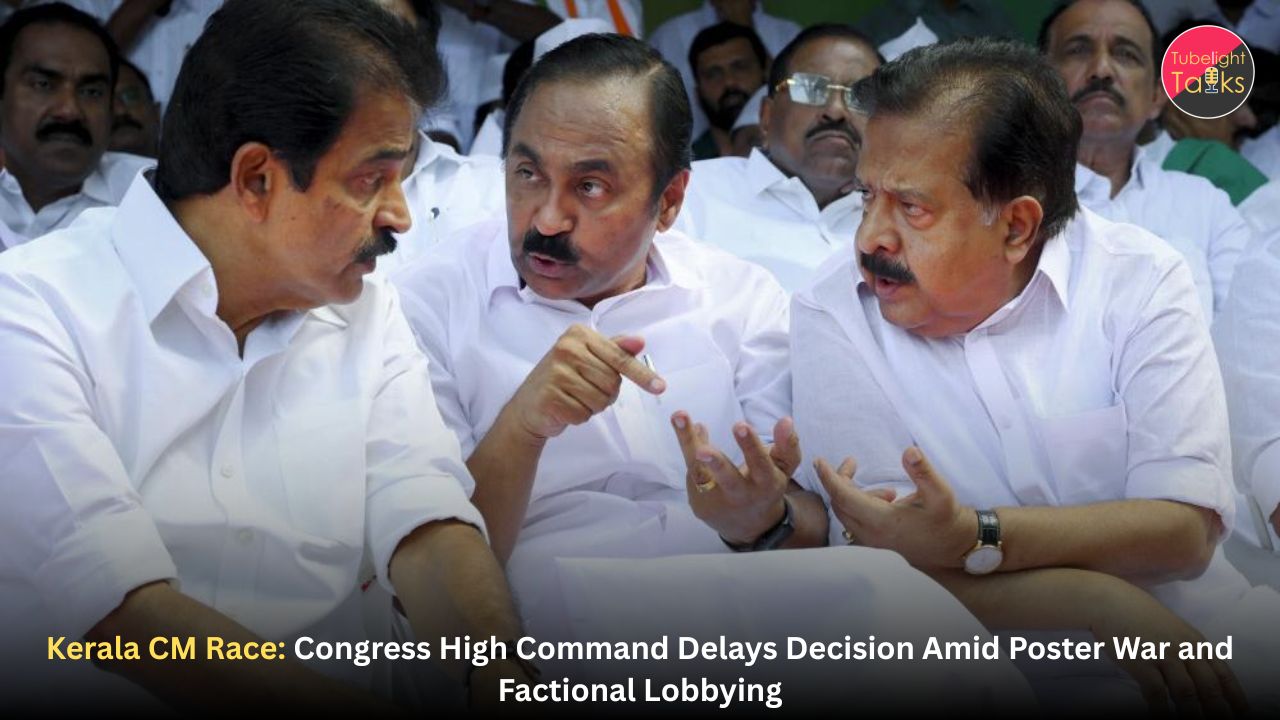
Kerala CM Race: Poster War Erupts as Congress High Command Prepares to Finalise Next Chief Minister
Kerala’s Chief Minister race has entered a tense and highly visible phase after the Congress-led United Democratic Front’s sweeping Assembly victory. What began as an internal leadership consultation has turned into a public contest among supporters of three major Congress leaders: K. C. Venugopal, V. D. Satheesan and Ramesh Chennithala. Posters, flex boards and demonstrations have appeared in different parts of the state, while senior leaders have been called to Delhi for discussions with Congress president Mallikarjun Kharge and Rahul Gandhi.
The newly elected Congress MLAs have already authorised the party high command to choose the next Congress Legislature Party leader, but the intense lobbying has forced the leadership to warn state leaders against public pressure tactics. The final decision is now expected after Delhi consultations.
Kerala CM Race: Why the Decision Has Become Difficult
Three Strong Contenders in the Field
The Congress high command is facing a delicate decision because all three main contenders bring different strengths. K. C. Venugopal is a powerful national-level organisational leader and is believed to have significant MLA support. V. D. Satheesan, the outgoing Leader of Opposition, led the party’s Assembly campaign aggressively against the LDF government. Ramesh Chennithala, a veteran leader and former Leader of Opposition, has long experience in Kerala’s faction-heavy Congress politics. Hindustan Times reported that all three leaders were in Delhi as the final decision was awaited.
The UDF’s victory has raised expectations, but it has also intensified internal competition. The Congress now has to choose a Chief Minister who can lead the government, satisfy MLAs, reassure allies, maintain party unity and deliver quickly on public promises. A wrong or poorly managed decision could create resentment before the new government even begins.
UDF’s Big Victory, Congress’s Big Test
Reports have described the UDF’s result as an emphatic win, with Hindustan Times saying the alliance secured 102 seats in the 140-member Assembly. That scale of victory gives the Congress-led front a strong mandate, but it also creates a leadership challenge because several senior figures can claim credit for the win.
In Kerala, Congress politics is rarely simple. The party has deep local networks, strong personalities and old factional lines. The high command must now convert an electoral victory into a stable government, and that requires careful balancing.
Also Read: Kerala Leadership: Newly Elected Congress MLAs Authorise High Command to Choose Next Leader
Poster War Breaks Out Across Kerala
Chennithala Posters in Idukki
The most visible sign of the leadership tussle has been the poster war. Economic Times reported that posters supporting Ramesh Chennithala as the UDF Chief Ministerial candidate appeared in Idukki on Saturday. These posters came after earlier posters supporting K. C. Venugopal were seen, turning the CM race into a street-level spectacle.
Such posters are not unusual in Congress politics, but their timing is sensitive. The MLAs have already authorised the high command to decide. Public campaigns by supporters can therefore appear as pressure tactics and may irritate the central leadership.
Venugopal Flex Board Controversy
Hindustan Times reported that a flex board bearing the image of late former Chief Minister Oommen Chandy alongside K. C. Venugopal was torn down and doused in black oil by rival supporters. The incident was especially jarring because Oommen Chandy remains one of the most respected Congress figures in Kerala’s recent history.
This controversy shows how emotional the leadership battle has become. When symbols of a beloved former leader are pulled into factional rivalry, the party risks damaging the unity it needs after victory.
Satheesan Camp Also Active
V. D. Satheesan’s supporters have also been active. Times of India reported that Congress is struggling for consensus as CM hopefuls press their claims, with Satheesan, Venugopal and Chennithala all being part of the high-stakes leadership race.
Satheesan’s argument is based on his role as Leader of Opposition and his public visibility during the anti-LDF campaign. His supporters believe he earned the right to lead after taking the fight directly to the outgoing government.
High Command Warns Against Public Lobbying
Delhi Leadership Puts Race “On Ice”
The Congress central leadership has now stepped in to control the situation. Economic Times reported that the high command temporarily halted discussions around naming the Kerala Chief Minister and warned against public lobbying, street demonstrations and pressure tactics. The leadership reportedly described such actions as contrary to party values.
This warning is important. The Congress does not want its victory celebration to turn into an image of internal chaos. If rival camps continue public shows of strength, it may give the opposition an opportunity to portray the UDF as divided before government formation.
Kharge and Rahul Gandhi Hold Talks
Senior Congress leaders, including Mallikarjun Kharge and Rahul Gandhi, have held discussions with Kerala leaders in Delhi. Times of India reported that the leadership was trying to reach consensus while warning factions not to destabilize the process through public protests.
This indicates that the party is trying to avoid both extremes: imposing a decision without consultation and allowing public lobbying to dictate the outcome. The final decision must appear democratic, disciplined and strategically sound.
Also Read: Kerala Trends Point Toward Possible Power Shift as UDF Moves Ahead of LDF
MLAs Have Already Left Decision to High Command
CLP Resolution Gives Central Leadership Authority
The Congress Legislature Party has already passed a one-line resolution authorising the high command to select the next leader. That means the formal authority now rests with the central leadership. This process gives Congress a way to avoid an open vote among MLAs, which could deepen factional divisions.
Times of India reported that a large share of MLAs had named K. C. Venugopal as their preferred choice, but the high command still has to consider strategy, factional balance and government stability before finalising the name.
Allies Also Matter
The UDF is a coalition, so Congress cannot make the decision in isolation from alliance expectations. IUML has said it expects Congress to consult allies before finalising the Chief Minister, while acknowledging that the final decision lies with Congress.
This is politically important because the next Chief Minister must not only command Congress MLA support but also maintain smooth relations with UDF partners. Coalition discipline will matter from the first day of government.
What Each Contender Represents
K. C. Venugopal: Organisational Power
Venugopal represents central organisational strength. He has played a major role in Congress’s national structure and has close working ties with the high command. Reports suggesting strong MLA support make him a serious contender. His selection would show that the central leadership wants someone with national coordination experience at the head of the Kerala government.
The risk is that some state leaders may see him as more of a national organiser than a grassroots state administrator. The high command will have to manage that perception if he is chosen.
V. D. Satheesan: Campaign Face and Assembly Fighter
Satheesan’s supporters argue that he carried the opposition battle in the Assembly and became the public face of Congress’s anti-LDF campaign. He has strong debating skills, public visibility and experience as Leader of Opposition.
The challenge is factional acceptance. If chosen, Satheesan would need to bring senior leaders and rival camps into a stable arrangement quickly.
Ramesh Chennithala: Veteran Experience
Chennithala brings seniority, administrative memory and long organisational experience. His supporters see him as a leader who understands Kerala’s political structure deeply.
The challenge is generational optics. After a sweeping victory, some in Congress may prefer a leader seen as part of a new phase rather than a return to an older leadership style.
Why the Poster War Could Hurt Congress
Victory Narrative at Risk
The UDF’s win should have given Congress a strong victory narrative: anti-incumbency defeated, LDF removed, new government ready. But poster wars and factional demonstrations risk shifting attention from public mandate to internal ambition.
Voters may begin asking whether the party is focused on governance or posts. That is why the high command’s warning against public lobbying is politically necessary.
Opposition Can Exploit Division
The LDF and BJP will watch the Congress leadership battle closely. If the decision is delayed or messy, opposition parties may claim that the UDF is unstable. In a politically aware state like Kerala, perception matters.
Government Formation Needs Discipline
A new government must begin with confidence. Cabinet formation, portfolio distribution, ally management and policy announcements require unity. If the Chief Minister begins under factional pressure, early governance may suffer.
Also Read: South India Political Earthquake: Tamil Nadu and Kerala Election Results 2026
What Happens Next?
Final Consultations in Delhi
Senior Kerala Congress leaders have been called to Delhi for consultations. The high command will weigh MLA preferences, factional balance, coalition comfort, administrative suitability and long-term political strategy.
Announcement Expected Soon
Reports suggest the final decision could come after the ongoing Delhi discussions. The party will likely try to announce the leader in a way that allows all camps to publicly support the choice.
Cabinet Formation Will Follow
Once the Chief Minister is chosen, attention will immediately shift to the cabinet. Congress must balance regions, communities, allies, experience, youth and women’s representation. IUML and other UDF partners will also expect fair representation.
Unity, Discipline and Public Responsibility
The Kerala CM race shows how even a major electoral victory can become fragile when ambition and factional pride rise above collective duty. Politics becomes meaningful only when leadership is treated as service, not personal entitlement. Sant Rampal Ji Maharaj’s guidance on honest conduct, humility, freedom from corruption and disciplined living offers a relevant moral lens for such moments.
In public life, these values matter deeply because a leader’s first duty is to protect trust, not to fuel division. Kerala’s next Chief Minister, whether Venugopal, Satheesan, Chennithala or another consensus choice, will ultimately be judged by transparent governance, welfare delivery, unity and responsibility toward the people.
FAQs on Kerala CM Race
1. Why is Kerala’s CM race in the news?
Kerala’s CM race is in the news because the Congress-led UDF won a major victory, but the party has not yet finalised who will become Chief Minister.
2. Who are the main contenders?
The main contenders are K. C. Venugopal, V. D. Satheesan and Ramesh Chennithala. All three have been involved in Delhi-level consultations.
3. What is the poster war?
The poster war refers to rival supporters putting up posters and flex boards backing different Congress leaders for the Chief Minister’s post.
4. Where did posters for Ramesh Chennithala appear?
Posters supporting Ramesh Chennithala as Chief Minister appeared in Idukki, according to reports.
5. What has the Congress high command said?
The high command has warned leaders against public lobbying, street demonstrations and pressure tactics while the leadership decision is being made.
6. Who will make the final decision?
The Congress high command, led by Mallikarjun Kharge and senior central leaders, will make the final decision after consultations with MLAs and Kerala leaders.
Related Stories



Discussion (0)