Census 2027 and Himachal’s Section 118 Backlog Show Why Data Governance Now Matters More Than Ever
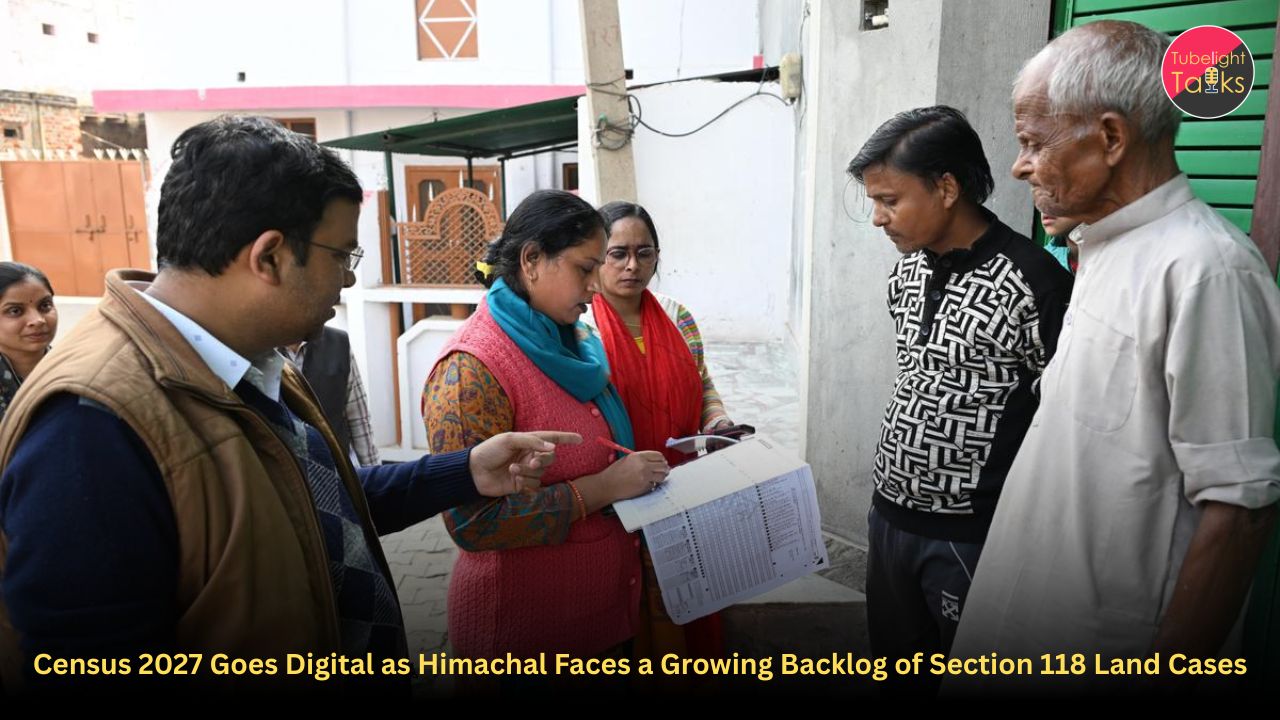
Census 2027 Goes Digital: India’s Census 2027 is officially moving ahead as the country’s first fully digital census exercise. PIB said the Union government has approved an outlay of ₹11,718.24 crore for the exercise and that Census 2027 will be conducted through digital means. Separately, Gazette notifications and official census material have confirmed the operational rollout of the first phase across notified windows in 2026.
At the same time, Himachal Pradesh is confronting a very different but equally record-driven governance problem: a substantial backlog under Section 118 of the Himachal Pradesh Tenancy and Land Reforms Act, which regulates transfer of land to non-agriculturists.
Indian Express reported that official data tabled in the Assembly showed 2,354 applications between January 1, 2023 and January 31, 2026, of which 1,494 were approved, 12 rejected, and 849 remained pending. That means the publicly verifiable backlog is not 300. It is much larger.
A Necessary Correction to the Headline Narrative
The headline formulation linking “300 cases” and census verification is not supported by the strongest sources currently available. Official census material confirms the digital rollout of Census 2027. Separate Himachal reporting confirms a large backlog of Section 118-related matters.
But the public reporting currently available does not show the Census directly “revealing” 300 violations. Instead, the clearer and more accurate picture is that Himachal has a sizable Section 118 backlog in its own right, with 849 pending applications according to official data cited in the Assembly.
That correction matters because record-based governance is only useful when the numbers are reported honestly. In the age of digital state systems, false precision is often more misleading than vagueness. If data is the backbone of modern administration, then fidelity to actual data becomes a democratic obligation.
Also Read: First Phase of India’s First Fully Digital Census 2027 Begins with 33 Officially Notified Questions
Why Census 2027 Is a Major Administrative Shift
Census 2027 is significant not only because of its scale but because of the way it will be conducted. PIB described it as a digital exercise, with funding provision for honorarium, training, IT infrastructure, and logistics. Other official census materials show that the first phase includes houselisting and housing census operations, with states and Union Territories notifying specific operational periods. This shift to digital collection and optional self-enumeration marks a major transition in how the state gathers foundational population data.
Digital census systems promise faster processing, better validation, easier integration, and potentially fewer transcription errors. But they also raise a deeper expectation: that governance as a whole will become more transparent, timely, and coherent. Once citizens are told that the state is modernising its information systems, they naturally begin to ask why other record-heavy domains remain slow, opaque, or burdened by backlog.
What Section 118 Represents in Himachal
Section 118 is not a minor procedural clause. It sits at the heart of Himachal Pradesh’s long-standing effort to regulate transfer of land to non-agriculturists. In a hill state with ecological vulnerability, limited land, and strong local anxieties around outside acquisition, Section 118 has both legal and political weight. The backlog therefore matters for more than administrative neatness. It affects land governance, investor expectations, local trust, and perceptions of whether the state is actually enforcing the regime it claims to protect.
Indian Express also reported that officials said district-level competent authorities had been asked to submit updated status reports on pending and approved cases. That is significant because it shows the state itself recognises the need for clearer information and updated scrutiny. But the existence of that need also reveals how much administrative fog may already have accumulated.
Why the Census and Land Backlog Belong in the Same Conversation
Even though Census 2027 did not directly uncover the Section 118 figure in current public reporting, the two stories belong together conceptually. Both are about record integrity. Both depend on administrative accuracy. Both expose the gap between what governments say they know and what systems can actually process. And both illustrate a central truth of modern governance: data is only useful when it is current, connected, and acted upon.
India is entering a period in which governance will increasingly be judged not just by laws or schemes, but by the quality of state records. If the census becomes digital but land oversight remains clogged, then the state modernises unevenly. Citizens then experience modernisation not as a smooth upgrade, but as a patchwork of advanced systems and old bottlenecks.
Backlog Is Never Just a Number
An 849-case backlog is not merely an administrative statistic. It represents delayed decisions, uncertain legal status, unresolved applications, and a potential opening for both misuse and mistrust. In land governance, backlog creates opacity. Opacity creates discretion. And discretion without timely resolution often creates suspicion.
That is why transparency about pending cases matters so much. A state can defend a strict land-protection law if it administers it consistently and efficiently. But if approvals, rejections, scrutiny, and enforcement remain entangled in delay, the law begins to appear selective or weak. In politically sensitive land regimes, that perception can be almost as damaging as actual non-enforcement.
Digital India Must Mean Honest India in Recordkeeping Too
The promise of digital government is not simply speed. It is traceability. Systems should tell citizens where a matter stands, what is pending, what has been cleared, and why. Census 2027 points toward that future in population data. Himachal’s Section 118 backlog shows how far many governance sectors still have to travel.
The test ahead is simple. Can digital state capacity be extended beyond flagship projects into difficult, politically sensitive administrative fields? If yes, India’s governance quality may genuinely improve. If not, digital progress will remain uneven branding over uneven institutions.
Truth in Records Is Also Dharma in Governance
Sant Rampal Ji Maharaj’s teachings place strong emphasis on truth, right conduct, and accountability in action. His official teachings repeatedly suggest that confusion and suffering persist where truth is obscured or ignored. That spiritual insight translates powerfully into governance: public records should not mislead, conceal, or drift away from reality.
When a census becomes digital and land governance faces backlog, the deeper issue is the same—will truth be recorded properly and acted upon responsibly? Public administration earns respect when its records are clean, its numbers are honest, and its decisions are not lost in delay.
Call to Action
Digital governance should make public systems clearer, not merely newer. Citizens should expect accuracy, disclosure, and timely resolution across all record-based state functions.
FAQs: Census 2027 Goes Digital as Himachal Faces a Growing Backlog of Section 118 Land Cases
1. Is Census 2027 officially digital?
Yes. PIB has said Census 2027 will be conducted through digital means.
2. Did official reporting confirm 300 pending Section 118 cases in Himachal?
No. The stronger public reporting currently available cites official Assembly data showing 849 pending cases.
3. What does Section 118 deal with?
It regulates transfer of land to non-agriculturists in Himachal Pradesh.
4. Did the Census directly reveal these Section 118 cases?
The public reporting currently available does not establish that direct link. It shows two parallel governance stories: digital census rollout and a Section 118 backlog.
5. Why do these stories matter together?
Because both reflect how modern governance depends on clean, accurate, and timely record systems.
Related Stories








Discussion (0)