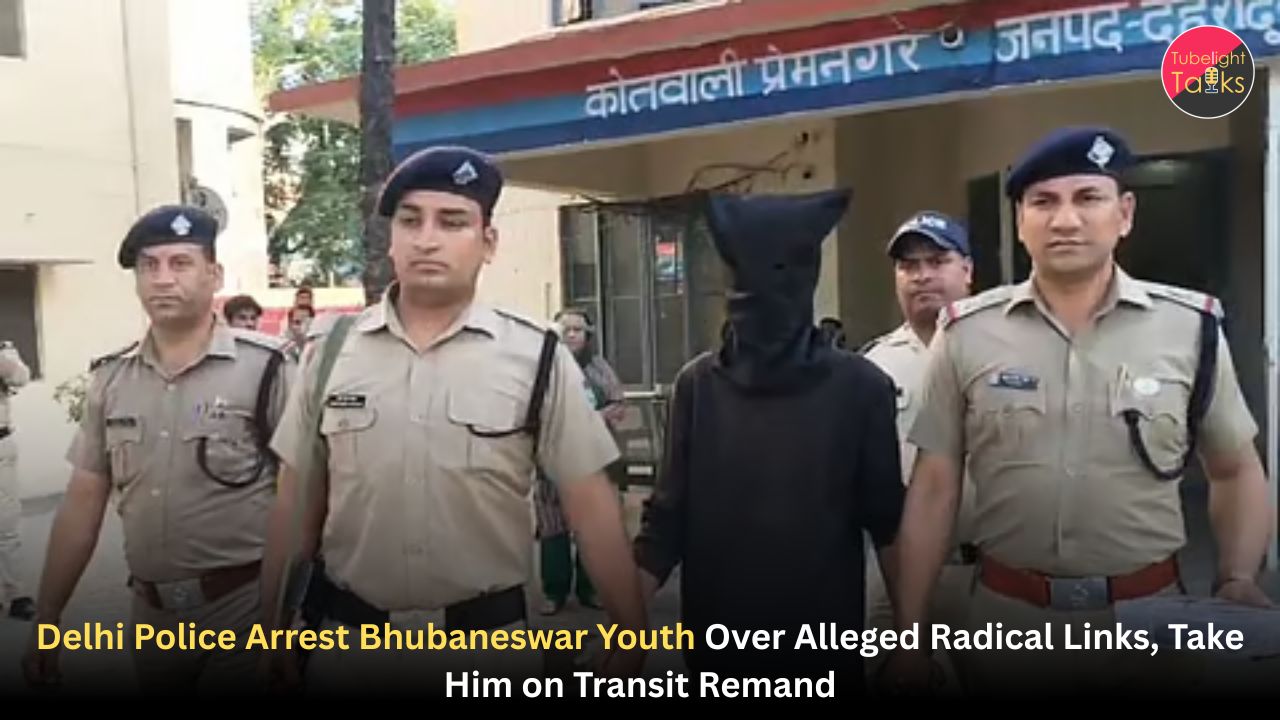
Delhi Police Arrest Bhubaneswar Youth in Radicalisation Probe, Highlighting the New Frontline of Internal Security
A 22-year-old man from Bhubaneswar, identified in current reporting as Sheikh Imran, has been arrested by Delhi Police and taken on transit remand over alleged links with a radical group. Indian Express reported that the Special Branch of Delhi Police carried out the arrest on Saturday with cooperation from local police in Odisha, after tracing online radicalisation-related activity through a wider investigation.
The case is being treated seriously because it appears to sit within a broader web of social-media-based extremist influence rather than a single isolated post or encounter.
One important correction is necessary at the outset. Current published reports identify the accused as 22 years old, not 23. They also focus on alleged links with a radical group, circulation of harmful content, and suspected online radicalisation.
The stronger sources available do not conclusively confirm the more dramatic claim that coordinated urban strikes were already operationally planned. That distinction matters, because in internal security reporting, overstating an allegation can damage credibility and confuse the nature of the threat.
How the Investigation Reached Odisha
The case reportedly developed after Delhi Police questioned a group of young men in Delhi over social-media content related to radicalisation. According to Indian Express and Times of India, the trail then extended to Odisha, where police scrutiny centered on Imran’s digital activities and contacts. This reflects the new investigative reality of internal security: the geography of a threat is no longer defined only by where a suspect lives, but by where digital influence travels.
Police said that through his social media accounts, the accused allegedly came in contact with a closed group on WhatsApp and Signal in which radical material on religious lines was circulated. That phrasing is significant.
It suggests investigators are focusing not merely on public content, but on semi-private or closed network spaces where recruitment, ideological conditioning, and trust-building can happen away from public view. In many modern radicalisation cases, the loudest propaganda is public, but the most consequential messaging is private.
Also Read: Delhi Court Grants Bail to Shabir Shah in Money Laundering Case
Why This Case Matters Beyond One Arrest
Cases like this are often misunderstood as small or purely local. They are not. Even when no attack has taken place, such arrests matter because they show how extremist ecosystems evolve. Radicalisation is often gradual. It begins with exposure, continues through repetition, and deepens through community validation in closed channels. By the time violence or operational intent becomes visible, the ideological groundwork may have been laid for months.
That is why police investigations increasingly focus on digital behaviour, content patterns, and network connectivity. The threat model has changed. Instead of asking only who possesses weapons or attends secret meetings, agencies now also ask who is being influenced, who is distributing narrative frames, and who is helping convert grievance into extremist identity. The Bhubaneswar arrest fits that broader pattern of preventive internal security work.
The Importance of Language in Security Reporting
Security reporting often becomes sensational too quickly. Terms like terror, sleeper cell, strike plan, module, and network are sometimes used interchangeably by public discourse even when investigative stages differ sharply. In this case, the best-supported public reporting points to alleged radical links, objectionable content, encrypted-group participation, and suspected influence by extremist views. Those are serious allegations, but they are not the same thing as a publicly documented operational plot.
This distinction is not about minimizing risk. It is about preserving clarity. Internal security agencies need public trust, and public trust grows when facts are reported carefully. Inflated narratives can create panic, stigmatize communities, and distort policy responses. Precise language, by contrast, helps citizens understand the actual nature of a threat and the appropriate scale of response.
Online Radicalisation Is Now a Major National Security Challenge
The details reported in this case are consistent with a larger trend seen globally: radicalisation pipelines increasingly rely on social platforms, encrypted messaging apps, and closed ideological circles. These environments make it easier for recruiters and propagandists to identify emotionally vulnerable individuals, isolate them from counter-narratives, and normalize extremist thinking as moral duty or group loyalty.
India’s security challenge is especially complex because the country’s digital scale is so large. Millions of young users move daily across public and private platforms, often encountering ideological material without context or supervision. In such an environment, early detection matters enormously. By the time a case reaches arrest, agencies are usually trying to determine not just one person’s behaviour but the reach of the network around him. That is why transit remand and device examination become central.
Why Transit Remand Matters
Transit remand is not a technical footnote here. It enables investigators to move the accused to the jurisdiction where the core probe is being run and where linked evidence, prior detentions, and digital forensic workflows may already exist. In practical terms, it allows agencies to integrate one arrest into a wider intelligence picture. Without that, separate pieces of a network can remain administratively disconnected.
This also means the public story may still be incomplete. Arrest is often the visible part of a much longer investigation. What investigators will now examine includes the accused’s device history, online contacts, role inside the alleged group, whether he was a passive consumer or active distributor, and whether others remain under watch. The most important findings often emerge after the arrest, not before it.
Security Must Be Firm, but Also Intelligent
Cases involving radicalisation demand firmness, but also nuance. A democratic state must disrupt genuine extremist ecosystems quickly, yet it must also distinguish between ideological exposure, active propaganda, facilitation, and direct operational intent. Those differences affect law, surveillance, rehabilitation, and public communication. A nation becomes more secure not when it reacts loudly, but when it reacts intelligently.
That is why this case should matter to parents, educators, civil society, and digital platforms as much as to police. Radicalisation is not only a policing issue. It is also a social resilience issue. The stronger a society becomes at identifying manipulation early, the less room extremist actors have to build influence under the cover of isolation and grievance.
Guarding the Mind Is Also Security
Sant Rampal Ji Maharaj’s teachings emphasize control of the mind, rejection of destructive influence, and righteous living based on truth rather than provocation. His official teachings repeatedly argue that harmful paths take root when discernment is weak and the mind becomes captive to false narratives. In the context of radicalisation, that insight feels strikingly relevant: internal security begins not only with policing borders and cities, but with protecting the mind from poisonous direction.
A society that cultivates moral clarity, compassion, and scriptural discernment is harder to radicalise. That does not replace law enforcement, but it strengthens the human defenses that law alone cannot build. The deeper answer to extremism is not just force. It is truth, discipline, and right understanding before hatred becomes identity.
Call to Action
Families, schools, communities, and platforms should take online radical content seriously. Early intervention is far easier than late recovery.
FAQs: Delhi Police Arrest Bhubaneswar Youth Over Alleged Radical Links, Take Him on Transit Remand
1. Who was arrested in this case?
Reports identify the accused as Sheikh Imran, a 22-year-old resident of Bhubaneswar.
2. Why was he arrested?
Police allege he had links with a radical group and was involved in circulating harmful religiously radical content online.
3. Which platforms are mentioned in the investigation?
WhatsApp and Signal are specifically named in police statements cited by the media.
4. Has a coordinated attack plot been publicly confirmed?
The strongest public reporting available focuses on alleged radical links and online activity, not a fully documented operational strike plan.
5. What happens next?
Delhi Police will continue investigation in their jurisdiction, including examination of digital devices, contacts, and network links.
Related Stories







Discussion (0)