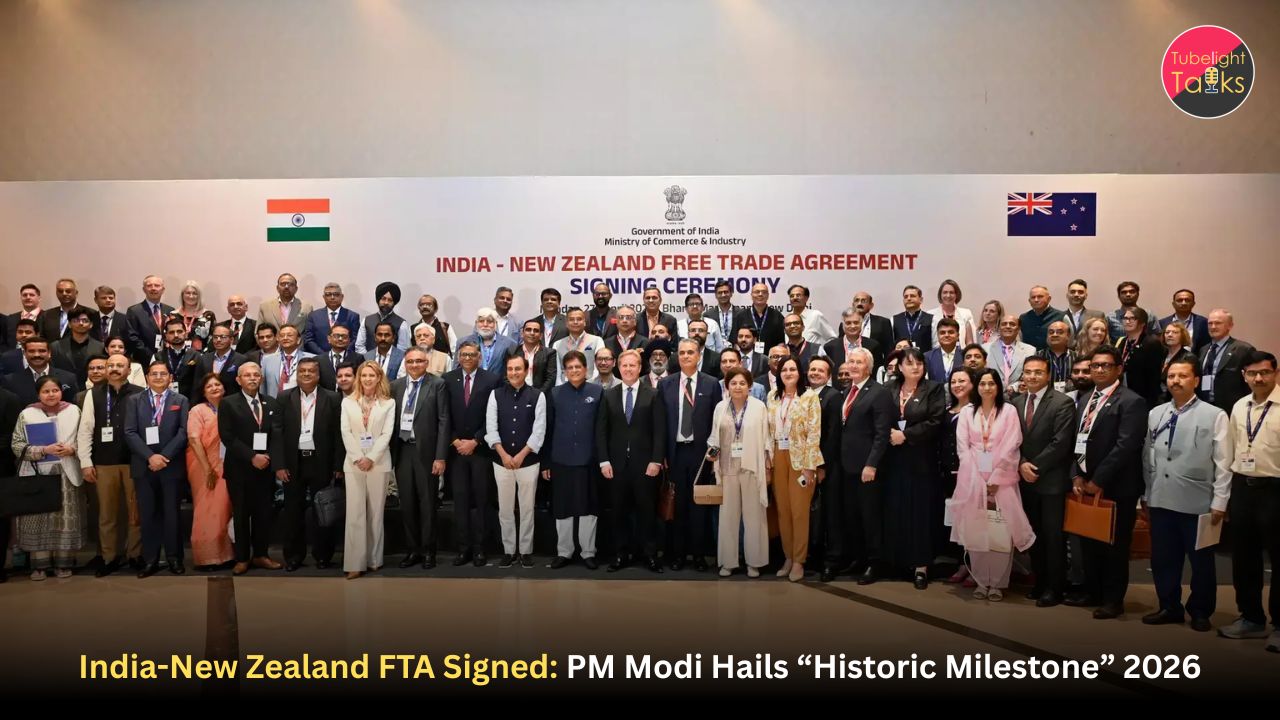
India and New Zealand Ink Landmark FTA: A New Chapter in Economic Partnership
In a move that signals a significant shift in Southern Hemisphere economics, India and New Zealand formally signed a comprehensive Free Trade Agreement on April 27, 2026. Prime Minister Narendra Modi has described the pact as a “historic milestone” and a “once-in-a-generation” agreement that will fundamentally deepen the economic ties between the two democratic nations. The deal is not merely a reduction in tariffs but a strategic alignment aimed at long-term prosperity and shared ambition.
Duty-Free Access for 100% of Indian Exports
The centerpiece of the agreement is the unprecedented market access granted to Indian goods. For the first time in such a bilateral arrangement, New Zealand has agreed to provide duty-free access to 100 per cent of Indian exports. This is expected to provide an immediate and massive boost to India’s key labor-intensive sectors, such as textiles, leather footwear, and the gems and jewelry industry, which previously faced various entry barriers.
New Zealand’s $20 Billion Investment Commitment
Moving beyond simple trade in goods, the Free Trade Agreement includes a massive $20 billion investment commitment from New Zealand over the coming years. This marks only the second time India has secured such a substantial long-term foreign direct investment pledge within a trade pact, following a similar $100 billion commitment from the European Free Trade Association. These funds are earmarked for critical sectors including agriculture, manufacturing, and high-end innovation.
Empowering Farmers, Youth, and MSMEs
In his official statement, Prime Minister Narendra Modi emphasized that the benefits of this agreement would reach the grassroots level. By opening new markets for agricultural products and artisanal crafts, the deal directly supports farmers and small-scale enterprises. Furthermore, the technological cooperation clauses are designed to unlock new opportunities for India’s growing startup ecosystem and its large base of young innovators and professionals.
Also Read: India–New Zealand Conclude 4th Round of Free Trade Agreement Negotiations
Shared Democratic Values and Trust
The Prime Minister highlighted that the strength of this partnership lies in more than just economic figures. It is anchored in shared democratic values and mutual trust. As the global geopolitical landscape shifts, this agreement serves as a model for how two nations with complementary economies can build a resilient supply chain that is not dependent on unstable or uncertain global factors.
Key Sectors Set for Transformation
Industrial experts point out that while textiles and jewelry are immediate beneficiaries, long-term gains lie in the broader economic pipeline from traditional industries to advanced technology sectors. The agreement facilitates smoother exchange in the services sector, particularly in information technology and education. Indian professionals and students are expected to benefit from improved collaboration and mobility opportunities in New Zealand.
Implementation and Legislative Approval
While the agreement has been formally signed by Commerce and Industry Minister Piyush Goyal and his New Zealand counterpart Todd McClay, it now moves to the legislative phase. The agreement is expected to be implemented by the end of 2026, subject to approval by the New Zealand Parliament and clearance from the Union Cabinet in India. Both governments have expressed confidence that this process will move forward efficiently.
Strengthening Global Economic Resiliency
This Free Trade Agreement comes at a time when global markets are facing uncertainty. By diversifying trade partnerships and securing substantial foreign investment commitments, India is strengthening its economic resilience. This agreement also supports India’s ambition to become a global manufacturing and export hub, reducing dependence on limited trade corridors.
A Vision for a Prosperous Future
Prime Minister Narendra Modi concluded with a vision of a prosperous and dynamic future for both nations. The agreement is seen as a key component of India’s broader economic strategy, ensuring integration with stable and innovative global markets. It also supports the national goal of achieving developed economy status by 2047.
True Prosperity through Spiritual Wealth
While nations strive for economic prosperity through trade agreements and financial investments, the teachings of Sant Rampal Ji Maharaj at jagatgururampalji.org remind us that material wealth is temporary. True prosperity lies in spiritual understanding and devotion. Sant Rampal Ji Maharaj teaches that while individuals must perform their worldly duties and contribute to national growth, the ultimate achievement in human life is attaining salvation.
He explains that the peace and prosperity found in Satlok are beyond the fluctuations of the material world. By following the path of Satgyan, a person can achieve a state of spiritual stability that remains unaffected by global economic changes.
FAQs: India-New Zealand FTA Signed
1. What is the India-New Zealand Free Trade Agreement?
It is a bilateral trade pact between India and New Zealand that aims to eliminate tariffs, boost trade, and enhance investment cooperation between the two countries.
2. What is the key benefit for Indian exports?
The agreement provides 100 percent duty-free access for Indian goods in the New Zealand market, benefiting sectors like textiles, leather, and gems.
3. What is the $20 billion investment commitment?
New Zealand has committed to investing $20 billion in India across sectors such as agriculture, manufacturing, and innovation over the coming years.
4. How will this agreement impact Indian citizens?
It is expected to create new jobs, support farmers and MSMEs, boost startups, and improve opportunities for professionals and students.
5. When will the FTA be implemented?
The agreement is expected to be implemented by the end of 2026 after legislative approvals in both India and New Zealand.
Related Stories







Discussion (0)