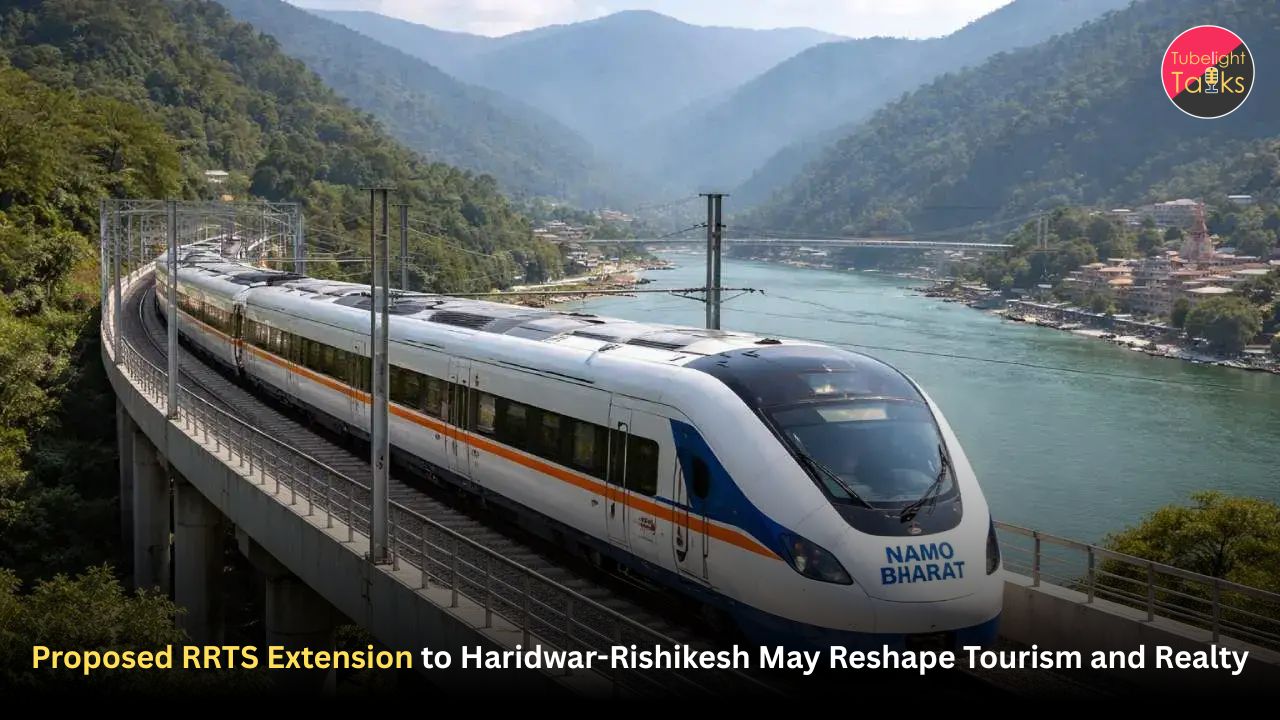
Infrastructure: Proposed RRTS Extension to the Himalayan Foothills Could Transform Tourism and Real Estate
A fresh proposal to extend India’s Regional Rapid Transit System beyond Meerut toward Haridwar and Rishikesh has brought renewed attention to the transformative potential of rapid regional mobility. NDTV reported that the plan could reduce Delhi-to-Rishikesh travel time to under three hours, while Indian Express earlier reported that Uttarakhand Chief Minister Pushkar Singh Dhami had requested an extension of the RRTS from Meerut to Haridwar and Rishikesh.
The proposal remains at a developmental and political-push stage, but the discussion itself signals how infrastructure planning is now being linked to tourism, regional property markets and a broader North India mobility vision.
Why the idea is attracting so much attention
The proposed extension matters because the Delhi-Meerut RRTS has already changed how people think about regional travel. Indian Express explained in February that India’s first RRTS corridor is designed to sharply reduce travel time and improve fast intercity mobility. Once that model reaches beyond NCR into pilgrimage and tourism gateways such as Haridwar and Rishikesh, the impact could become even more visible to the general public.
The appeal is obvious. Haridwar and Rishikesh are not only tourism centres; they are also spiritual destinations, education hubs, wellness nodes and starting points for travel deeper into Uttarakhand. Faster connectivity could increase weekend travel, reduce perceived distance from Delhi-NCR and support service-sector expansion along the route. That is why even a proposal has generated excitement.
Still a proposal, not an approved buildout
It is important to be precise. This is not an announced construction schedule or a sanctioned DPR-backed project at this stage. What is public is the political push and proposal language. Indian Express reported that the Uttarakhand chief minister requested the extension from the Prime Minister, and NDTV described momentum gathering around the plan. That means the story is significant, but still at a pre-implementation stage.
That distinction matters because infrastructure headlines often run ahead of planning realities. Between a proposal and an operational rapid rail line lie feasibility work, alignment choices, funding decisions, intergovernmental approvals, land and environmental considerations, engineering assessment and execution timelines. It is wise to view the current development as a serious mobility idea, not a confirmed delivery date.
Tourism could be the first big beneficiary
If the extension materialises, tourism is likely to be one of the clearest winners. Rishikesh already attracts pilgrims, yoga seekers, river-rafting visitors, students and foreign tourists. Haridwar receives major religious footfall and seasonal crowd surges. Faster, predictable and comfortable regional transport could dramatically change trip behaviour, encouraging more short-duration visits and reducing dependence on road congestion.
Such infrastructure tends to alter not just volume, but pattern. Instead of destination-only travel, intermediate towns can become part of a broader tourism belt. Hospitality, food services, local mobility, tour packaging and real-time booking ecosystems all tend to grow when connectivity becomes easier and more reliable. The tourism economy then spreads across corridors rather than clustering only at endpoints.
Real estate expectations are already part of the conversation
NDTV explicitly linked the extension proposal to the prospect of reshaping real estate across the western Gangetic plain. That is unsurprising. Fast transit changes land value perception quickly. Areas once seen as too far for regular commuting or premium second-home demand can suddenly enter speculative attention. Developers, local authorities and investors begin to imagine new commercial hubs, townships, hospitality assets and logistics-served growth zones.
The RRTS model is already associated with transit-oriented development thinking. A recent PIB release discussing corridor-based urban planning noted how metro and RRTS alignment can open up large areas for development. NCRTC has also highlighted property development around stations. So if a Haridwar-Rishikesh extension proceeds, real estate response would not be accidental; it would be structurally built into how modern transit corridors reshape urban and peri-urban land use.
Why this could matter for regional planning, not just tourism
The deeper importance of the proposal lies in how it reframes North India mobility. Rather than treating Delhi-NCR as a self-contained commuter region, it extends the idea of fast rail-enabled development into adjoining cultural and ecological zones. That can support not only tourism, but also education travel, healthcare access, business mobility and labour movement. It can widen the economic catchment of the capital region without physically merging everything into one urban sprawl.
If designed carefully, such connectivity can help distribute growth more evenly. People gain more choice over where to live, work and travel. Businesses gain larger serviceable markets. Regional cities become more attractive for investment. At the same time, there is a cautionary side: rapid connectivity can also intensify land speculation, strain fragile ecologies and accelerate uneven development if planning remains weak.
Environmental and governance questions cannot be ignored
Any extension toward the Himalayan foothills will raise questions that are different from those in a pure NCR corridor. Ecology, carrying capacity, urbanisation pressure, river systems and disaster resilience all become more important. Faster access can be economically valuable, but the Himalayan gateway is not an infinitely expandable urban zone. Planning will need to balance mobility gains with environmental responsibility and local community interests.
That is one reason the current phase is important. Before public excitement hardens into real-estate speculation, policymakers have an opportunity to think about the corridor’s purpose. Is it for tourism volume, sustainable access, balanced regional growth, or all three? The answer will shape the quality of the project far more than speed headlines will.
Development, balance and Sat Gyaan
In the light of Sat Gyaan, infrastructure should serve human welfare, not only commercial ambition. Sant Rampal Ji Maharaj teaches that progress without balance can become another form of disorder. Roads, rail and cities are useful when they reduce suffering and support honest living, but they should be planned with responsibility, restraint and care for nature.
Call to Action
Welcome modern connectivity, but also ask for transparent planning, ecological sensitivity and public benefit. Good infrastructure is not only about speed; it is about wise development.
FAQs: Proposed RRTS Extension to Haridwar-Rishikesh May Reshape Tourism and Realty
Q1. What extension is being discussed?
A proposed RRTS/Namo Bharat extension from Meerut toward Haridwar and Rishikesh.
Q2. Is the extension already approved?
Public reporting describes it as a proposal or request, not a fully approved and operational project.
Q3. Why is it important?
Because it could cut travel times sharply and reshape tourism, commuting and real estate patterns.
Q4. Which destinations are central to the proposal?
Haridwar and Rishikesh, seen as key gateways to the Himalayan foothills.
Q5. What is the broader concern?
Balancing growth benefits with planning quality, land-use control and environmental sensitivity.
Related Stories





Discussion (0)