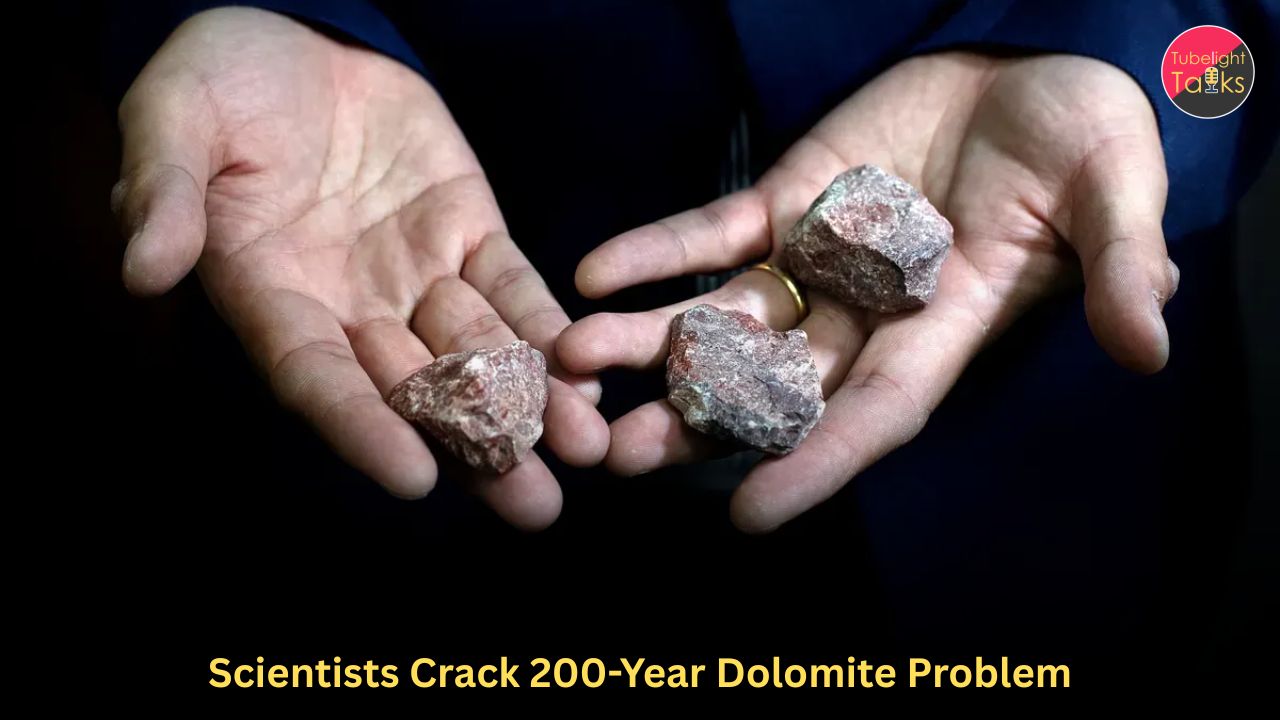
Scientists Solve the 200-Year-Old Dolomite Problem
Scientists have solved a long-standing geology puzzle known as the “dolomite problem.” Although dolomite is abundant in ancient rocks, researchers struggled for nearly two centuries to grow it under natural conditions in the laboratory. Work by researchers from the University of Michigan and Hokkaido University explained how periodic removal of crystal defects allows dolomite to grow.
What Is Dolomite?
Dolomite is a calcium magnesium carbonate mineral found in many ancient rocks and landscapes, including the Dolomite mountains, Niagara Falls and Utah’s Hoodoos.
Why It Was a Mystery
Dolomite is common in rocks older than 100 million years but rare in modern environments. Laboratory attempts repeatedly failed because calcium and magnesium atoms often attached in the wrong positions.
Also Read: AlphaGenome Helps Decode Disease-Causing DNA Changes
Defects Stopped Crystal Growth
When atoms attach incorrectly, tiny defects form on the growing dolomite surface. These defects prevent additional ordered layers from forming, making growth extremely slow.
Water Acts Like a Reset Button
Researchers found that misplaced atoms are less stable and can dissolve when washed with water. Repeated washing through rain, tides or changing water levels removes defects and allows growth to continue.
Laboratory Breakthrough
Using atomic simulations and electron microscopy, researchers mimicked this defect-removal process and finally grew dolomite in the lab under relevant conditions.
Lessons Beyond Geology
The finding may help scientists design better strategies for growing advanced materials. Sometimes, controlled dissolution can improve crystal quality rather than destroy it.
Earth Science and Spiritual Reflection
The dolomite mystery shows that nature works through deep order over long time scales. Sant Rampal Ji Maharaj teaches that creation reflects divine law and that humans should seek true knowledge beyond surface appearances.
Call to Action
Students should explore geology, materials science and earth chemistry. Understanding minerals can help improve both climate science and advanced technology.
FAQs: Scientists Crack 200-Year Dolomite Problem
Q1. What is the dolomite problem?
It is the mystery of why dolomite is abundant in nature but hard to grow in labs.
Q2. What stopped dolomite growth?
Tiny atomic defects blocked ordered crystal layers.
Q3. How does nature solve it?
Water repeatedly washes away unstable defects.
Q4. Who solved the puzzle?
Researchers from the University of Michigan and Hokkaido University contributed to the breakthrough.
Q5. Why does this matter?
It helps geology and may improve advanced crystal manufacturing.
Related Stories










Discussion (0)