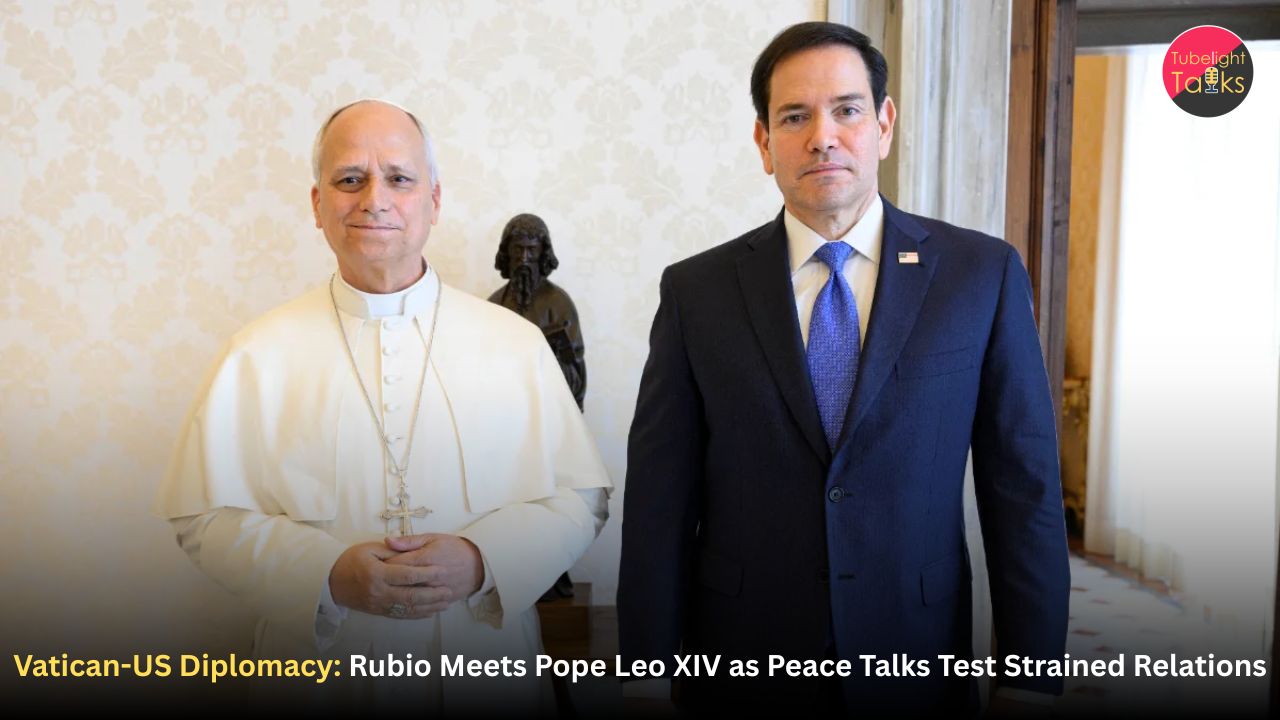
Vatican-US Diplomacy: Marco Rubio Meets Pope Leo XIV in Rome to Discuss Peace Amid Strained Relations
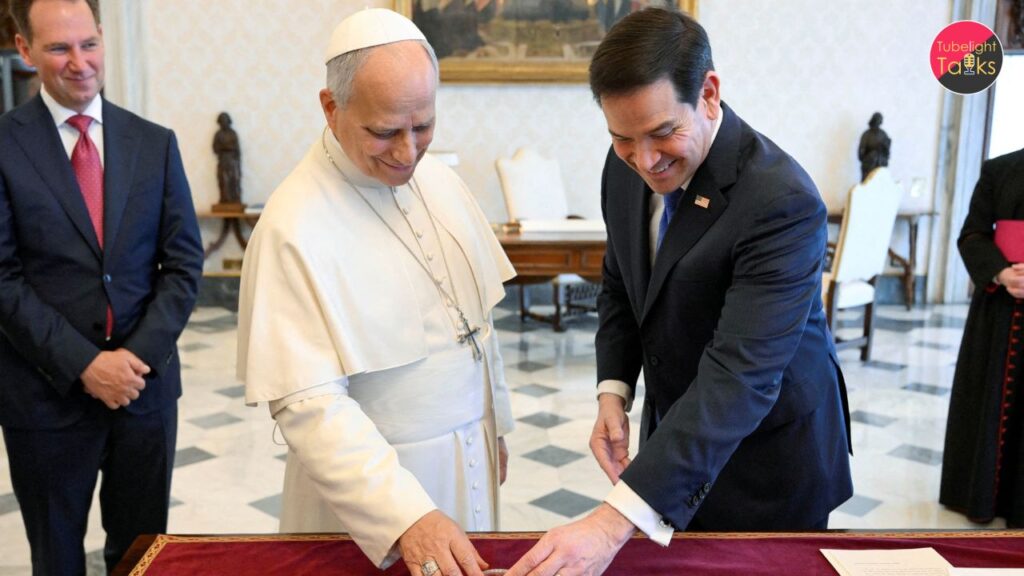
Vatican-US Diplomacy: U.S. Secretary of State Marco Rubio met Pope Leo XIV at the Vatican in a high-stakes diplomatic engagement aimed at easing strained relations between Washington and the Holy See. The meeting took place during Rubio’s two-day visit to Italy and Vatican City, with discussions focusing on countries affected by war, peace efforts, the Middle East, human dignity and bilateral relations. Vatican News confirmed that Pope Leo held an audience with Rubio in the Apostolic Palace and that the talks included nations marked by war.
The visit came amid visible tension after President Donald Trump repeatedly criticized the pontiff over his opposition to the Iran war and his calls for peace. Both sides described the meeting in constructive terms, but the underlying diplomatic strain remains clear.
Rubio Meets Pope Leo XIV at the Vatican
A Carefully Watched Audience
Rubio’s meeting with Pope Leo XIV was watched closely because it came at a difficult moment in U.S.-Vatican relations. The Vatican confirmed that the U.S. Secretary of State arrived in Italy and went to the Vatican, where he met the pope in the Apostolic Palace. The official Vatican report said the discussions included countries marked by war, making the meeting strongly connected to ongoing global crises.
The Vatican is not only a religious centre; it is also a diplomatic actor with global moral influence. When a U.S. secretary of state meets the pope during wartime tensions, the conversation carries symbolic weight. It signals that Washington understands the importance of Vatican diplomacy, even when the two sides disagree.
The meeting also had a personal dimension because Pope Leo XIV is the first U.S.-born pope. That fact makes the strained relationship even more unusual. A U.S. administration publicly clashing with an American pope over war and peace is diplomatically rare.
Meeting With Cardinal Pietro Parolin
Rubio also met senior Vatican officials, including Secretary of State Cardinal Pietro Parolin, the Holy See’s top diplomat. This part of the visit mattered because Vatican diplomacy is often conducted through careful language, long-term channels and quiet negotiation. Reuters reported that the Vatican’s statement after the meeting, which said the two sides pledged to improve bilateral relations, was read by insiders as recognition of unusually deep tensions.
That wording was careful but meaningful. When diplomatic statements emphasize improvement of relations, it often indicates that relations need repair. The Vatican and Washington may still cooperate on humanitarian aid, migration, religious freedom and peace efforts, but their positions on the Iran war have become sharply different.
Why U.S.-Vatican Relations Are Strained
Pope Leo’s Criticism of War
Pope Leo XIV has increasingly spoken against war, violence and the arms-driven logic of international politics. Reuters reported that the pope, who had previously kept a lower profile in his early months, has recently spoken more forcefully against war and despotism. His criticism of the Iran war drew the ire of President Trump.
For the Vatican, war is not judged only through military strategy. It is judged through human suffering, civilian casualties, displacement, moral responsibility and the danger of normalizing violence. Pope Leo has repeatedly urged leaders to turn away from violence and protect human life.
For the Trump administration, the Iran conflict is being framed as a security necessity involving freedom of navigation, nuclear concerns and deterrence. This creates a moral and strategic divide: Washington emphasizes power and security; the Vatican emphasizes peace and human dignity.
Trump’s Attacks on the Pope
The meeting happened after weeks of public criticism by Trump toward Pope Leo XIV. Reuters noted that Trump repeatedly attacked the pontiff over the Iran war, while AP reported that Rubio’s visit was partly an effort to ease tensions with the Vatican after Trump’s criticism of the pope’s calls for peace.
Public attacks on a pope are diplomatically sensitive, especially when the pope is calling for peace during an active conflict. They can upset Catholic communities, strain relations with the Holy See and complicate U.S. engagement with countries where the Vatican has moral influence.
Rubio’s role, therefore, was not only to discuss policy. He also had to repair tone.
Main Themes of the Meeting
Peace in War-Affected Regions
Vatican News stated that the meeting included discussions about countries marked by war. This likely covered Ukraine, the Middle East, Iran-related tensions and possibly humanitarian crises in the Western Hemisphere.
The Vatican often approaches conflicts through humanitarian principles: protection of civilians, dialogue, prisoner exchanges, refugee care, negotiation and moral restraint. The U.S. approach under Trump has been more force-based, using military pressure, sanctions and naval deployments alongside diplomacy.
The meeting therefore brought two different diplomatic languages into the same room. Rubio represented state power. Pope Leo represented moral pressure.
Human Dignity
The State Department and U.S. embassy messaging after the meeting emphasized shared commitments to peace and human dignity. That language is important because human dignity is one of the few areas where the two sides can agree even when they disagree on war policy.
Human dignity includes protection of civilians, religious freedom, humanitarian aid, care for displaced people, and resistance to dehumanization during conflict. Both the U.S. and Vatican can publicly support these principles, even if their methods differ.
Western Hemisphere Issues
Reuters reported that the U.S. embassy to the Holy See said Pope Leo and Rubio discussed topics of mutual interest in the Western Hemisphere. This may include migration, Cuba, Venezuela, poverty, religious freedom and humanitarian aid.
This is especially relevant because Pope Leo spent decades as a missionary and bishop in Peru before becoming pope. His experience in Latin America gives him deep understanding of poverty, migration, inequality and political instability in the region.
Also Read: Marco Rubio’s India Visit: New Delhi Prepares for High-Stakes Bilateral Talks and Quad Diplomacy
Rubio’s Wider Rome Mission
Italy, Iran and the Strait of Hormuz
Rubio’s Vatican visit was part of a broader diplomatic mission in Rome. AP reported that he met Italian Prime Minister Giorgia Meloni and Foreign Minister Antonio Tajani while pressing European allies to take firmer action against Iran. He warned that Iran was attempting to normalize control over the Strait of Hormuz and called that unacceptable.
This shows that Rubio’s trip had two tracks. One was repair diplomacy with the Vatican and Italy. The other was pressure diplomacy over Iran. He wanted European partners to move beyond statements and support U.S. efforts to protect maritime security.
This dual purpose made the visit complicated. Rubio was trying to calm tensions with Catholic and European partners while also pushing a hard line against Iran.
Italy’s Cautious Position
Italy has been cautious about the U.S.-Israeli military campaign in Iran. AP reported that Meloni described her meeting with Rubio as constructive, frank and productive, but also stressed that each country must defend its own national interests. Italy has resisted involvement in offensive operations and expressed concern about escalation.
That matters for the Vatican because Rome and Vatican City are geographically close, diplomatically linked and often affected by the same public debates. The Vatican’s peace message and Italy’s caution both show that U.S. allies are not fully aligned with Washington’s Iran strategy.
Pope Leo’s Peace Appeal After the Meeting
Call to Calm Global Tensions
A day after meeting Rubio, Pope Leo used his first anniversary as head of the Catholic Church to pray that world leaders would calm global tensions, reduce hatred and turn away from violence. Reuters reported that he asked God to enlighten those with special responsibilities of government and lamented that world peace is endangered by international tensions and an economy that prefers arms trade over respect for human life.
This speech gave deeper meaning to the Rubio meeting. Pope Leo did not name the U.S. directly in that moment, but the message was clearly relevant to global leaders involved in war and arms escalation.
Warning Against Becoming Used to War
The pope also urged people not to become accustomed to war. This is a powerful warning because modern society can become numb to daily images of destruction. When wars continue for months or years, civilian suffering can turn into background noise.
In that context, Vatican diplomacy tries to keep moral attention alive. The pope’s role is to remind leaders that human beings are not statistics, and peace is not weakness.
Can Rubio Repair the Relationship?
Positive Language, Real Differences
Both sides used constructive language after the meeting. The Vatican and U.S. officials emphasized continued dialogue and shared interests. Rubio described the relationship with the Catholic Church as productive and important. AP reported that he sought to ease tensions with the Vatican following Trump’s criticism of the pope’s peace calls.
However, the differences remain real. The Vatican opposes war escalation and emphasizes humanitarian consequences. The Trump administration is using military pressure in Iran and demanding stronger European backing. Those positions cannot be harmonized through one meeting.
Diplomacy Needs Repeated Engagement
The meeting is best understood as a first step in damage control. It may reduce public hostility, reopen communication and prevent a deeper rupture. But lasting improvement will require continued respect, careful language and practical cooperation on humanitarian issues.
If Trump continues attacking the pope, Rubio’s repair efforts may not hold. If the Vatican continues criticizing the Iran war, Washington may remain irritated. The relationship will depend on whether both sides can disagree without public rupture.
Why This Matters Globally
Vatican Diplomacy Has Moral Reach
The Vatican has no army, but it has moral influence. Its statements can shape Catholic opinion, humanitarian debate and peace advocacy across continents. During conflicts, the Holy See often supports negotiation, prisoner exchange, civilian protection and humanitarian corridors.
A strained U.S.-Vatican relationship can weaken coordination on issues where both sides could otherwise work together, including refugees, religious freedom, humanitarian relief and conflict mediation.
U.S. Needs Partners Beyond Military Alliances
The U.S. may have military power, but in complex global crises it also needs moral and diplomatic partners. The Vatican can reach communities, leaders and regions that formal diplomacy sometimes cannot. Repairing ties with the Holy See may therefore help Washington maintain broader international legitimacy.
Peace, Diplomacy and the SatGyaan Message
The Rubio-Pope Leo meeting shows that military power and political diplomacy are not enough when the world is burning in hatred, war and mistrust. JagatguruRampalJi.org explains that Sant Rampal Ji Maharaj’s True Spiritual Knowledge teaches that all human beings are children of one Supreme Father and that real social change begins when individuals transform from within. The same official teachings describe righteous living, compassion and non-violence as essential aspects of the spiritual path.
In relation to Vatican-U.S. diplomacy, this SatGyaan is directly relevant: leaders may meet in palaces and issue statements, but lasting peace will not come until human hearts reject ego, violence, greed and domination. Sant Rampal Ji Maharaj’s teachings guide people toward truth, compassion, scripture-based devotion and brotherhood. A world guided by such true knowledge would not need endless wars to settle disputes; it would seek justice, humility and peace as the natural duty of humanity.
FAQs on Vatican-US Diplomacy
1. Who met at the Vatican?
U.S. Secretary of State Marco Rubio met Pope Leo XIV at the Vatican’s Apostolic Palace during his visit to Rome.
2. What did Rubio and Pope Leo discuss?
The discussions included countries affected by war, peace efforts, human dignity, the Middle East and issues of mutual concern between the Vatican and Washington.
3. Why were U.S.-Vatican relations strained?
Relations were strained because Pope Leo criticized the Iran war and President Trump repeatedly attacked the pope over his peace-focused position.
4. Did Rubio meet other Vatican officials?
Yes. Rubio also met senior Vatican officials, including Vatican Secretary of State Cardinal Pietro Parolin.
5. What did Pope Leo say after the meeting?
Pope Leo urged world leaders to calm tensions, reduce hatred, turn away from violence and resist an economy driven by arms over human life.
6. Did the meeting resolve the tensions?
The meeting helped reopen dialogue and both sides pledged to improve relations, but major differences over war, diplomacy and humanitarian priorities remain.
Related Stories



Discussion (0)