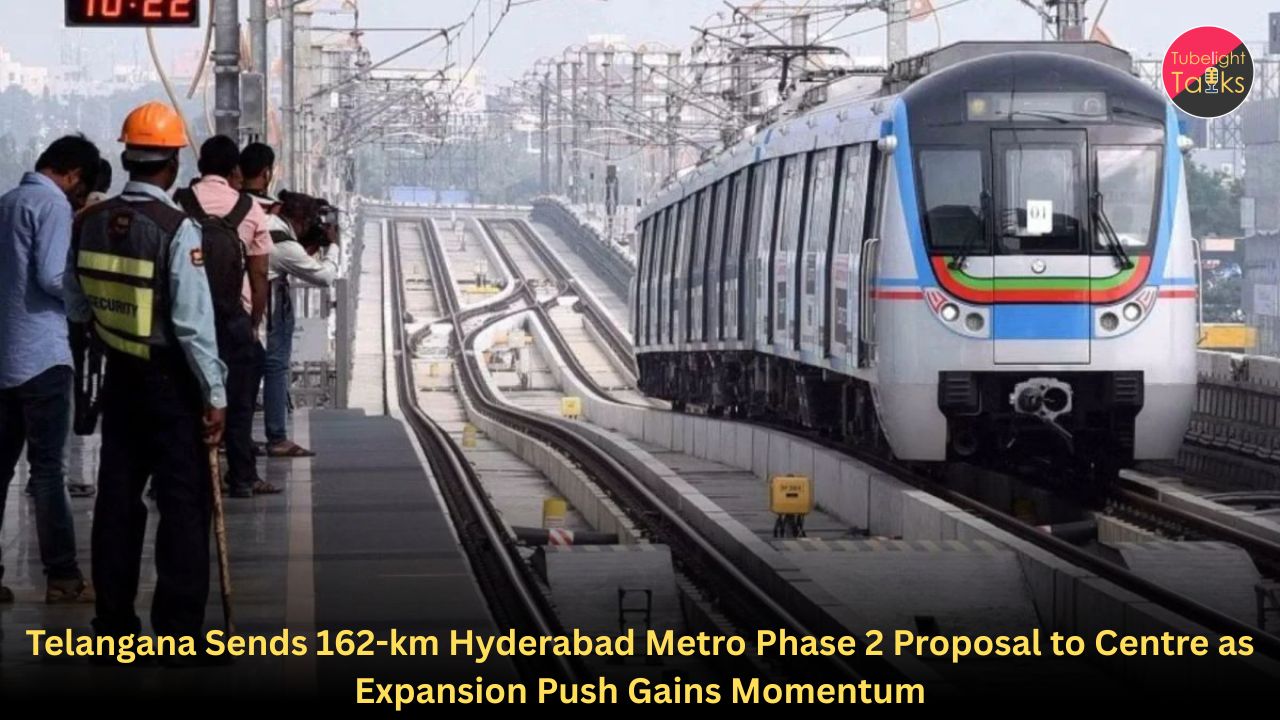
Hyderabad Metro’s Next Leap: Telangana Sends 162-Km Expansion Plan to the Centre
Hyderabad Metro Phase 2 Proposal: The Telangana government has submitted proposals to the Union government for a large-scale Hyderabad Metro Phase 2 expansion covering 162.5 km across eight corridors. According to a written reply in the Lok Sabha cited by Indian Express, the Ministry of Housing and Urban Affairs has received proposals for Hyderabad Metro Rail Phase-II, covering 76.4 km across five corridors, and Hyderabad Metro Phase-II(B), covering 86.1 km across three corridors. That makes the combined expansion one of the most ambitious urban mobility proposals currently under central appraisal.
One factual clarification is important here. The strongest currently available public sources confirm the 162-km-plus submission and corridor breakdown, but they do not support the specific ₹14,500 crore figure as the total cost of the full Phase 2 expansion. Public reporting around the project cites differing cost structures for various segments, while official central replies focus on receipt of the proposal and the appraisal process rather than final sanctioned cost.
Why Phase 2 Matters More Than Phase 1 Ever Did
Hyderabad is no longer the city for which Phase 1 alone was enough. The metropolitan footprint has expanded, new residential clusters have deepened, the airport and growth corridors matter more, and road congestion has become a daily structural burden rather than an occasional complaint.
A metro system that stops expanding in such a city gradually becomes less a mobility backbone and more a partial corridor service. Phase 2 is therefore not a luxury addition. It is the difference between a metro that shapes growth and one that merely serves fragments of it.
That is also why the state has linked expansion to broader restructuring of Hyderabad Metro governance. Official and public reporting around the state’s takeover of Phase I from L&T suggest that Telangana sees ownership consolidation and future expansion as connected.
A government that wants seamless network growth often prefers stronger control over operations, planning, and integration. In that sense, Phase 2 is part of a larger effort to reframe Hyderabad Metro as a long-horizon public mobility system rather than a narrowly bounded PPP legacy asset.
What the Centre Has Actually Confirmed
The most concrete official confirmation currently in the public domain is procedural rather than financial. Tokhan Sahu, Minister of State in the Ministry of Housing and Urban Affairs, said in a Lok Sabha reply that the Centre had received the Telangana government’s proposals. He also noted that metro projects are highly cost-intensive and therefore undergo detailed appraisal and examination at multiple levels under Metro Rail Policy, 2017. That means submission is significant, but sanction is not automatic.
This distinction matters because urban infrastructure politics often blurs proposal and approval. A state can announce an ambitious network. A ministry can acknowledge receipt. But between those moments lies the most difficult stage: appraisal, funding architecture, policy compliance, ridership modelling, and prioritisation. The Hyderabad proposal is now inside that difficult stage.
The Scale of the Vision
A 162-km expansion is not an incremental adjustment. It is a city-shaping proposition. HMRL-linked public material has described the next phase as the biggest leap in Hyderabad Metro’s growth, designed to widen access to fast, reliable, multimodal connectivity across rapidly urbanising zones. That framing is important because the argument for Phase 2 is not just that the current system needs extension. It is that Hyderabad’s future urban form depends on whether mass transit can reach the places where the city is still spreading.
Infrastructure of this scale also has network effects beyond mobility. Metro corridors shape land values, commute patterns, housing choice, labour access, retail clusters, and urban density. A line is never just a line. It creates a preferred geography of growth. That is why decisions taken at the proposal stage will influence how Hyderabad develops socially and economically over the next decade.
Why Funding and Governance Will Decide Everything
The engineering challenge is large, but the governance challenge may be larger. Hyderabad Metro Phase 2 will require not only capital but also integration, land management, station planning, multimodal access, and public confidence that the project will not stall midway. Public reporting suggests that cost figures vary depending on which set of corridors or phases is being discussed, and that the state’s metro takeover decisions are themselves part of a larger financial transition.
That means the success of Phase 2 will depend on more than Delhi’s approval. It will depend on a credible funding model, clarity on central and state shares, orderly institutional control, and consistent public communication. A project this large cannot survive on announcement energy alone. It needs administrative stamina.
What Hyderabad Stands to Gain
If executed well, the gains are substantial: reduced traffic load, lower commuter stress, improved access to growth corridors, better integration with airport and outer urban zones, and stronger support for a city whose economic profile keeps expanding. Hyderabad has long had the demand profile for stronger metro penetration. Phase 2 could move the system from being important to being indispensable.
But the inverse is also true. If the city grows faster than the transit backbone, congestion and commute inefficiency become embedded into daily life. Once that happens, the economic cost compounds silently through lost time, fuel waste, pollution, and lower urban productivity. This is why metro projects often look expensive only until the cost of not building them becomes visible.
Infrastructure Is Also a Moral Choice
Sant Rampal Ji Maharaj’s teachings emphasize doing right karmas that genuinely help society. His official teachings repeatedly frame value not in appearance alone, but in work that reduces suffering and improves life. Urban infrastructure can be read through that lens too. Public transport is not merely concrete and steel. It is a choice about whether a city will serve collective wellbeing or force every citizen into avoidable daily strain.
When transport planning is done honestly and for the public good, it becomes an act of service. It helps students reach opportunity, workers reach jobs, families save time, and cities breathe a little easier. Seen this way, the success of a metro expansion is not measured only in kilometres laid, but in the amount of public hardship it prevents.
Call to Action
Submission is a start. The real questions now are when the Centre responds, how funding is structured, and whether the project moves with credible timelines.
FAQs: Telangana Sends 162-km Hyderabad Metro Phase 2 Proposal to Centre as Expansion Push Gains Momentum
1. How big is the Hyderabad Metro Phase 2 proposal?
The submitted proposal covers 162.5 km in total.
2. How is the expansion divided?
Phase II(A) covers 76.4 km across five corridors, and Phase II(B) covers 86.1 km across three corridors.
3. Has the Centre approved it yet?
The Centre has confirmed receipt of the proposal, but the project is still under detailed appraisal.
4. Is the ₹14,500 crore total officially confirmed for the whole expansion?
The strongest public sources available do not confirm that as the final total for the full 162-km-plus Phase 2 network.
5. Why is this expansion important?
Because Hyderabad’s growth now requires a much wider mass-transit backbone to reduce congestion and support future urban mobility.
Related Stories





Discussion (0)