Rangpur Mob Attacks Reopen Bangladesh’s Deep Minority Safety Question
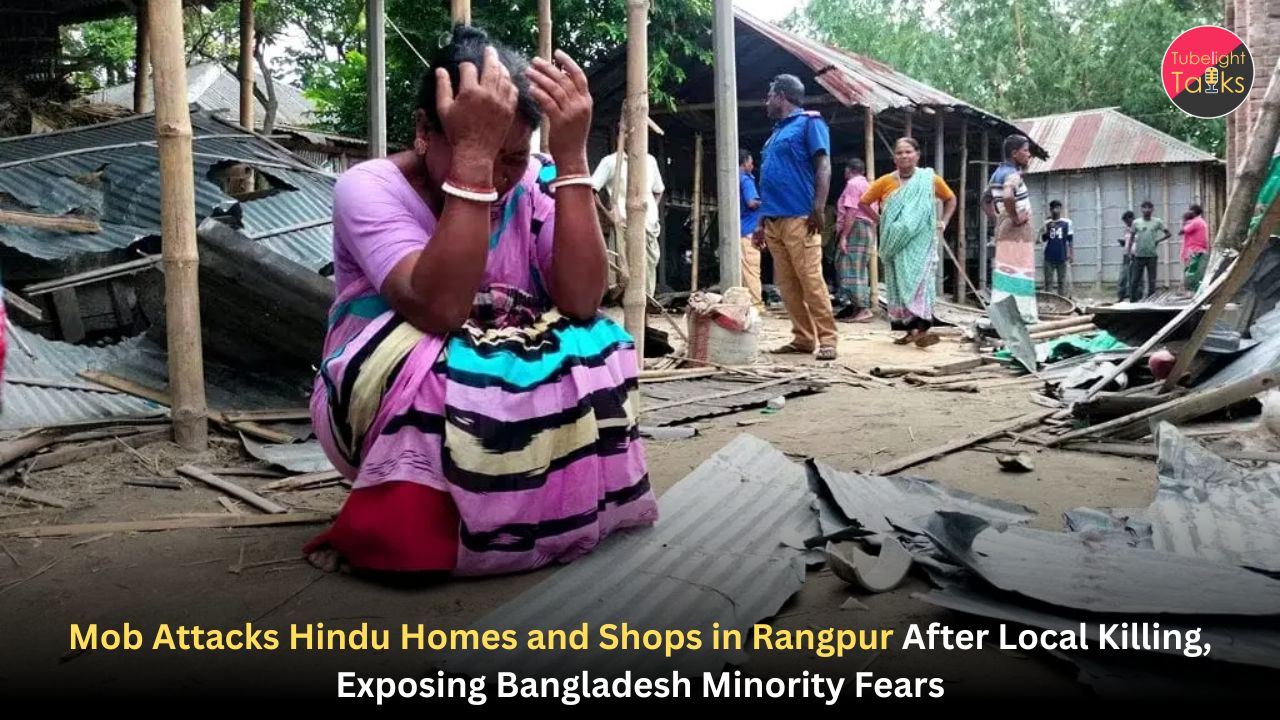
Reports from Bangladesh say Hindu households and businesses in Rangpur were attacked by an angry mob after the killing of a local Muslim youth. Multiple reports state that the violence took place even though the deceased youth’s family reportedly said the Hindu community had nothing to do with the murder. That detail is devastating, because it suggests the attacks were not driven by verified accountability but by collective targeting and communal vulnerability.
Current reports indicate the violence occurred in the Daspara market area of Rangpur, where a sizable Hindu community lives. Prothom Alo was cited as saying more than a hundred Hindus live in the area, and reporters found the alleged murder suspect’s house vacant as he went into hiding. That again underscores the core injustice: a whole community appeared to be made vulnerable for a killing allegedly linked to an individual dispute.
Why This Incident Matters Far Beyond One Locality
Communal mob attacks are never purely local. Even when they happen within a narrow geographic area, they send a wider national signal to minorities: your safety may be conditional, your innocence may not protect you, and the crowd may arrive before the law does. That is why such attacks create damage beyond broken homes or shops. They also damage trust in equal citizenship.
The Rangpur incident fits a pattern that rights observers have repeatedly warned about in Bangladesh: religious minorities, especially Hindus, remain vulnerable during moments of rumor, political transition, or communal anger. Amnesty’s most recent country reporting noted that religious minorities in Bangladesh continued to face violence. Even when the state is not the direct attacker, the persistence of such episodes raises difficult questions about deterrence, policing, and social protection.
The Most Disturbing Detail: Innocence Did Not Matter
Perhaps the most disturbing part of the available reporting is that the victim’s family itself reportedly said they had no issue with the Hindu community and believed others were responsible. Yet the mob attacks still occurred. That means the violence cannot be explained as spontaneous grief seeking justice. It points instead to a communal trigger structure in which vulnerable minorities become convenient targets regardless of evidence.
This is exactly why minority protection is one of the hardest tests for any democracy or state. A majority community rarely needs active reassurance that innocence will be individually judged. Minorities often do. The law matters most when rumor is faster than evidence and fear is more contagious than fact. In Rangpur, the available reporting suggests the law arrived too late to prevent harm.
Why Language Like “Mob Attack” Should Not Blur Responsibility
There is always a danger that the phrase “mob violence” turns human choices into weather. A mob is not a natural disaster. It is a group of individuals who decide, together, to target the weak. The language of communal rage can sometimes obscure agency, as though destruction simply happened by itself. It did not. People attacked homes and businesses belonging to a minority group after a killing that had not been tied to that group.
That means responsibility must be understood at several levels: those who attacked, those who incited, those who failed to prevent, and those who may later try to minimize the incident as emotional overflow rather than rights violation. Societies do not become safer by calling persecution spontaneous. They become safer by naming it clearly and punishing it credibly.
A Minority Lives Not Only with Violence, but with Anticipation of Violence
One of the least understood dimensions of communal targeting is the anticipatory trauma it creates. A family whose shop is attacked loses property. A community that watches the attack loses something harder to count: the assumption that normal life is normal. Once that assumption breaks, every festival, local quarrel, rumor, or political change becomes charged with anxiety.
For minorities in South Asia, that psychological cost is familiar. It is why even smaller incidents resonate widely. They are not read one by one. They are read cumulatively. Rangpur is therefore not just a local incident. It is part of a larger question: can minorities in Bangladesh rely on the state to secure them not after violence, but before it?
What Authorities Must Now Be Judged On
In incidents like this, the public should watch four things: arrest of attackers, protection of affected families, compensation and restoration, and official language. Each matters. Arrests test seriousness. Protection tests urgency. Compensation tests responsibility. Language tests honesty. If authorities treat the violence merely as a disturbance rather than a communal targeting event, then the administrative response will likely be weaker than the moral reality.
At the same time, police statements cited in reports suggest that investigators were tracking the real killers and had identified some vandals. That is important, but it is only the beginning. Minority confidence is not restored by words alone. It is restored when the state visibly establishes that targeting innocents carries consequences.
Why This Is a Human Rights Story, Not Just a Crime Story
A murder investigation and a communal attack are not the same kind of event. The first is a criminal case involving responsibility for one killing. The second is a human-rights issue involving the safety of a protected minority group. When a community is attacked for something it did not do, the event crosses from crime into discriminatory collective punishment.
That distinction matters because policy responses differ. A murder is solved by investigation and prosecution. A minority-rights crisis requires those things plus public reassurance, preventive deployment, political condemnation, and social accountability. Without that wider response, communities remain legally acknowledged but existentially exposed.
Humanity Must Come Before Identity
Sant Rampal Ji Maharaj’s teachings strongly reject social divisions that turn human beings against one another and emphasize that mankind is one. His official writings and teachings repeatedly stress that truth, compassion, and righteous conduct are superior to identity-based hatred. In that light, communal attacks are not only unlawful. They are a profound fall from human duty.
The Rangpur violence reminds us how quickly societies betray their own humanity when religion becomes a trigger for blame rather than a guide to conscience. Protection of the innocent is not a minority demand. It is a civilizational minimum. Any society that fails there weakens itself, not only its victims.
Call to Action
Calm matters, but justice matters more. Minority safety improves only when attackers are identified, prosecuted, and politically disowned.
FAQs: Mob Attacks Hindu Homes and Shops in Rangpur After Local Killing, Exposing Bangladesh Minority Fears
1. What happened in Rangpur?
Reports say a mob attacked Hindu households and businesses after the death of a local Muslim youth.
2. Were Hindus accused by the victim’s family?
No. Reporting says the deceased youth’s family reportedly stated that the Hindu community had nothing to do with his murder.
3. Why is this being seen as a minority-rights issue?
Because innocent members of a religious minority were reportedly targeted collectively after an unrelated killing.
4. Is there a wider context of concern?
Yes. Amnesty has noted that religious minorities in Bangladesh continue to face violence.
5. What should authorities do now?
Investigate the original murder, arrest those who attacked minority homes and shops, and ensure visible protection and restoration for affected families.
Related Stories






Discussion (0)