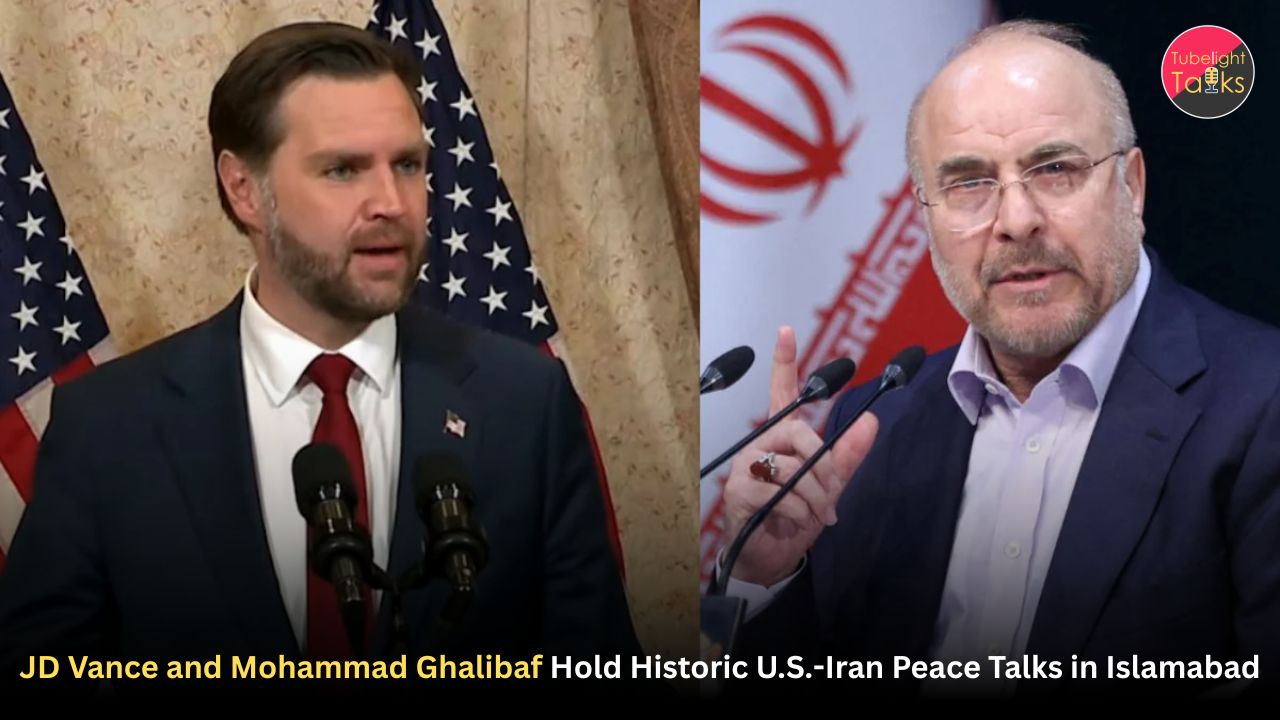
Historic Diplomacy in Islamabad: JD Vance and Mohammad Ghalibaf Lead Rare U.S.-Iran Talks
The rare face-to-face meeting between U.S. Vice President JD Vance and Iranian Parliament Speaker Mohammad Bagher Ghalibaf in Islamabad has emerged as one of the most consequential diplomatic developments of April 2026.
According to current reporting, the talks are aimed at shoring up a fragile ceasefire after weeks of war, restoring some stability to the Strait of Hormuz, and preventing the conflict from expanding further across the region. Pakistan’s role as host and intermediary has also drawn global attention, especially because these are being described as the highest-level direct U.S.-Iran contacts in decades.
Why the Islamabad Meeting Matters
The importance of the Islamabad talks lies in both symbolism and timing. Symbolically, U.S.-Iran direct engagement at this level is extremely rare. Practically, the region remains volatile, global markets are still reacting to disrupted shipping, and several fronts linked to the wider crisis remain unresolved. Reporting from AP indicates the agenda goes beyond merely keeping guns silent.
It includes questions tied to Iran’s nuclear and ballistic missile programs, maritime security in and around the Strait of Hormuz, and Tehran’s ties with regional armed groups such as Hezbollah. That means the meeting is not a ceremonial handshake. It is a test of whether adversaries can turn a battlefield pause into a structured process.
A Fragile Ceasefire, Not a Final Settlement
It is important to frame the situation carefully. The strongest sources do not say that a permanent peace has already been achieved. They describe an ongoing negotiating effort under the shadow of a fragile ceasefire. AP reported that key disagreements remain, especially over whether Israeli strikes on Hezbollah in Lebanon fall under the truce framework. Iran appears to want broader guarantees and relief, while the U.S. position remains more guarded.
That distinction matters because many ceasefires fail when the parties have different interpretations of what is covered, what counts as a violation, and what must happen before sanctions, access, or military de-escalation can move forward.
Also Read: Orthodox Easter Ceasefire Begins in Russia-Ukraine War, but the Truce Remains Fragile
Pakistan’s Diplomatic Moment
Pakistan’s role has become central to the optics and logistics of this meeting. Reports indicate that the city was placed under extraordinary security, with the capital effectively locked down around the venue. The talks were hosted amid heavy security at the Islamabad Serena Hotel, and Pakistani leaders have been publicly projecting the event as proof that the country can act as a serious diplomatic bridge in a crisis-ridden neighborhood.
For Islamabad, this is more than hosting a meeting. It is an attempt to reposition itself as a credible mediator in a volatile strategic environment.
The Stakes for Energy and Shipping
These talks are also being watched because of what they could mean for sea routes and energy markets. The Strait of Hormuz remains one of the world’s most important chokepoints for oil and gas. Even a temporary disruption there sends shockwaves through freight rates, insurance costs, and crude benchmarks.
AP’s reporting connects the current negotiations directly to maritime tensions and regional instability, while other current coverage shows traffic through the strait only gradually resuming. In that sense, the Islamabad meeting is about more than diplomacy between two rivals. It is about whether the wider world can avoid another wave of supply-chain panic.
What Each Side Appears to Want
The broad contours of both delegations’ goals are becoming clearer. Iran is reported to be seeking security guarantees, relief linked to frozen assets or economic pressure, and a wider interpretation of ceasefire obligations that includes the Lebanese front. The U.S., by contrast, appears focused on ensuring free maritime passage, containing escalation, and tying any longer-term deal to security issues that go well beyond the immediate truce.
This mismatch is not unusual in war-ending negotiations. One side looks for immediate political and economic gains; the other pushes for structural restrictions and future compliance. Durable ceasefires happen only when those two layers are somehow bridged.
Public Pressure Outside the Negotiating Room
Another complication is public mood. AP reported protests in both Tel Aviv and Beirut, showing that street-level opinion remains deeply charged. Even when negotiators want room to compromise, domestic politics can narrow their options. Leaders on all sides must calculate how concessions will be read at home. This is why talks can appear constructive in private while public rhetoric remains harsh. The negotiating room is only one arena; television screens, social media, and public rallies form the other battlefield.
What Success Would Actually Look Like
Success from these talks would not necessarily mean a grand peace accord this week. More realistically, it would mean a clearer ceasefire mechanism, a shared understanding of violations, continued communication channels, and measurable progress on maritime security.
If the talks produce those building blocks, they could lower the chance of immediate collapse and open the door to broader negotiations. If they fail, the region may slide back into retaliatory cycles, with energy flows and civilian life again paying the price. That is why even incremental progress in Islamabad matters.
When Restraint Becomes the Real Victory
At moments like this, the deepest lesson is that force can stop an enemy for a while, but it cannot build trust or lasting peace by itself. Sant Rampal Ji Maharaj’s teachings emphasize that anger, domination, and revenge push humanity toward suffering, while true wisdom, restraint, and righteous conduct open the path toward peace and balance.
His official teachings repeatedly stress right karmas and true worship as the basis of a stable life and society. In the context of international conflict, that message feels especially relevant: durable peace begins when power is guided by conscience rather than ego.
Call to Action
Peace talks are always surrounded by rumor, propaganda, and selective leaks. Readers should follow verified reporting, official updates, and carefully sourced analysis rather than social-media noise. In moments of war and peace, accuracy is not optional; it is a public responsibility.
FAQs: JD Vance and Mohammad Ghalibaf Hold Historic U.S.-Iran Peace Talks in Islamabad
1. Are the U.S. and Iran officially at peace now?
No. Current reporting describes the Islamabad engagement as talks aimed at strengthening a fragile ceasefire, not as a completed permanent peace agreement.
2. Who is leading the talks?
The U.S. delegation is being led by Vice President JD Vance, while Iran’s side is led by Parliament Speaker Mohammad Bagher Ghalibaf, with other senior officials also involved.
3. Why is Islamabad hosting the meeting?
Pakistan is acting as mediator and host, positioning itself as a diplomatic intermediary amid a highly sensitive regional crisis.
4. Why is the Strait of Hormuz part of the conversation?
Because it is a critical global energy route, and conflict around it affects oil, gas, shipping insurance, and international trade.
5. What is the biggest obstacle to a durable ceasefire?
The biggest challenge is that both sides appear to have different expectations about the scope of the truce, regional security, and what concessions must come first.
Related Stories





Discussion (0)