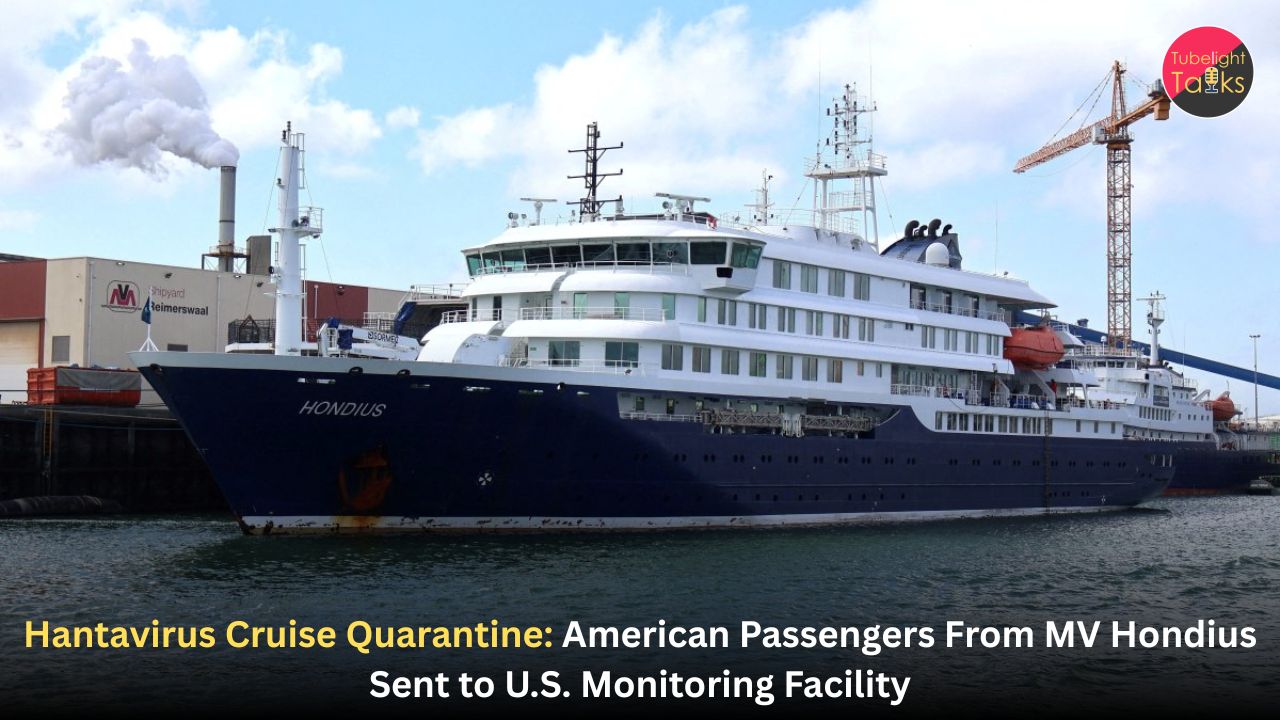
Hantavirus Cruise Quarantine: American Passengers From MV Hondius Face U.S. Monitoring as Argentina Searches for Outbreak Origin
Hantavirus Cruise Quarantine: The deadly MV Hondius cruise outbreak has entered a new phase as American passengers from the so-called “hantavirus cruise ship” are being repatriated to the United States under medical supervision and sent for quarantine, monitoring and evaluation. U.S. health officials are arranging the return of 17 American passengers from the Dutch expedition vessel, which has been linked to an outbreak of the Andes strain of hantavirus.
The ship is expected to reach the Canary Islands before the Americans are flown by government medical transport to Offutt Air Force Base in Nebraska and then moved to the National Quarantine Center at the University of Nebraska. At the same time, Argentina is racing to determine where the outbreak began, as the ship departed from Ushuaia on April 1.
MV Hondius Hantavirus Crisis: What Is Happening Now?
American Passengers to Be Quarantined in the U.S.
The U.S. Centers for Disease Control and Prevention has announced plans to repatriate 17 American passengers from the MV Hondius after the ship arrives in the Canary Islands. The passengers are expected to travel via a U.S. government medical flight to Offutt Air Force Base in Omaha, Nebraska. From there, they will be transported to the National Quarantine Center at the University of Nebraska for monitoring and evaluation.
This step does not mean all American passengers are sick. It means health officials are taking a precautionary approach because the outbreak involves the Andes strain of hantavirus, a rare but serious virus that can cause severe respiratory illness. Quarantine allows doctors and epidemiologists to observe exposed passengers, test if symptoms develop and reduce any potential risk to families and local communities.
The CDC has also sent a team of epidemiologists and medical staff to the Canary Islands to assess exposure risk before repatriation. Another team is being sent to Offutt Air Force Base to assist with health assessments once the passengers arrive in the United States.
Also Read: Hantavirus Cruise Crisis: MV Hondius Passengers Traced Worldwide After Deadly Andes Strain Outbreak
Global Contact Tracing Expands
The MV Hondius outbreak is no longer only a shipboard medical emergency. It has become a multi-country contact-tracing operation. Passengers disembarked at different points before the outbreak was fully confirmed, and some continued onward by air. Singapore, for example, tested two residents who had been on the ship and on the same flight from Saint Helena to Johannesburg as a confirmed case who later died in South Africa. Those two Singaporean residents tested negative but remain under quarantine and monitoring.
The wider public risk remains low, but authorities are being cautious because the Andes strain is unusual among hantaviruses. Most hantaviruses spread mainly through rodent exposure, but Andes virus has been associated with rare human-to-human transmission in close-contact settings.
Three Deaths and Multiple Linked Cases
Deadly Cluster Raises Alarm
The outbreak linked to MV Hondius has caused three deaths. Reuters reported that the ship has been associated with three deaths and eight suspected or confirmed infections. The deceased include a Dutch couple and a German national. Several other passengers or crew members have been evacuated, tested or placed under medical monitoring.
These deaths have made the incident deeply concerning because hantavirus pulmonary syndrome can progress quickly. Early symptoms may appear similar to flu, travel fatigue or stomach illness, but severe cases can lead to respiratory distress and intensive-care treatment.
Andes Virus Confirmed
The strain involved is Andes hantavirus, a South American strain that can cause severe lung disease. The Guardian reported that passengers on the MV Hondius tested positive for Andes virus and that Argentina’s health ministry has noted its high severity in recent cases.
Health officials are therefore not treating this as a routine cruise illness. Norovirus outbreaks, influenza and respiratory infections are more commonly associated with cruise ships. Hantavirus is different because it is usually linked to rodents or contaminated environments. This makes the origin investigation especially important.
Argentina Searches for the Origin
Ushuaia Under Scrutiny
The MV Hondius departed from Ushuaia, Argentina, on April 1. Because of that, Argentine authorities are investigating whether exposure may have occurred before the ship left port or during travel in Patagonia. One hypothesis under review is whether the first infected passengers may have been exposed during outdoor activity, possibly birdwatching, in areas where infected rodents may have been present.
However, local officials in Tierra del Fuego have strongly pushed back against claims that the outbreak began in Ushuaia. They argue that the Dutch couple who later died had travelled for months through Argentina, Chile and Uruguay before reaching Ushuaia and spent only a short time in the region before boarding the ship. They also noted that Tierra del Fuego has not previously recorded a case of the Andes hantavirus variant.
This disagreement shows the sensitivity of the investigation. Ushuaia is a major hub for Antarctic cruises, and any suggestion that the outbreak originated there could damage tourism. But health investigations must follow evidence, not economic pressure or political fear.
Rodent Testing and Route Reconstruction
Argentina’s national health authorities are examining the travel history of the suspected early cases. Investigators may need to trap and test rodents along routes visited by passengers, examine outdoor exposure points, review accommodation history, reconstruct shore activities and compare genetic sequencing from viral samples.
Argentina has also been helping international partners detect the virus. The Guardian reported that Argentina was sending genetic material and testing equipment to several countries to support detection efforts.
The key question is whether the outbreak began from rodent exposure before boarding, from a location visited during the cruise, or from limited close-contact transmission after an initial infection.
Why Andes Hantavirus Is Different
Most Hantaviruses Are Rodent-Borne
Hantavirus infection usually occurs when people inhale particles from infected rodent urine, droppings or saliva. Exposure can happen when contaminated dust is disturbed in cabins, sheds, campsites, fields, storage spaces or wilderness areas.
In most hantavirus strains, person-to-person spread is not a major concern. That is why hantavirus outbreaks are usually linked to environmental exposure rather than community transmission.
Andes Strain Can Spread Through Close Contact
The Andes strain is the exception that makes this outbreak more complex. Rare human-to-human transmission has been documented, especially among close contacts, caregivers, household members or people sharing prolonged exposure. This does not mean the virus spreads easily like common respiratory infections, but it does justify quarantine and monitoring of exposed passengers.
Cruise ships create close-contact environments. Passengers may share cabins, dining spaces, corridors, medical areas and group activities. If one infected person develops symptoms onboard, tracing close contacts becomes essential.
Why Cruise Ships Are Difficult During Outbreaks
Confined Spaces and Limited Medical Capacity
Cruise ships are challenging during outbreaks because people live close together for long periods. Expedition ships add another layer of difficulty because they often travel to remote locations, far from advanced hospitals. The MV Hondius itinerary involved Antarctica and isolated South Atlantic islands, making evacuation and testing more complicated.
If a passenger becomes severely ill at sea, the ship’s medical team can provide first response, but severe hantavirus cases may require intensive care, oxygen support or advanced hospital treatment.
International Passenger Mix
The MV Hondius had passengers and crew from multiple countries. When an outbreak is identified, responsibility becomes shared between the ship operator, flag state, port states, national health authorities, WHO-linked systems and passengers’ home countries.
This is why Americans are being repatriated to Nebraska, Singaporeans are being monitored under quarantine, and Argentina is investigating origins. A single shipboard outbreak can quickly become a global coordination exercise.
Also Read: Hantavirus Outbreak on Cruise Ship: 3 Dead, WHO Probes Cases Near Cape Verde
Public Risk: Low but Closely Monitored
No Need for Panic
Health agencies have repeatedly indicated that the risk to the general public is low. The main concern is for people who were onboard the MV Hondius, shared close contact with infected persons, travelled on specific flights with confirmed cases or had direct exposure to suspected infection routes.
The public should not assume that casual contact with travellers creates high risk. Hantavirus is not typically spread through ordinary public interaction. The focus is targeted monitoring, not mass panic.
Symptoms Should Not Be Ignored
Exposed individuals should watch for fever, muscle aches, fatigue, headache, nausea, abdominal symptoms, cough or breathing difficulty. Anyone who travelled on the vessel or had close contact with a confirmed case should follow health authority instructions and seek medical care if symptoms develop.
Lessons From the MV Hondius Outbreak
Stronger Expedition Cruise Preparedness
The crisis shows that expedition cruise operators need strong infectious disease protocols. These should include pre-travel health screening, clear illness reporting, onboard isolation capability, coordination with public health agencies, medical evacuation plans and environmental exposure guidance.
Biosecurity Beyond Antarctica
Much attention is often placed on protecting Antarctica from visitors, but this outbreak shows the reverse risk too: travellers may pick up infections before or during remote expeditions and then carry them across countries.
Transparent Communication Matters
Passengers, families and the public need clear information. Confusion creates fear, while silence fuels rumours. Authorities must explain what is known, what remains under investigation and what steps people should take.
Disease, Fear and the Need for Compassion
The MV Hondius crisis reminds humanity that disease can expose both physical vulnerability and social responsibility. Patients, passengers, crew, families and health workers need compassion, truth and patience rather than stigma or blame. The teachings of Sant Rampal Ji Maharaj and Sat Gyaan emphasize truth, humility, compassion, righteous conduct and true worship according to holy scriptures.
Sant Rampal Ji Maharaj’s teachings guide people away from intoxication, corruption, dishonesty, violence, greed and careless behaviour. In the context of this outbreak, the message is deeply relevant. Fear should not make society cruel. Sat Gyaan teaches that human life is precious and temporary, and that true security comes through moral discipline, service and devotion to the Supreme God.
FAQs on Hantavirus Cruise Quarantine
1. What is happening to American passengers from MV Hondius?
Seventeen American passengers are being repatriated to the United States under medical supervision and sent to the National Quarantine Center at the University of Nebraska for monitoring and evaluation.
2. Why are they being quarantined?
They are being quarantined as a precaution because the ship is linked to an outbreak of Andes hantavirus, a serious strain that can rarely spread between people in close-contact settings.
3. How many people have died in the outbreak?
Three deaths have been linked to the MV Hondius outbreak, with several confirmed or suspected infections reported.
4. Where did the cruise begin?
The MV Hondius departed from Ushuaia, Argentina, on April 1.
5. Is Argentina confirmed as the source of the outbreak?
No. Argentina is investigating possible origins, but local officials in Tierra del Fuego dispute claims that the outbreak began in Ushuaia.
6. Is the general public at high risk?
No. Health authorities consider the wider public risk low, but exposed passengers and close contacts are being monitored carefully.
Related Stories








Discussion (0)